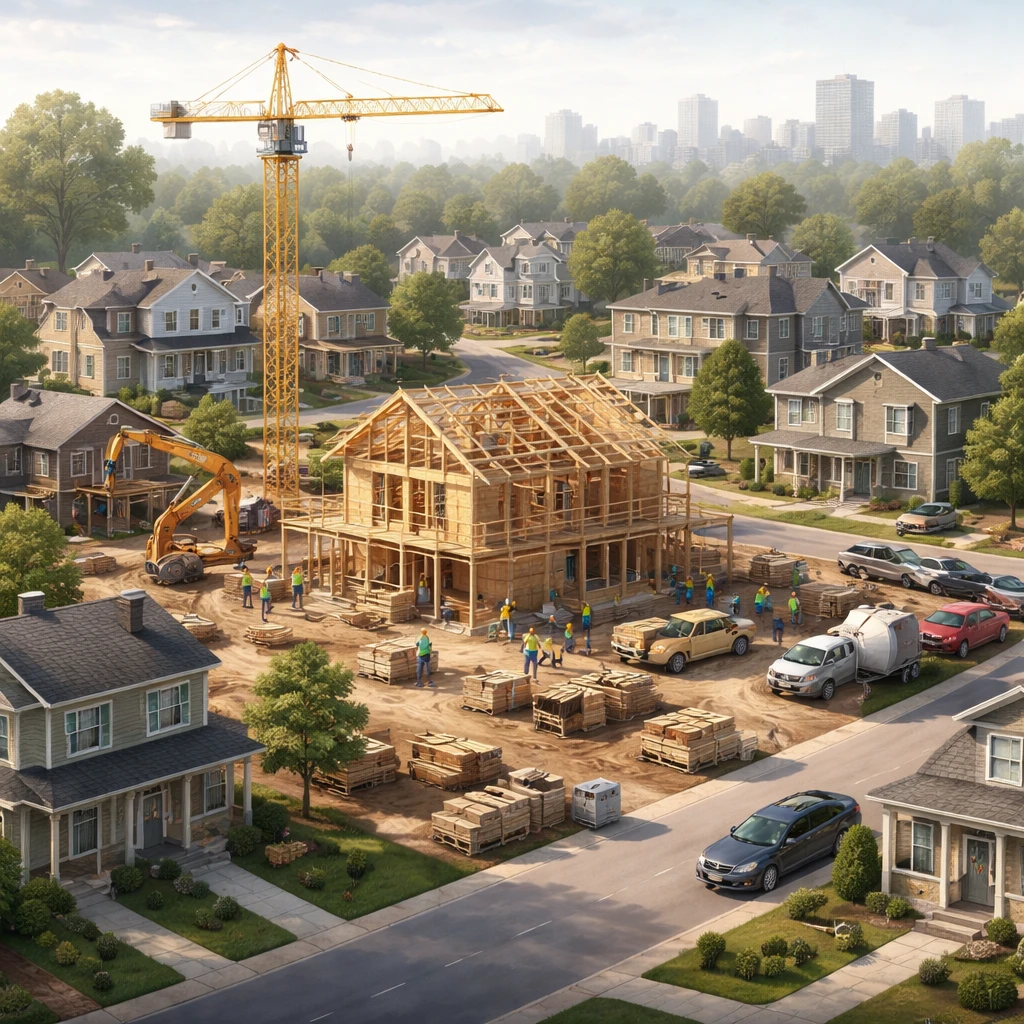

Housing affordability remains a significant challenge for numerous U.S. households, prompted by soaring home prices and sustained high mortgage interest rates. Despite President Donald Trump's declarations to confront this crisis, concrete federal directives have yet to materialize from the executive branch. Meanwhile, a bipartisan coalition of senators and representatives has introduced legislative packages designed to combat escalating housing costs by addressing zoning restrictions and reducing federal barriers impeding construction.
These congressional efforts aim to directly tackle the persistent shortage of affordable housing units that have contributed to market stress. The House of Representatives is slated to conduct a floor vote on its bill this week, representing a critical juncture in the legislative process. Public concern over housing affordability is evidenced by a New York Times/Siena University poll indicating that more than 50% of registered voters consider housing costs to have become prohibitively expensive.
The Basis of the Housing Shortage
Since the financial downturn of 2008, construction of new homes has not kept pace with demand, resulting in a deficit widely acknowledged by market analysts and policymakers. According to an October estimate from Goldman Sachs, an estimated three to four million additional housing units are requisite to bridge the current supply gap. The congressional package seeks to reverse this trend through targeted reforms.
The Senate introduced the ROAD to Housing Act, spearheaded by Senators Tim Scott (R-South Carolina) and Elizabeth Warren (D-Massachusetts). Initially incorporated into a broader legislative measure late last year, it was subsequently excluded from the final House-negotiated bill. The Senate plans to revisit the ROAD to Housing Act as a standalone proposal in upcoming weeks.
In parallel, the House of Representatives’ version, labeled the Housing for the 21st Century Act and introduced by Rep. French Hill (R-Arkansas), contains a more focused scope with 25 provisions compared to the Senate's broader 40-point agenda. The executive branch's current position regarding formal endorsement or veto remains unspecified, although prior signals expressed some support toward the Senate’s legislative approach.
Provisions Targeting Zoning and Permitting Reform
Experts attribute much of the restrictions on new homebuilding to stringent local zoning and land use regulations, which are governed by various municipal and county governments rather than the federal government directly. Despite the decentralized nature of land-use policies, loosening zoning regulations could significantly augment housing availability. Goldman Sachs projects this could add an estimated 2.5 million additional units nationally within the next decade.
Accordingly, both bills incentivize state and local governments to adopt more housing-friendly land-use policies. They seek to empower these local entities with enhanced tools, guidance, and flexibility to facilitate increased construction.
Specifically, the Senate’s bill proposes linking community development grants from the Department of Housing and Urban Development to demonstrable housing production outcomes. Localities demonstrating acceleration in homebuilding may receive bonus funding, while those lagging could face reductions. Conversely, the House bill requires grantees to disclose local policies that potentially restrict housing supply, including zoning laws, increasing transparency.
Both legislative packages allocate funds to assist local governments in creating pattern books, which are pre-approved housing designs intended to expedite the construction permit process and standardize approvals.
Encouraging Manufactured Housing Expansion
Another element within the bills aims to bolster the production and deployment of manufactured homes. Traditionally constructed in factories then transported to sites, these homes offer a quicker, more economical alternative to conventional building techniques.
Federal regulations since 1974 mandate that manufactured homes be mounted on a permanent wheeled chassis to enable transport. However, the wheeled base introduces additional costs and zoning constraints, as many localities restrict these structures to mobile home parks.
Removing the wheeled base requirement could decrease unit costs by $5,000 to $10,000 per home, per data from the Bipartisan Policy Center, and increase site options, potentially alleviating supply pressure.
Addressing the Aging Housing Stock
Due to a significant slowdown in new construction over the last two decades, the average age of U.S. housing has increased substantially. Census data reveals the median age of homes now stands at 40 years, with nearly half predating 1980, marking substantial aging since 2005's median of 31 years. Many of these older homes suffer from disrepair, as identified in a 2023 Harvard Joint Center for Housing Studies report.
The bills feature measures to facilitate financing for homeowners and landlords to undertake repairs and modifications, thereby extending the usable life and quality of existing housing inventory.
Additionally, the legislation would streamline efforts to convert underused office buildings and other vacant structures into residential units, a strategy growing in popularity following the rise in remote work during the pandemic.
The Administration's Approach
President Trump has intensified attention to the housing affordability challenge via a series of recent proposals. Last month, he enacted an executive order barring large institutional investors from acquiring single-family homes, a move intended to reduce competition but one which analysts say likely will have limited impact on expanding supply.
Furthermore, the administration outlined plans for Fannie Mae and Freddie Mac to purchase $200 billion in mortgage bonds to reduce mortgage rates. Proposals have also emerged advocating adjustments to 401(k) regulations, allowing penalty-free withdrawals for down payments.
Redfin chief economist Daryl Fairweather characterized these demand-side initiatives as likely to raise homebuyer interest but insufficient to resolve the fundamental shortage of affordable homes, potentially fueling higher prices where supply remains restricted.
President Trump has expressed reservations about significantly expanding housing supply to protect existing homeowners' equity, emphasizing the importance of maintaining high home values.
Andy Winkler, managing director at the Bipartisan Policy Center, noted that in many markets, augmenting supply may not cause home prices to decline sharply but could moderate the pace of price increases, balancing affordability and investment security.