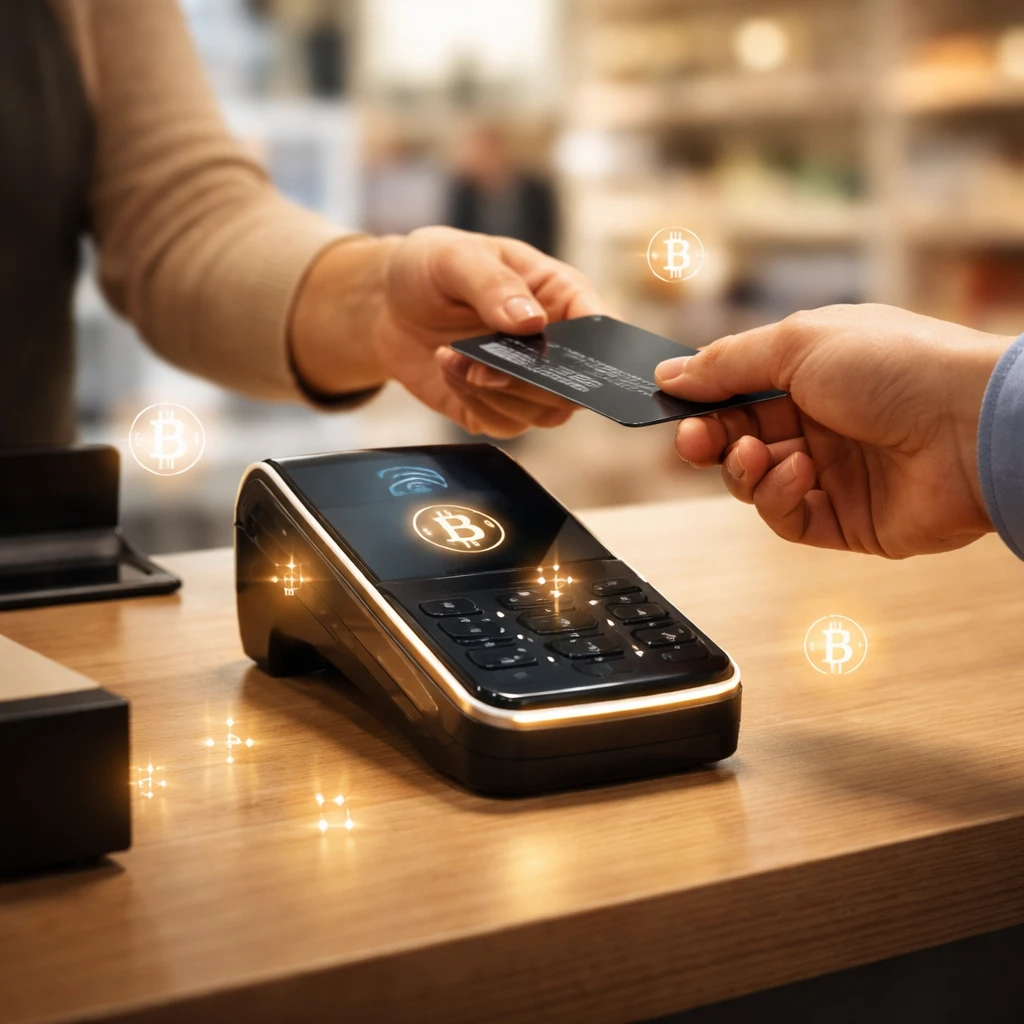

Block Advances Bitcoin Integration, Highlighting Cryptocurrency's Emerging Role in Retail Payments
February 3, 2026
Finance

Block Advances Bitcoin Integration, Highlighting Cryptocurrency's Emerging Role in Retail Payments

Square's new Bitcoin payment capabilities may signal broader adoption potential within the fintech sector

Summary

Block, led by Jack Dorsey, is pioneering Bitcoin payment solutions within its Square seller segment, allowing U.S.-based merchants to accept transactions and convert card sales into Bitcoin seamlessly. This development may indicate growing practical use cases for Bitcoin as a medium of exchange, extending beyond its traditional role as a speculative asset.

Key Points

Block's Square segment has launched Bitcoin payments and conversion features, enabling U.S. merchants to accept and convert card sales into Bitcoin.
The Bitcoin functionality is available to millions of U.S.-based merchants, excluding those in New York, with verification required.
Other fintech companies like SoFi Technologies are innovating with Bitcoin, exemplified by partnerships to use the Lightning network for efficient cross-border payments.

Over the past ten years, the payments landscape has seen significant transformation, with companies like Block standing at the forefront of this evolution. The fintech firm, under the leadership of Jack Dorsey, has become an influential player, particularly among consumers and small business owners, driving substantial growth throughout its operations.

Recently, Block introduced a substantial feature through its Square division—its service segment dedicated to facilitating transactions for merchants. Square launched a Bitcoin payments option, enabling many small businesses within the United States to accept Bitcoin as a method of payment. Additionally, it rolled out Bitcoin conversion capabilities, allowing merchants to automatically convert portions of their daily card transactions into Bitcoin. This capability effectively reduces barriers for merchant adoption of cryptocurrency payments.

It is important to note that these Bitcoin payment features are currently restricted to merchants operating in the United States, with the explicit exclusion of New York-based businesses. Eligible merchants must also undergo verification processes to access the service. Despite these limitations, this is a meaningful step toward integrating Bitcoin into everyday commercial transactions.

By the end of 2023, Square had accumulated a user base exceeding 4 million merchants, the majority of whom are based in the United States. Given this scale, the Bitcoin payment functionality represents a potentially large market segment of millions of merchants domestically eligible to utilize these services.

Other fintech entities are also expanding their involvement with Bitcoin technology. SoFi Technologies, a digital banking platform serving approximately 13.7 million customers, is partnering with start-up Lightspark to leverage the Lightning network. The partnership aims to enable rapid and cost-efficient cross-border Bitcoin payments, illustrating continued industry commitment to advancing Bitcoin's practical applications.

Bitcoin’s price growth underscores its prominence in the financial ecosystem. Over the last decade, the cryptocurrency appreciated more than 22,000 percent. While Bitcoin primarily remains an asset for financial speculation with some critics questioning its intrinsic value, its huge increase in value is undeniable.

The recent Square introduction marks a significant move towards Bitcoin achieving wider acceptance as a medium of exchange, beyond its speculative origins. Future commentary from Block's management regarding the adoption rates of this payment functionality will be valuable for assessing the trajectory of cryptocurrency use in retail.

Should Square’s integration see strong uptake, it could signal other financial service providers to consider similar offerings, potentially resulting in increased market demand for Bitcoin. Such development might support sustained or increased valuation for the cryptocurrency over time.

Risks
  • Bitcoin payment features are currently limited geographically, excluding New York and requiring merchant verification, which may constrain adoption.
  • Bitcoin’s status as primarily a speculative asset with critics disputing its intrinsic value introduces uncertainties around its long-term use as a currency.
  • The ultimate adoption and commercial success of Bitcoin payments depend on merchant uptake and broader acceptance within the financial services sector, which remains to be seen.
Disclosure
This article presents an objective analysis of Block's Bitcoin payment initiative and does not constitute investment advice or endorsement of the company's stock or cryptocurrency.
Search Articles
Category
Finance

Financial News

Ticker Sentiment
SQ - positive
Related Articles
Cryptocurrency Market Holds Steady Amid Anticipation of US-Iran Developments

The cryptocurrency market demonstrates a cautious stance as Bitcoin approaches the $69,000 mark. Oth...

XRP's Market Prospects in 2026: Assessing the Path Toward $1

The cryptocurrency sector is experiencing significant downturns at the beginning of 2026, with XRP, ...

SoFi Shares Slip Slightly Despite Strong Q4 Earnings and Bullish Outlook

SoFi Technologies Inc’s stock saw a minor decline Tuesday afternoon following a period of heighten...

Fiserv Posts Strong Q4 2025 Earnings, Stock Climbs Amid Investor Optimism

Fiserv reported fourth quarter 2025 results that exceeded analyst expectations, with revenue of $5.3...

Shopify’s Stock Gains Momentum Ahead of Q4 2025 Earnings Release

Shopify Inc. shares surged on Tuesday in anticipation of the company’s fourth-quarter and full-yea...

SAP Collaborates with Cohere to Deliver Global Sovereign AI Solutions Starting in Canada

SAP SE is enhancing its collaboration with Cohere to deploy sovereign AI solutions worldwide, initia...