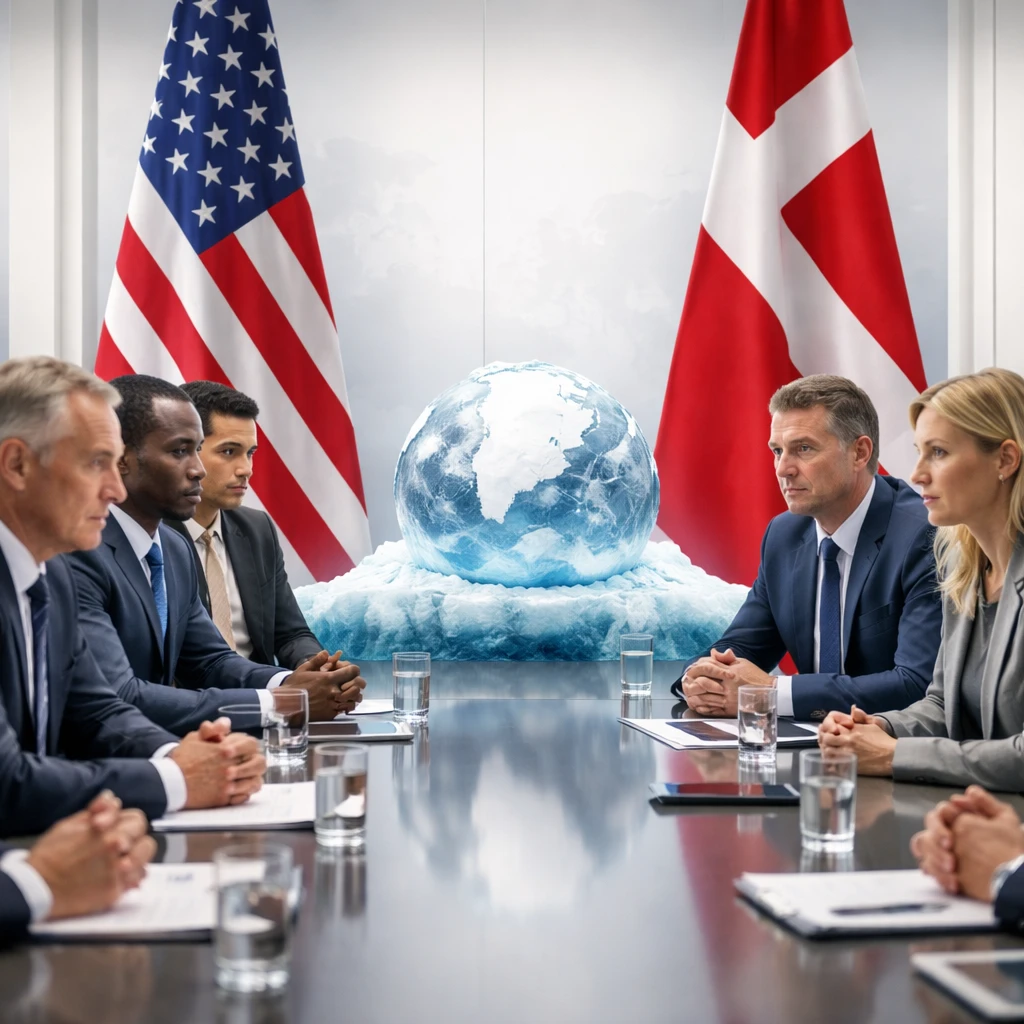

In recent developments causing unease within the global business community, President Donald Trump has announced intentions to implement new tariffs concerning Greenland, prompting heightened apprehension among CEOs in both the United States and Europe.
This emerging geopolitical dispute centers on Greenland, a territory under Danish sovereignty, which has become the focal point of President Trump's administration's trade policy considerations. The proposition to levy tariffs has introduced a level of unpredictability that industry leaders warn could disrupt established commercial relationships and investment decisions.
Business executives express concern that such tariffs may not only affect direct trade involving Greenland or Danish interests but could ripple across a broader spectrum of transatlantic economic activities. The uncertainty generated by these policy moves complicates financial forecasting and strategic planning within companies engaged in markets connected to the Atlantic corridor.
Richard Quest, reporting for prominent financial news outlets, highlights that the turmoil incited by these tariff threats is negatively impacting the corporate climate by introducing risks that are difficult to quantify or manage.
From an operational perspective, CEOs anticipate that tariff impositions might increase costs, affect supply chain continuity, and challenge prior assumptions embedded in trade agreements. This environment of unpredictability deters investment and may slow commerce between the United States and its European allies, including Denmark.
Moreover, the political dimensions of the situation elevate concerns beyond standard trade disagreements. Actions perceived as aggressive or unilateral by one party, such as the proposed tariffs associated with Greenland, carry the potential for retaliatory measures and strained diplomatic relations, which in turn could have broader economic repercussions.
Industry leaders are urging for clarity and dialogue to mitigate the damage looming over international business and to restore confidence in the stability of trade frameworks that have, until now, functioned as reliable foundations for cross-border commerce.
Given the current state of flux, CEOs stress the importance of closely monitoring developments and preparing strategic responses to the implications of tariffs and associated geopolitical tensions. They underscore that ensuring resilience amid such challenges is critical for sustaining global business operations.
In summary, the threat of new tariffs over Greenland introduced by the Trump administration has unsettled major business figures, introducing harmful uncertainty into the economic exchange between the United States and European allies, particularly Denmark. This disruption has the potential to alter trade dynamics and exert pressure on corporate performance amid a backdrop of heightened political sensitivities.