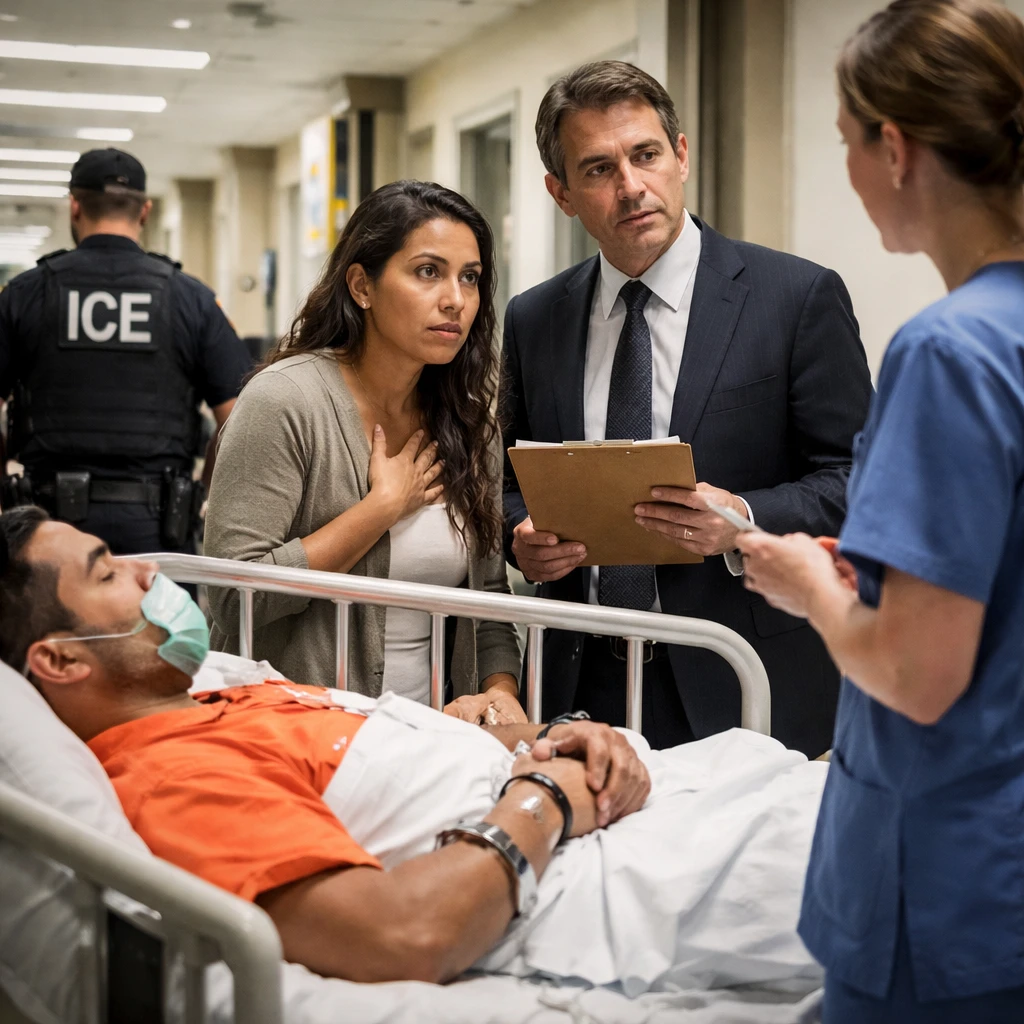

Efforts to maintain communication with Julio Ce9sar Pef1a, a detainee hospitalized after a ministroke, reveal obstacles encountered by families and legal representatives seeking whereabouts and health updates for patients under immigration custody. Pef1a, apprehended outside his home in Glendale, California, recounted to his wife, Lydia Romero, that he was shackled to his hospital bed, guarded, and that calls were monitored, expressing fear over his declining health and desire for familial support. When Romero inquired about the hospital's location, Pef1a was unable to disclose it, citing ICE restrictions.
Viridiana Chabolla, Pef1a's attorney, encountered similar impediments in obtaining information from ICE officials and the medical contractor at the Adelanto ICE Processing Center, who refused to confirm Pef1a's location. Attempts to verify his presence at a nearby medical institution, Providence St. Mary Medical Center, were unsuccessful due to hospital policies deferring to ICE regarding confirmations of detainees receiving care.
Families and legal advocates nationwide report encountering wide-ranging difficulties in accessing information, connecting with ICE detainees hospitalized for illness or injury, and ensuring they receive adequate emotional and legal support. Hospitals frequently decline to disclose the presence and condition of detainees, permitting immigration authorities to regulate visitation and communication, which may infringe upon constitutional rights and increase vulnerability to mistreatment according to legal experts.
Healthcare facilities contend that restrictive information sharing and visitation policies are implemented to safeguard patient confidentiality, protect medical staff, and ensure security. Staff members from cities such as Los Angeles, Minneapolis, and Portland, Oregon, note that these policies, sometimes called "blackout procedures," involve registering patients under pseudonyms or withholding any confirmation of their presence, complicating hospital operations.
Advocacy groups, including the California Immigrant Policy Center, express concern over the adoption of blackout procedures across multiple institutions. Legislative measures in certain states aim to protect immigrant patients from enforcement actions in healthcare settings, yet protections for individuals already held in ICE custody remain largely unaddressed.
Since President Donald Trump's inauguration, over 350,000 arrests by federal immigration agents have increased the number of detainees requiring medical attention outside detention facilities. Reports indicate that many detainees are admitted for preexisting or detention-related conditions. ICE has faced criticism for harsh enforcement measures and inadequate medical care within its facilities. Recent statements by lawmakers highlight ongoing health concerns among detained individuals.
Although exact data on hospitalized detainees' numbers remain unavailable, ICE reports indicate at least 38 deaths in immigration custody between 2025 and early 2026. The Department of Homeland Security has not publicly detailed policies related to detainee healthcare or specific cases such as Pef1a's.
ICE guidelines state detainees should have rights to telephone access, visitations, and confidential consultations with attorneys, although visitation parameters can be restricted during hospitalization, with hospitals generally expected to adhere to their own policies regarding next of kin notifications in severe illness.
Representatives from hospital associations refrain from commenting on specific policies or cases. Some acknowledge that confidentiality requests from law enforcement to limit disclosure of detainee information are honored, yet public inquiries generally allow for patient verification and contact in other contexts.
Medical and legal professionals emphasize that hospitals commonly share patient information and facilitate family visitation. However, in cases involving law enforcement custody, such transparency is often curtailed to minimize threats or unauthorized interactions due to limited hospital security compared to detention centers. Some high-profile individuals also request similar privacy protections.
Critics argue that immigration detention is civil rather than criminal, and most detainees do not have criminal records, raising questions about the justification for restrictive information policies in hospital settings.
Pef1a's background includes no criminal record; he immigrated from Mexico as a child and has family with military service in the U.S. He suffers from severe health issues including terminal kidney disease and partial blindness. Detained shortly after dialysis treatment in December, initial access to him was possible through an ICE detainee locator system, but hospitalization removed his information from public tracking, and family visits were denied at detention facilities.
Phone calls from Pef1a to his wife were brief and monitored, intensifying concerns about his inability to receive in-person support during critical health events. His restrained state and denial of family contact raise ethical questions about the necessity and proportionality of security measures in medical settings.
According to ICE policy, detainees should have family visitations within operational constraints and hold the right to confidential legal advice. However, application of these rights in hospital environments remains ambiguous, with hospitals focusing on medical care and sometimes deferring to immigration authorities for access and information decisions.
Legal representatives report prolonged struggles to locate hospitalized clients and gain visitation rights, with some detainees registered under aliases and hospitals initially denying their presence. Family members often face exclusions as well.
For example, Bayron Rovidio Marin, an injured detainee monitored by ICE at a county hospital without charges, was among those affected by restrictive policies. Recent county-level efforts seek to limit the use of blackout procedures to balance safety and accessibility, emphasizing prevention of threats and disruptions over broad information suppression.
Healthcare workers describe the situation as compromising patient care standards and denying detainees needed family advocacy, with concerns that detainees endure isolation and rushed treatment without appropriate oversight.
At some institutions, staff report that ICE and hospital administrators actively inhibit communication between patients in custody and their families, contravening medical ethics and aggravating health risks. Blackout policies are viewed as facilitators of patient concealment and neglect.
In Portland, public discontent from nurses regarding institutional compliance with ICE has led to contentious exchanges between healthcare workers and hospital management over accusations of misinformation and alleged human rights violations amid detainee treatment.
Pef1a’s eventual hospital identification came days before Christmas when attorneys were informed of his transfer to Victor Valley Global Medical Center near Adelanto, shortly before his expected release. Upon arrival, family found him unconscious, intubated, and still chained to the hospital bed following a severe seizure two days prior, details not previously shared with relatives or legal counsel.
Hospital representatives declined to comment on individual cases citing privacy laws, affirming compliance with legal disclosure requirements. Following extensive medical care, Pef1a was cleared for discharge in early January. His family is pursuing legal avenues to adjust his immigration status based on his son’s military service, while deportation proceedings remain pending.