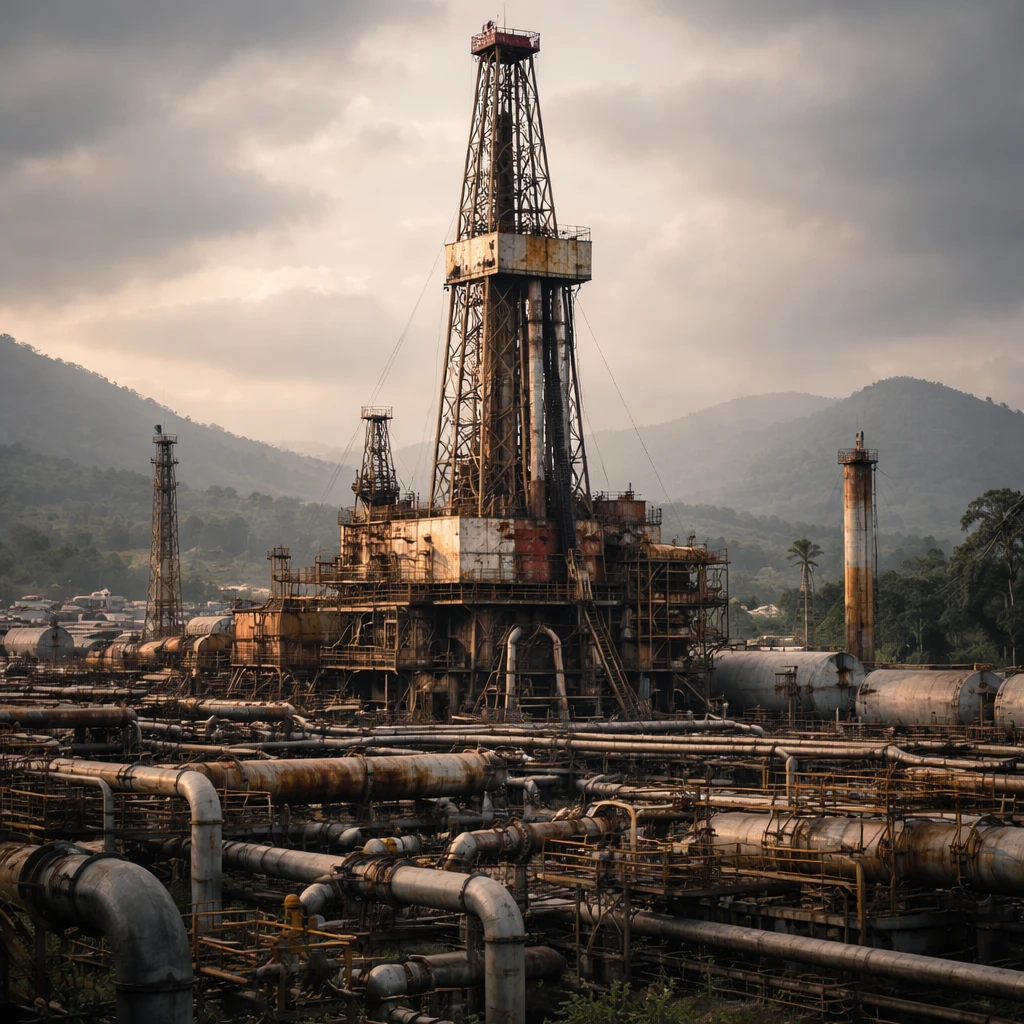

President Donald Trump has publicly emphasized his expectation that American energy companies will spearhead the restoration of Venezuela’s heavily damaged oil sector. Venezuela, home to the globe's most extensive proven oil reserves, presents an alluring opportunity. However, experts in the energy industry highlight numerous obstacles that may hinder US oil companies from achieving successful operations there.
Central to these concerns is the extensive destruction of Venezuela’s oil infrastructure, which would necessitate significant reconstruction efforts. Trump himself has acknowledged the need for billions of dollars of investment to remediate the decay caused by years of neglect. Beyond capital costs, crude oil prices currently do not offer the kind of profitability that would easily justify such substantial expenditures. Adding complexity is Venezuela's crude, which is notably expensive to refine compared to many other varieties.
Attempting to attract investment in Venezuela's oil industry is a formidable undertaking in a politically stable environment; the challenge only intensifies amid the country’s political turmoil following the ouster of its former authoritarian leader. The ambiguity surrounding Venezuela’s future political landscape weighs heavily on corporate strategists contemplating ventures within the country.
Clayton Seigle, a senior fellow in the Energy Security and Climate Change Program at the Center for Strategic and International Studies, summarized this perspective by remarking, "This whole situation leaves more questions than answers about Venezuela’s political future, which will be foremost in the considerations of corporate and industry planners looking at potential opportunities there."
Recent U.S. military action marked a dramatic turn in Venezuelan politics. On Saturday, U.S. special forces conducted a significant operation resulting in the apprehension of Venezuelan President Nicolás Maduro and his wife, Cilia Flores, subsequently transporting them to New York to face charges, including narco-terrorism conspiracy, cocaine importation conspiracy, and weapons offenses. President Trump declared that the United States would manage the country temporarily until a secure leadership could be established.
In parallel, Venezuela’s Supreme Court appointed Delcy Rodriguez, who oversees the state-run oil company Petróleos de Venezuela, S.A. (PDVSA), as the interim president. Following this, Trump expressed determination that American oil firms would help Venezuela realize its dormant potential as a key global oil producer.
Trump stated, "We’re going to have our very large United States oil companies, the biggest anywhere in the world, go in, spend billions of dollars, fix the badly broken infrastructure—the oil infrastructure—and start making money for the country." This vision demonstrates a clear intent to leverage American energy sector capabilities to revitalize Venezuelan oil production.
Historically, foreign oil enterprises have engaged with Venezuela’s oil industry for over 100 years. The country’s proximity to the United States has made it a strategically important partner. Additionally, Venezuela’s crude oil, known for being inexpensive yet viscous, matched the specifications of American refinery operations, which were largely developed to process this type of oil effectively. In the early 1990s, Venezuela implemented policies designed to further stimulate investment in its oil sector.
However, the oil industry's trajectory significantly shifted with the rise of socialist leader Hugo Chávez in 1999. Upon taking office, Chávez assumed direct control over PDVSA, allowing the oil infrastructure to deteriorate. This decline impaired the ability of companies operating in Venezuela to maintain or increase crude production. Over the past quarter-century, the country's oil output has declined by more than a third.
Reflecting on this, Trump commented on Saturday, "We built Venezuela’s oil industry with American talent, drive, and skill, and the socialist regime stole it from us." His remarks emphasize a perceived loss of American influence and control over Venezuela’s oil assets.
Currently, Chevron stands as the last American oil company maintaining operations in Venezuela. It has navigated the challenges posed by U.S. sanctions over the past decade, operating intermittently through waivers that permitted continued activity. Approximately 25% of Venezuelan oil, produced by Chevron, is shipped to the United States. Such a sustained presence positions Chevron advantageously within the Venezuelan oil landscape.
According to energy expert Clayton Seigle, "Chevron has been operating there for literally 100 years, and they’ve seen it all. They have stuck through thick and thin to hold a very advantageous position now." This continuity makes it difficult for other firms to establish a foothold.
Michael Klare, senior visiting fellow at the American Arms Association, echoed this view, noting the challenges for newcomers: "Any company moving in will need years to duplicate that capability." He underlines the intricate and demanding nature of pumping oil in Venezuela, a process that Chevron has mastered over time but few have the technology or experience to replicate.
Following the recent political developments, a spokesperson for Chevron affirmed that the company intends to "continue to operate in full compliance with all relevant laws and regulations." This statement underscores Chevron's cautious approach amidst the evolving political and regulatory environment.
In summary, the ambition to rejuvenate Venezuela's oil production via American firms confronts multifaceted complexities, including the need for extensive infrastructure investment, refining challenges, fluctuating crude prices, entrenched operational expertise held by Chevron, and an uncertain political backdrop. Navigating these factors will be critical for any U.S. company considering entry or expansion within Venezuela’s oil sector.