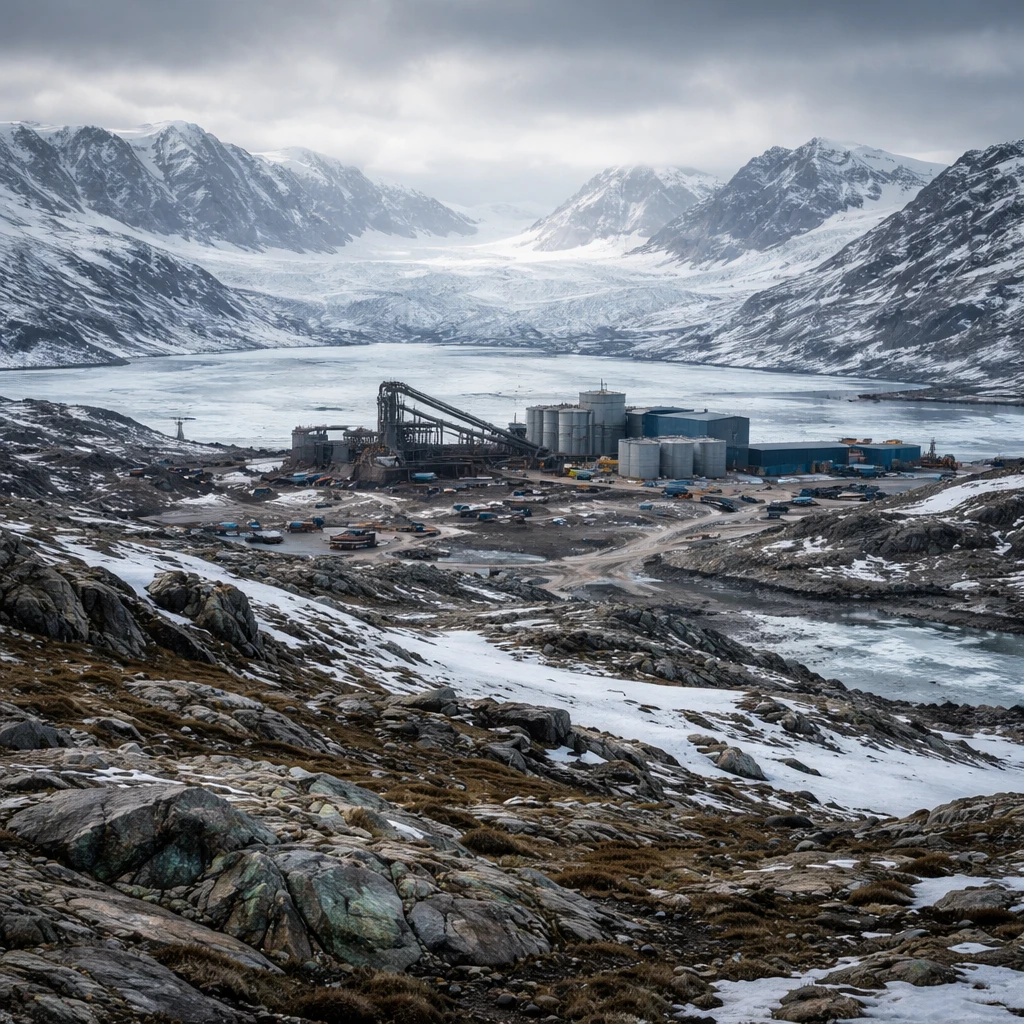

The mineral wealth beneath Greenland’s icy surface has captured the attention of the United States, which views these resources as a strategic necessity in response to China's dominant role in rare-earth metal supply chains. These metals are indispensable components in advanced military technologies, electric vehicles, and medical imaging equipment, making Greenland an attractive target for resource acquisition within US strategic circles.
President Donald Trump has expressed firm intentions regarding Greenland, asserting the strategic importance of securing the island. During a press briefing attended by oil industry leaders, he emphasized the administration’s determination to pursue Greenland's natural resources, suggesting that efforts would continue regardless of Greenland’s or Denmark’s receptiveness. Though official rhetoric has occasionally downplayed the island’s resource importance, former national security adviser Mike Waltz affirmed that the administration’s focus remains on “critical minerals” and natural resource acquisition.
However, the practicality of extensive mining operations in Greenland faces significant hurdles, primarily due to the island's extreme Arctic environment. Vast portions of Greenland lie above the Arctic Circle, covered by ice sheets up to a mile thick, and experience prolonged periods of darkness. These conditions complicate and substantially increase the cost of mineral extraction. Researchers note that mining activities in such polar regions can be up to five to ten times more expensive than comparable operations elsewhere.
Beyond the environmental difficulties, Greenland lacks the necessary mining infrastructure and skilled labor pool to support large-scale resource development, further delaying potential exploitation efforts. Malte Humpert, founder and senior fellow at The Arctic Institute, characterizes the concept of transforming Greenland into a US-centered rare-earth production hub as unrealistic at best, likening it unfavorably even to lunar mining due to the terrain’s challenges.
Despite the formidable environmental and operational challenges, Greenland government and businesses demonstrate openness to foreign investment. Christian Keldsen, managing director of the Greenland Business Association, highlighted a cooperative approach toward US commercial interests, questioning the rationale behind aggressive overtures such as territorial acquisition. Greenland’s self-governing status under Denmark and its longstanding political stability distinguish it sharply from other resource-rich regions, such as Venezuela.
Growing attention to US ambitions in Greenland intensified following President Trump's move to assert control over Venezuela’s oil assets, which spurred speculation about potential US territorial acquisitions elsewhere. Predictive market data shows an increase in the perceived likelihood of the United States gaining control over parts of Greenland, rising to approximately 40% by early 2025.
However, experts caution against expecting swift progress in transforming Greenland into a mineral extraction powerhouse. Jacob Funk Kirkegaard, a senior fellow at the Peterson Institute for International Economics, emphasizes that if Greenland contained readily exploitable mineral wealth, private corporations would have already capitalized on it. The central issue remains the enormous initial capital outlay and logistical complexities that dissuade business ventures despite the island’s favorable openness to investment.
Potentially, the Trump administration might consider financial inducements or guarantees to incentivize US companies to bear the high risks associated with Greenland’s mineral development, akin to guarantees sought by oil companies for operations in Venezuela. Yet such strategies raise concerns about reliance on public funds and whether this approach offers a sustainable or reasonable foundation for territorial acquisition.
The Arctic climate crisis, causing accelerated ice melt and temperature increases, has generated some optimism about economic opportunities in Greenland. Nonetheless, environmental researchers caution that melting ice creates new hazards like unstable ground and landslides, complicating rather than simplifying mining activities. Humpert stresses that climate change merely reduces ice coverage but does not transform Greenland into an accessible or temperate environment.
Moreover, Greenland enforces strict environmental regulations reflecting local priorities for preserving the island’s pristine natural conditions. Any attempt by an external actor to diminish these rules could provoke strong opposition from the local populace and disrupt the political stability critical to operational security and cooperation.
The prospect of selling Greenland to the United States would involve complex political processes, including likely a referendum among Greenlanders, who predominantly oppose becoming a US territory. A recent poll indicates that only 6% of the population supports such a change, while 85% reject it.
Academic voices caution that US aggressive rhetoric may jeopardize diplomatic relations with Greenland and its sovereign parent state, Denmark. Adam Lajeunesse, an expert in Arctic policy, warns that portraying the US as an overbearing actor risks rebranding the country from a partner to a bully, potentially galvanizing resistance. This sentiment reportedly is already influencing public perceptions, with growing wariness toward American initiatives perceived as coercive.
Christian Keldsen echoes concerns about the damaging effects of confrontational language, noting that US actions currently raise suspicions among Greenlanders about intentions to assert control over their territory. This skepticism challenges the prospects of collaboration and threatens to undermine efforts to engage Greenland commercially and strategically.
In sum, while Greenland's mineral resources present undeniable strategic value to the United States, formidable environmental, economic, regulatory, and political factors constrain the feasibility of immediate resource extraction. The intricate balance of respecting local governance, environmental stewardship, and securing economic viability complicates the path forward for any US ambitions in Greenland.