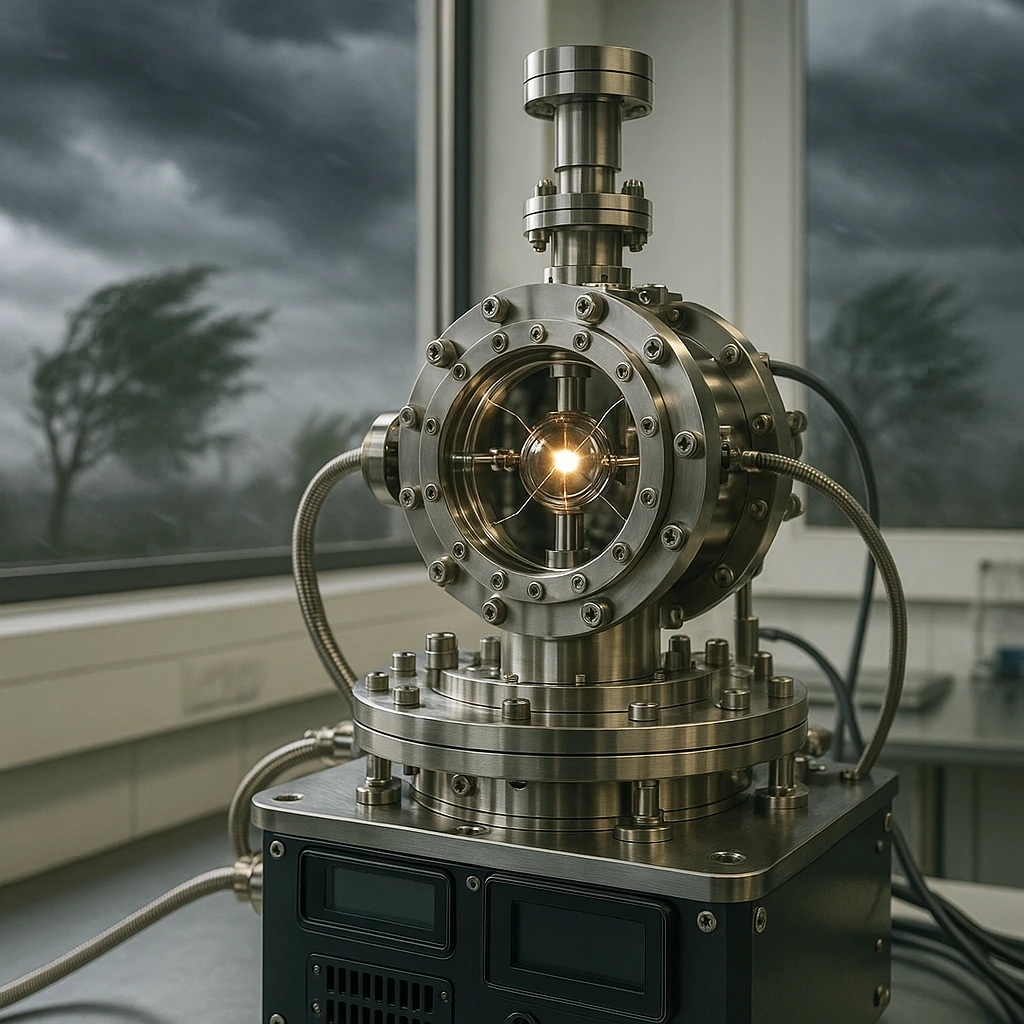

The official timekeeping of the United States experienced a minute delay last week due to a power outage at the National Institute of Standards and Technology (NIST) facility located near Boulder, Colorado. A destructive windstorm swept through the region, disrupting electrical power and triggering a series of events that culminated in a slight slowing of the nation’s official time standard by approximately 4.8 microseconds.
NIST plays a central role in establishing the national time standard, termed NIST UTC (Coordinated Universal Time), which is computed from an aggregation of atomic clocks positioned throughout the Boulder campus. These precision instruments employ the resonant frequencies intrinsic to atoms—such as cesium and hydrogen—to maintain unparalleled accuracy in time measurement.
Specifically, at least sixteen atomic clocks, including cesium beam clocks and hydrogen masers, provide continual readings from which a weighted average is calculated to determine the U.S. official time. This responsibility is overseen by the Secretary of Commerce in collaboration with the U.S. Navy, a system that has governed timekeeping since 2007.
During the windstorm-induced power failure, while the atomic clocks themselves continued to operate unaffected thanks to their internal battery backups, the connection between certain clocks and NIST’s broader measurement and distribution infrastructure failed. This network disruption, together with a failure in the laboratory’s backup generator system, led to a temporary loss of synchronization and caused the official time to fall behind its accurate value by nearly five millionths of a second.
According to Rebecca Jacobson, a spokesperson for NIST, the 4.8 microsecond lag represents an extremely brief interval. To place this in perspective, a human blink takes about 350,000 microseconds, making the time deviation imperceptible to the general public.
Even though the discrepancy might appear trivial, the impact varies significantly depending on the application. Jeff Sherman, a supervisory research physicist at NIST, explained that the 4.8 microsecond drift is both minuscule and substantial depending on context. While everyday activities are unlikely to be affected, sectors requiring exact timing such as telecommunications, GPS navigation, and critical infrastructure monitoring might experience adverse effects due to such timing interruptions.
Following the storm, emergency operations staff at the NIST facility managed to bring backup power online via a diesel generator reserved for such contingencies. Restoration efforts enabled the lab to begin assessing the damage and initiate corrections to the time offset by Saturday evening.
NIST maintains communication with advanced users of its timekeeping network, informing them of any disruptions to facilitate adjustments in their operations. The agency also provides alternative timing services to high-end clientele to mitigate risks associated with such outages.
This incident underscores the reliance of critical systems on highly accurate and continuous time signals, and highlights the vulnerabilities that natural events and infrastructure failures can pose even to sophisticated measurement systems.