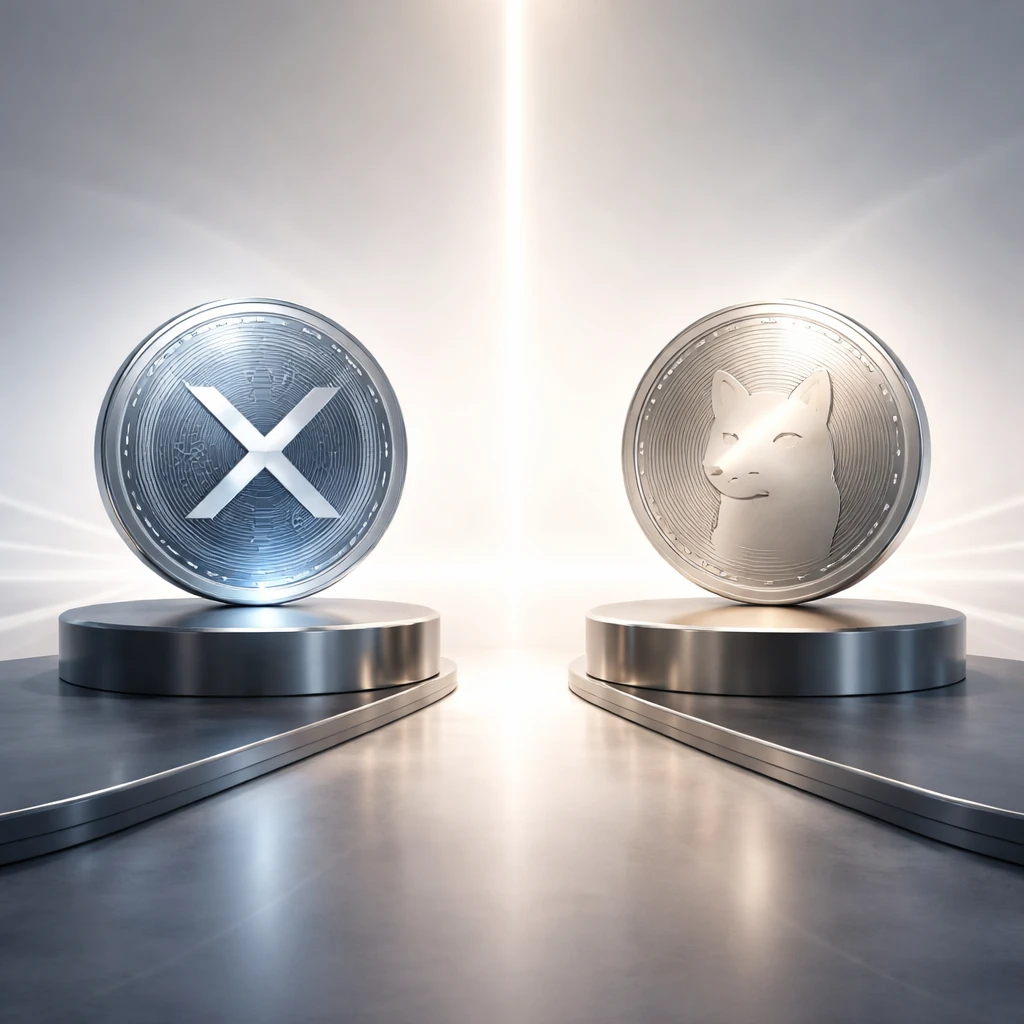

Cryptocurrencies XRP and Dogecoin, both launched in 2013, have historically offered substantial returns for early adopters. To illustrate, an initial investment of $10,000 in XRP at its inception could potentially be worth approximately $3.57 million today. Comparatively, the same amount invested in Dogecoin during its early days might have grown to an estimated $7 million. These impressive returns, however, presuppose that investors maintained their holdings through considerable market downturns—including three crypto winters and a significant recession in the United States.
Despite their past successes, the last year saw both cryptocurrencies experience notable value declines. XRP's price decreased by nearly 10%, while Dogecoin suffered a more pronounced drop of nearly 60%. Understanding the reasons behind these setbacks and assessing each token's future potential are essential for investors looking ahead to the next decade.
Contrasting Foundations and Operational Mechanisms
XRP serves as the native token for the XRP Ledger, a blockchain developed by the fintech company Ripple Labs. Before XRP was launched, its entire supply of 100 billion tokens was pre-minted, distinguishing it from cryptocurrencies like Bitcoin, which are continuously mined, or Ethereum, which supports staking mechanisms. XRP's primary function is to facilitate rapid financial transactions on the Ripple network by acting as a bridge currency that connects two fiat currencies during cross-border transfers. This mechanism aims to offer a faster, more economical, and possibly more secure alternative to conventional interbank methods such as SWIFT transfers.
In contrast, Dogecoin finds its origins in the open-source codebase of Litecoin, itself a derivative of Bitcoin's blockchain. Like other proof-of-work (PoW) cryptocurrencies, Dogecoin is mined through energy-intensive computational processes. Unlike Bitcoin and Litecoin, which have capped supplies, Dogecoin utilizes an unlimited supply model, currently with 168 billion tokens in circulation. Advocates for Dogecoin suggest that this unlimited supply encourages broader usage and circulation rather than accumulation.
It is noteworthy that neither XRP Ledger nor Dogecoin's blockchain inherently supports smart contracts, a feature increasingly integral to decentralized applications (dApps) and tokenized assets. Both platforms, however, have recently introduced limited compatibility with Ethereum-based decentralized applications, potentially expanding their capabilities.
Recent Developments and Market Challenges
XRP's trajectory faced significant uncertainty in 2020 when the U.S. Securities and Exchange Commission (SEC) filed a lawsuit against Ripple. The SEC alleged that Ripple's sales of XRP tokens were unlicensed securities transactions, leading major crypto exchanges to delist XRP and causing Ripple to lose important financial clients. The case concluded in August 2025 with Ripple incurring a smaller-than-expected fine and a ruling clarifying that XRP sold to retail investors on public exchanges does not constitute unlicensed securities. This outcome prompted exchanges to reinstate XRP and facilitated the approval and launch of XRP-focused exchange-traded funds (ETFs).
Despite these positive regulatory outcomes, XRP faces competitive pressures from stablecoins, including Ripple's own Ripple USD (RLUSD). Since stablecoins are pegged closely to the U.S. dollar, they may serve as more stable bridge currencies, challenging XRP's market position. Unlike Bitcoin, valued for its limited scarcity, or Ethereum, valued for its developer utility, XRP's valuation does not currently benefit from these traditional value drivers.
Dogecoin gained popular attention fueled significantly by endorsements from notable figures such as Elon Musk, Mark Cuban, and Snoop Dogg. Elon Musk's sporadic social media announcements generated price surges, and various companies, such as Tesla, began accepting Dogecoin for payments. Additionally, CleanCore Solutions announced an acquisition plan for 5% of Dogecoin's circulating supply to establish a "Dogecoin Treasury." The crypto community also witnessed the approval of Dogecoin-focused spot ETFs in late 2025, enhancing retail investor accessibility. Despite these developments, Dogecoin's fundamental advantages remain limited compared to other cryptocurrencies like Bitcoin and Litecoin.
Forecasting Long-Term Value and Investment Potential
Given the data and developments presently available, it appears improbable that an investment of $10,000 into either XRP or Dogecoin will reach $1 million within the next ten years. Extending the speculative horizon, XRP presents a comparatively promising outlook. Its integration within Ripple's growing financial technology ecosystem and the company's pursuit of a U.S. banking charter signal potential pathways for future value growth. The evolution of Ripple into a comprehensive banking institution could influence XRP's valuation positively over the coming decades.
By contrast, Dogecoin's future seems less assured. Its market momentum largely depends on social media influence and public sentiment rather than intrinsic technological or economic advantages. This reliance on hype rather than fundamental utility poses challenges for sustained long-term growth.