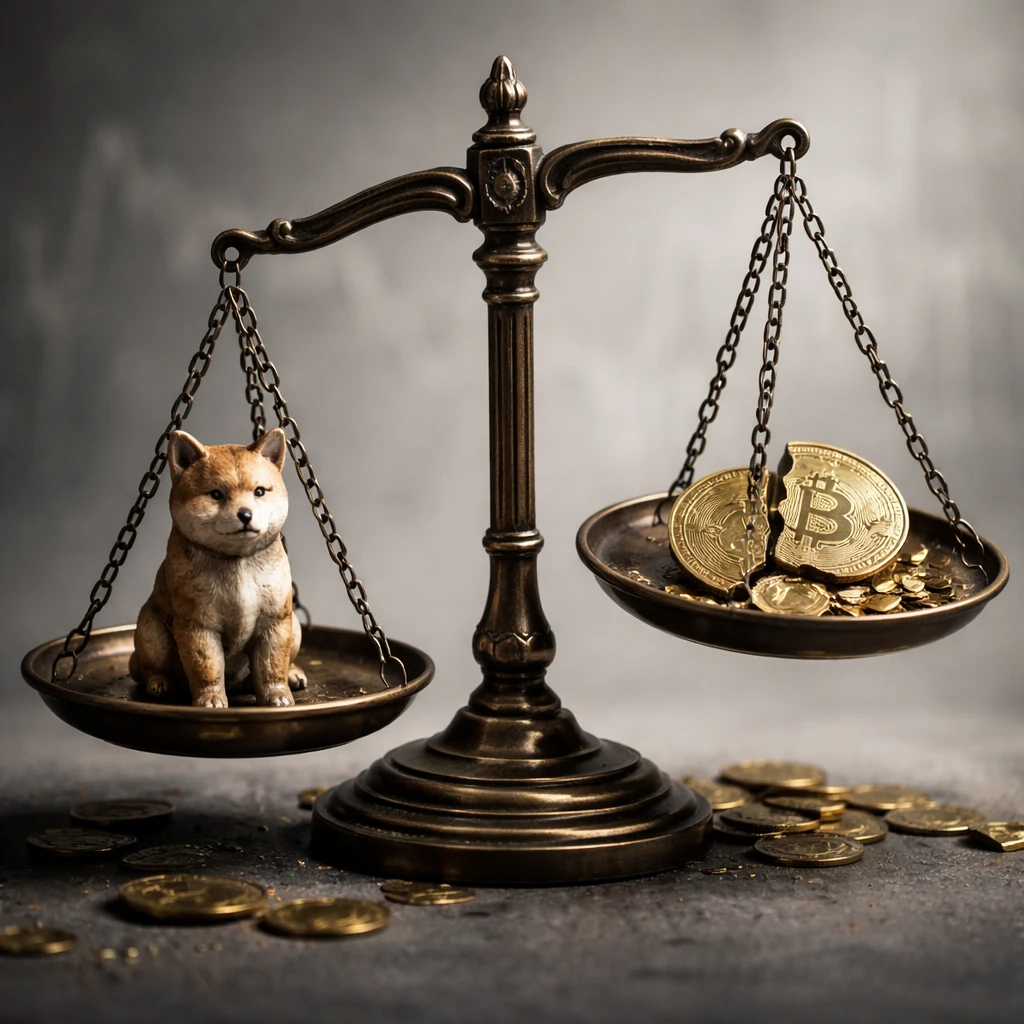

Over the past five years, the cryptocurrency sector has experienced significant growth, characterized by substantial gains in leading assets such as Bitcoin, Ethereum, and XRP. These top tokens have generated considerable positive returns, rewarding investors who adopted a buy-and-hold approach despite the market's inherent volatility. However, not every cryptocurrency enjoys similar favor, and substantial risks persist within the broader digital asset landscape.
Among the many tokens circulating in the marketplace, Shiba Inu and Bitcoin Cash stand out as examples of cryptocurrencies that may present considerable hazards to investors. This detailed review assesses why an investment of $100,000 in either token could face steep losses, based on current developments and market data.
Shiba Inu: From Rapid Rise to Declining Relevance
Introduced in August 2020, Shiba Inu swiftly became one of the most talked-about meme coins, capturing the attention of retail investors with its rapid price appreciation. Early adopters of SHIB saw impressive returns owing to extreme volatility, yet the token has subsequently experienced a notable decrease in market position.
Since hitting its peak valuation in 2021, Shiba Inu’s market value has contracted by roughly 90%. Despite the project's efforts to invigorate demand through mechanisms designed to burn tokens and thus reduce supply, these initiatives have barely dented the total outstanding SHIB supply. Consequently, the intended effect of scarcity to support price appreciation has largely been negligible.
Further compounding the token’s challenges, Shiba Inu launched a layer-2 network with aims to foster ecosystem development. Unfortunately, this platform has failed to generate sustained bullish momentum or attract significant ancillary developer projects that could add utility or broaden adoption.
Moreover, Shiba Inu’s foray into the metaverse realm, branded "SHIB: The Metaverse," has not met expectations. Despite multiple delays, the early access release in late 2024 did not evolve into an engaging or active virtual environment, suffering from extremely low user activity levels. As general enthusiasm for metaverse projects has diminished across the market, this initiative appears to be faltering as a catalyst for the underlying token’s value.
At present, Shiba Inu holds a market capitalization near $5 billion, positioning it as the 24th-largest cryptocurrency by valuation. Classified as a meme coin with weakening market relevance and lacking compelling fundamental drivers to elevate its valuation, SHIB represents a precarious investment choice looking toward 2026 and beyond.
Bitcoin Cash: Gains Overshadowed by Limited Adoption and Scale
Bitcoin Cash emerged from a fork of the Bitcoin blockchain in August 2017, intending to improve upon Bitcoin's scalability by offering faster transaction speeds and reduced fees. Its market proponents anticipate continued growth tied to increasing adoption, contributing to a recent positive price trajectory.
Over the past year, Bitcoin’s price declined by approximately 6%, whereas Bitcoin Cash experienced a roughly 44% increase. Presently, Bitcoin Cash commands a market capitalization estimated at $12.7 billion, ranking it as the 11th-largest cryptocurrency. This disparity in performance has attracted investor interest, hopeful that BCH may advance further in market ranking.
Nevertheless, a deeper examination of Bitcoin Cash’s competitive position reveals that its market value remains a small fraction compared to Bitcoin’s $1.8 trillion capitalization. Despite short-term price gains, Bitcoin Cash has not markedly closed the gap against its progenitor in relative scale or influence.
Institutional adoption for Bitcoin Cash is notably sparse, raising questions about its long-term viability. While Bitcoin Cash offers certain practical advantages regarding transaction costs and speed, Bitcoin’s market value primarily stems from its speculative appeal rather than widespread use as a payment medium. Accordingly, Bitcoin Cash does not exhibit distinctive advantages as a transactional currency when compared with numerous other competitors within the crypto ecosystem.
This situation suggests that Bitcoin Cash risks devolving into a speculative asset that behaves similarly to meme coins over time. Its valuation may experience moderate gains aligned with broader market trends; however, investors placing significant bets on its continuous growth and longevity confront substantial risks.
Conclusion
While certain cryptocurrencies have demonstrated robust performance and resilience, others like Shiba Inu and Bitcoin Cash face notable headwinds due to declining market presence, underwhelming developer activity, and limited adoption. Both assets carry risks that could substantially reduce the value of sizeable investments over the coming years, reinforcing the need for careful due diligence and risk assessment in this dynamic market.