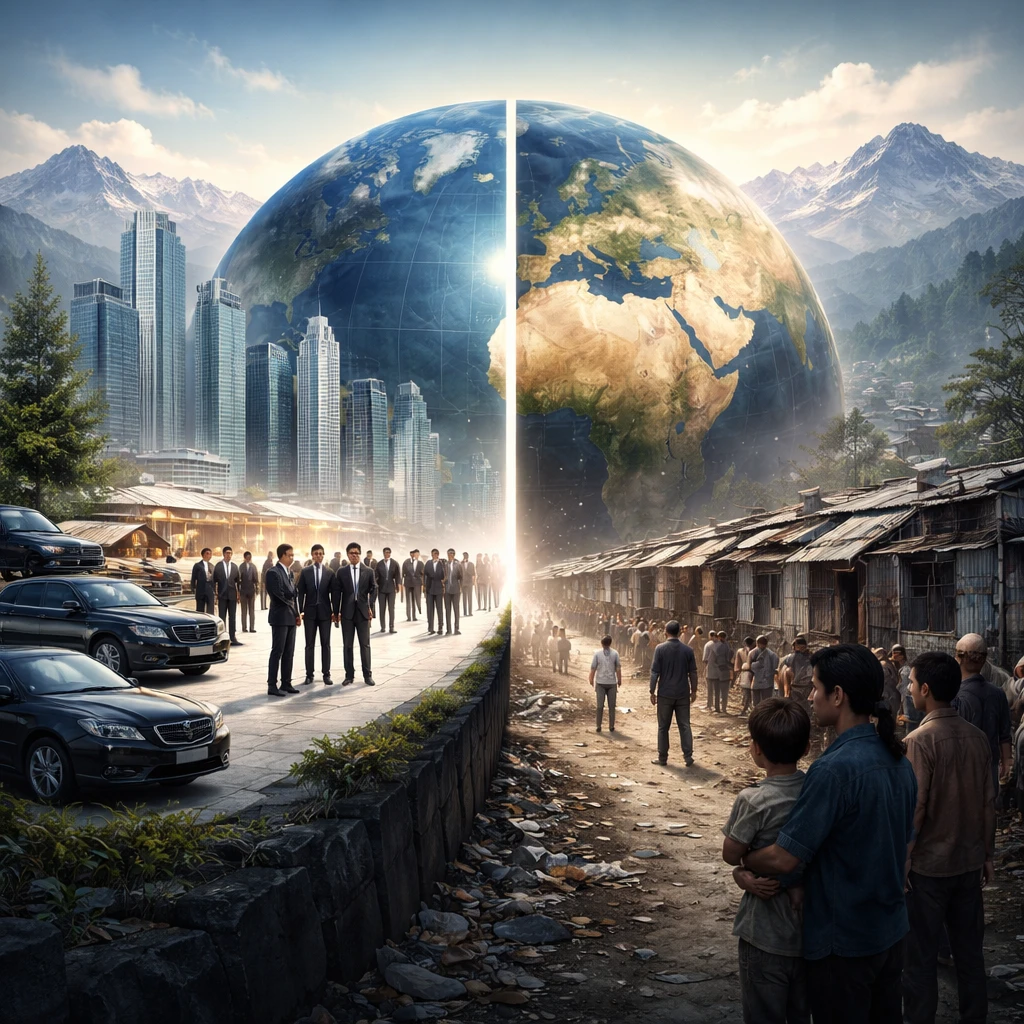

In early 2026, the annual World Economic Forum (WEF) gathering in Davos has taken on a distinctly urgent tone. Known for its gatherings of influential business leaders, politicians, and intellectuals, the event is now confronting pressing global issues that challenge the current international order. In particular, two major concerns dominate this year’s discourse: the attendance of former US President Donald Trump, and the intensifying economic disparities that threaten social stability, represented by what experts describe as a "K-shaped" economic trajectory.
The presence of Trump, a figure often associated with disruptive trade policies and nationalist rhetoric, looms large as an explicit reminder of geopolitical divisions. However, beyond this visible political dynamic lies a more complex and persistent challenge. The concept of a K-shaped economy has gained traction among economists and policymakers alike, depicting a bifurcated recovery from the COVID-19 pandemic that began in 2020. While some segments of society have prospered, others continue to face significant setbacks, resulting in widening gaps in wealth and opportunity.
Peter Atwater, an economist who has discussed the K-shaped economic pattern extensively, illustrates this divergence. According to his analysis, the bifurcation started with the pandemic's onset, which indiscriminately impacted populations worldwide, but evolved during recovery as wealthier individuals and sectors rebounded and even expanded their financial standing. Conversely, lower-income groups found themselves increasingly marginalized, with limited gains and often worsening circumstances.
Observable data supports this divide. Stock markets, despite recent volatility, hover near historic highs, reflecting investor confidence concentrated within financial markets. At the same time, luxury industries, exemplified by steady premium airline ticket sales and robust demand for upscale accommodations, sustain strong growth. Contrastingly, a significant portion of the population faces challenges such as housing affordability crises, which, while a problem for many, also represent an asset appreciation boon for others already owning property in scarce markets.
This dichotomy only sharpens the contrast between the Davos attendees and those outside the forum’s sphere. The event, historically perceived as a convergence of global elites who often arrive in private jets and dine on high-end cuisine while discussing issues such as poverty and climate change, paradoxically highlights the growing separation between those with vast resources and those without. Atwater remarks that the pandemic has exacerbated this divide, increasing the social and economic distance between top earners and everyone else. He points out that direct interactions between these groups have diminished, replaced largely by remote service exchanges such as deliveries.
Within Davos, there is an awareness of these optics. Larry Fink, CEO of BlackRock and a prominent figure at the forum, articulated this tension during his opening speech. He acknowledged the irony that many who are most affected by the forum's discussions rarely attend, underscoring a fundamental challenge: the forum aims to shape a world accessible to all, yet it remains a gathering of a privileged few. However, Fink’s observation on this divide, while candid, is seen by some critics as a recurrent acknowledgement that has not yet translated into effective action.
Indeed, critics have underscored the forum's history of misjudging or dismissing emerging societal currents until their consequences become unavoidable. Examples have included failures to anticipate events such as Brexit, the rise of populist movements like MAGA, and early underestimations of pandemic threats in 2020, when delegates continued traditional networking activities despite health risks. Additionally, Davos once enthusiastically embraced concepts like the metaverse, which have since lost momentum.
The failure to fully grasp the underlying forces behind movements such as MAGA ties directly into the broader issue of economic inequality illustrated by the K-shaped recovery. This problem transcends national borders, manifesting in various forms globally. For instance, recent turmoil in Iran exemplifies the risks posed by entrenched disparities: prolonged inflation and fiscal mismanagement have eroded middle-class wealth, while systemic corruption has concentrated power and resources among a small elite. These conditions have sparked widespread protests and harsh government crackdowns, underscoring the destabilizing potential of economic inequity.
Given these examples, the Davos assembly faces a critical juncture. Experts like Atwater emphasize that sustaining vast wealth concentration without repercussions is increasingly untenable. He warns that the accumulation of vulnerabilities within the system could soon trigger unforeseen consequences, suggesting that society may be close to a tipping point where existing tensions could ignite more significant upheaval.
In summary, the 2026 World Economic Forum convenes amid significant and interconnected challenges. While the figure of Donald Trump provides a visible focal point for geopolitical friction, the deeper and arguably more profound issue remains the escalating division within global economies and societies. The forum’s capacity to move beyond symbolic recognition of these divides toward substantive solutions will be crucial in shaping the trajectory of a world faced with growing instability.