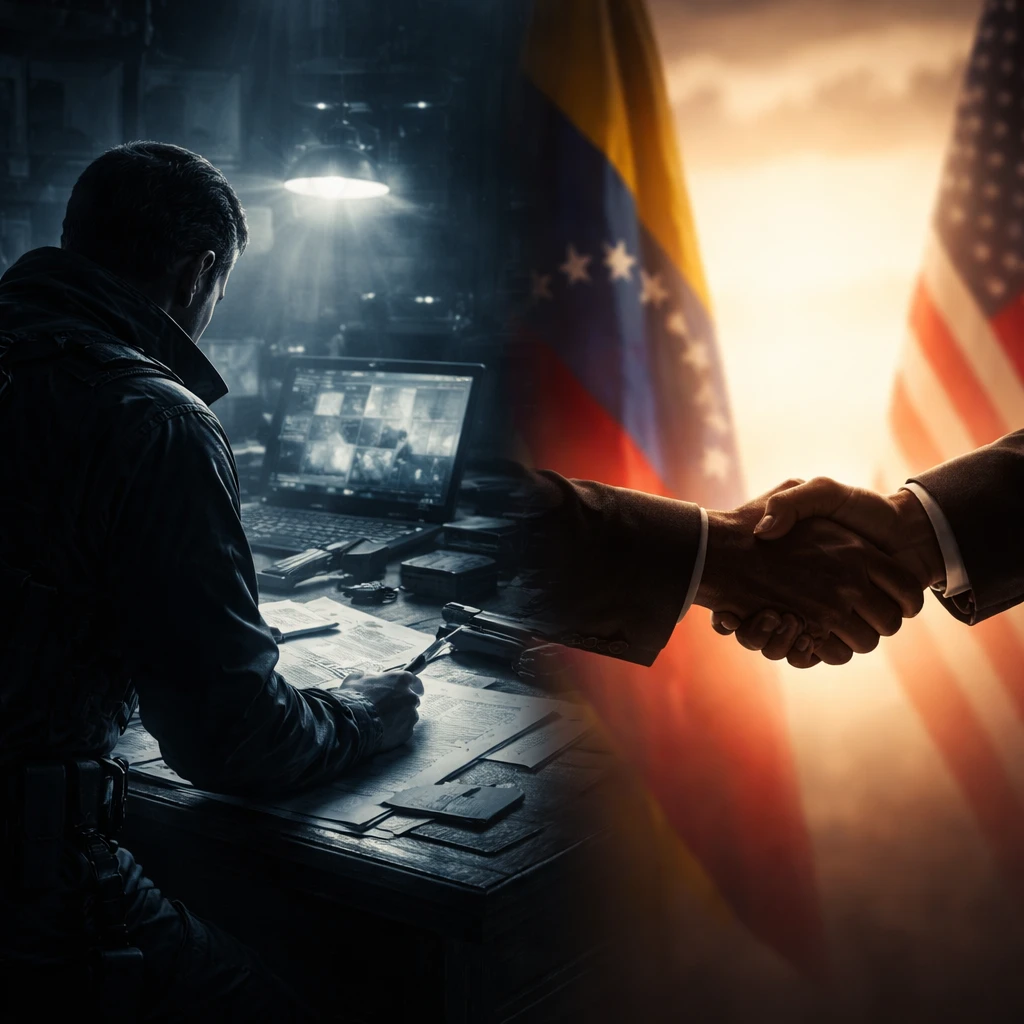

Delcy Rodríguez, currently serving as Venezuela’s acting president, has been ensnared in U.S. law enforcement investigations for numerous years. According to declassified documentation and informed sources within the Drug Enforcement Administration (DEA), Rodríguez has been a significant subject of agency scrutiny since at least 2018. The agency’s files underscore her as a “priority target” as of 2022 due to extensive allegations involving financial crimes and illicit trafficking networks.
Over the weekend, intelligence files disclosed by the DEA illustrate a multi-year examination into Rodríguez’s purported connections to large-scale drug trafficking operations, schemes involving gold smuggling, and complex money laundering activities. A confidential informant reportedly informed DEA agents in 2021 about Rodríguez’s alleged use of hotels on Isla Margarita, a Venezuelan island, as fronts for laundering financial proceeds. Documentation reveals that Rodríguez’s name recurs across close to a dozen DEA investigations spanning Latin America and the United States.
Significant among her alleged associations is her connection to Alex Saab, identified as a close financial associate of Nicolás Maduro. Saab’s 2020 arrest on money laundering charges marks a critical node in investigations tying Rodríguez to broader corrupt practices within Venezuela’s political framework. Sources in law enforcement indicate that interest in Rodríguez intensified as her political influence grew within Venezuela.
Despite these serious allegations and ongoing investigations, Rodríguez has received public commendation from former President Donald Trump. Since the detainment of Maduro, Trump has referred to her as a “terrific person” and asserted that she maintains open communication lines with U.S. officials. This public endorsement has drawn attention given the DEA’s covert determination of her as a priority target for alleged financial crimes.
Kurt Lunkenheimer, an ex-federal prosecutor based in Miami, addressed the tension arising from this dichotomy. He remarked, “She was on the rise, so it’s not surprising that she might become a high-priority target.” Lunkenheimer further noted the crucial distinction between being a focus of investigative discourse and the establishment of concrete evidence sufficient to justify indictment. He observed that the U.S. government has yet to publicly charge Rodríguez or include her in official accusations alongside Maduro and other Venezuelan officials.
Attempts to secure comments from both Rodríguez’s representatives and the White House have not yielded immediate responses. Thus, the dichotomy between political praise and law enforcement scrutiny persists without official clarification from involved parties.
Meanwhile, the geopolitical maneuvering between the U.S. and Venezuela continues to unfold with significant developments. Relating to recent U.S. military and economic actions, President Trump announced that the United States had commenced receipt of substantial oil shipments from Venezuela following a successful operation that purportedly resulted in Maduro’s capture. Trump asserted that these shipments are poised to contribute to the reduction of fuel prices. Concurrently, political actors such as Vice President J.D. Vance influenced legislative decisions by voting against a Senate resolution that would have mandated congressional approval prior to further military engagements in Venezuela.
Amid heightened diplomatic tensions, Rodríguez publicly demanded verification of life for Nicolás Maduro and his spouse following the military strike. President Trump signaled the possibility of additional military interventions within Venezuela and intimated potential actions extending to Colombia and Mexico, should those governments fail to cooperate with U.S. strategic aims. Rodriguez was also suggested as possibly facing consequences more severe than those experienced by Maduro.
The evolving narrative illustrates the complex challenges in assessing Venezuela’s leadership within the framework of U.S. political and law enforcement priorities, where public statements and covert investigations appear at odds, reflecting the intricate dynamics governing interstate relations and internal investigations.