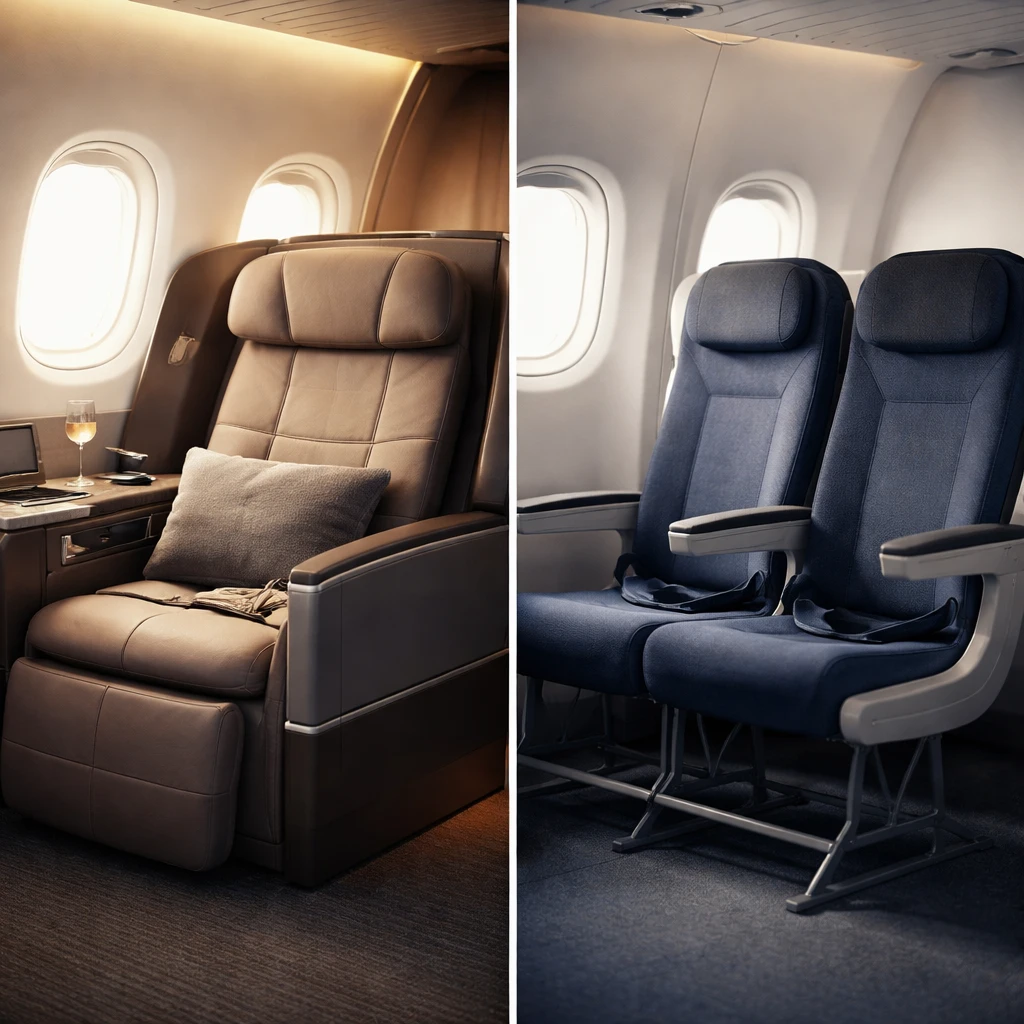

Delta Air Lines' latest quarterly financial results offer a revealing snapshot of the current landscape in the American economy, particularly how it manifests in consumer behavior in air travel. The airline disclosed that ticket sales in its main cabin category, which generally represent the least expensive fares, decreased by 7% compared to the same period last year. Conversely, ticket sales for premium cabins, encompassing business and first-class seats, rose by 9% year over year. Remarkably, this marks the first occasion in Delta's history where premium cabin sales have overtaken those of the economy class.
The implications of these figures are significant. They illustrate a clear divide in economic fortunes among different consumer segments—wealthier individuals and their associated corporations are maintaining or increasing discretionary expenditures on travel, while the broader public remains cautious and conservative in their spending habits. This vertical split in economic health and consumption patterns aligns with what economists describe as a K-shaped recovery or economy.
Delta's financial outlook for 2026 further cements the airline's strategic focus in response to these trends. The company forecasts a 20% increase in profits next year, attributing much of this growth to its premium customer base. This group not only includes the traditional corporate travelers, who have historically been a reliable revenue source for airlines, but now also comprises an expanding segment of affluent leisure travelers seeking upgraded vacation experiences. This shift has prompted Delta to plan a 3% expansion in overall seat capacity for the year, primarily through aircraft interior modifications and the introduction of new planes. Crucially, this growth targets premium cabins exclusively, refraining from increasing main cabin seats altogether.
Delta’s Chief Executive Officer, Ed Bastian, highlighted this strategic direction during a call with members of the press, stating that essentially all seat growth will be in the premium sector, with no anticipated expansion in the main cabin. This approach demonstrates that Delta views the increasing demand for higher-priced travel options not as a temporary phenomenon but as a sustained trend shaping the future of its business.
This premium-focused shift is not unique to Delta. Industry analysts, including Jefferies’ Sheila Kahyaoglu, have noted that airlines are engaged in what could be described as a "premium arms race." This competition involves substantial investment in loyalty programs, upgraded lounges, and other amenities seeking to attract and retain affluent travelers who generate higher profit margins.
From the perspective of those flying economy, this ongoing focus on premium offerings means that the experience in the back of the plane is unlikely to see significant improvements. Economy travel remains basic, with limited seat space, fewer comfort features, and minimal enhancements. The dynamics inside a commercial airplane thus vividly illustrate the economic disparities—passengers seated upfront enjoy spacious legroom, complimentary cocktails, and exclusive services, often having paid two to three times the cost borne by those in the rear cabins.
This scenario serves as a microcosm of the broader divide characterizing the U.S. economy: a clear bifurcation where the economic upper echelon thrives, marked by increased spending power and choice, while the majority face financial restraint and a frugal approach to discretionary expenses like travel. In this context, Delta’s business strategy aligns closely with a market reality driven by unequal wealth distribution and differentiated consumer behavior.
In summary, Delta’s recent earnings and forthcoming capacity investments underscore the airline's commitment to catering to premium travelers, reflecting a broader economic pattern where prosperity and access to enhanced services increasingly diverge along income lines. The evolution in air travel demand and service focus offers a practical lens through which to observe and understand the prevailing K-shaped economy.