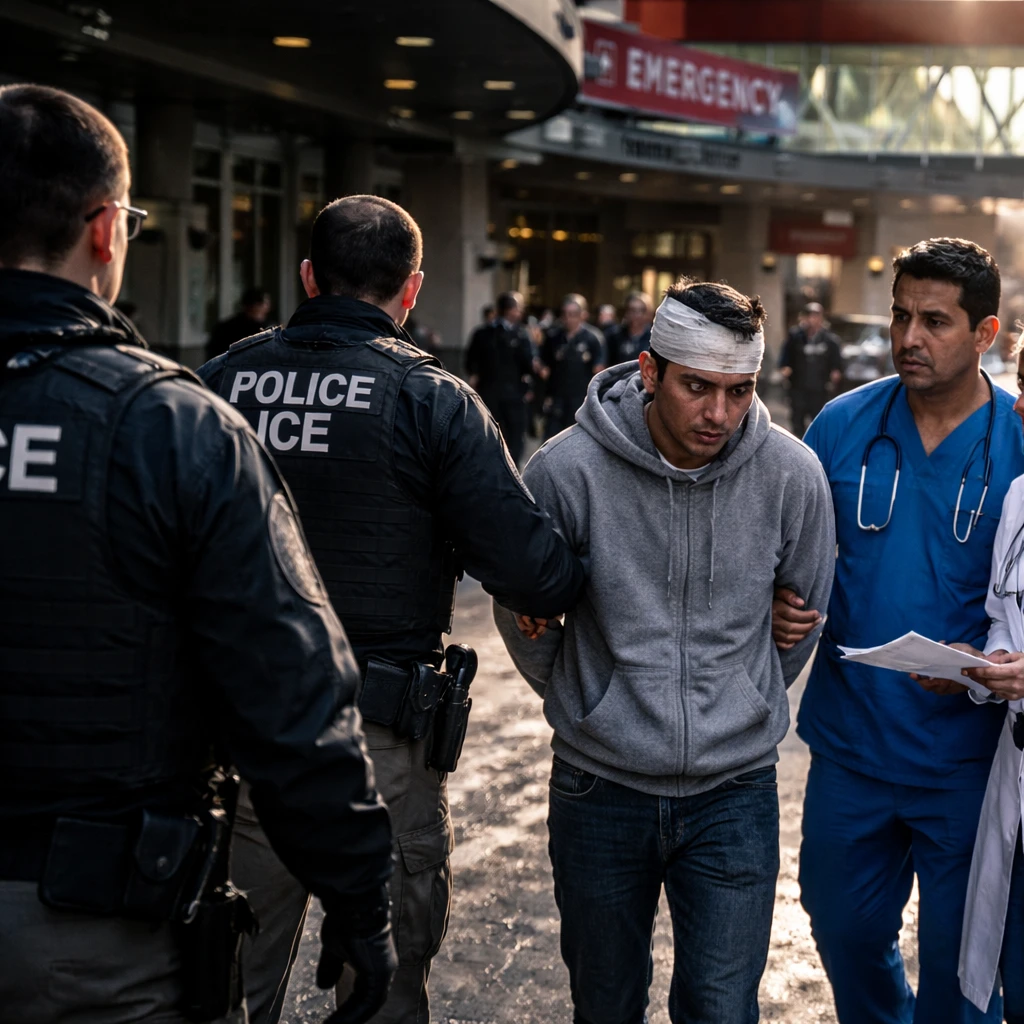

In Minneapolis, Minnesota, serious doubts have been cast on Immigration and Customs Enforcement’s (ICE) version of events concerning the severe head and facial injuries sustained by Alberto Castañeda Mondragón, a migrant from Mexico. When federal immigration agents brought the 31-year-old to the Hennepin County Medical Center (HCMC), ICU nurses quickly questioned ICE’s claim that Castañeda Mondragón had intentionally hurled himself headfirst against a brick wall while attempting to flee while handcuffed.
According to court documents filed by his legal counsel seeking release, ICE agents initially asserted that the migrant’s cranial and facial fractures resulted from a purposeful act of self-harm during an escape attempt. However, multiple healthcare providers familiar with the case have stated the injuries and brain bleeding observed are inconsistent with such an explanation.
One ICU nurse, speaking anonymously due to hospital confidentiality policies, described the ICE account as "laughable"—albeit with no humor given the severity of the injuries—emphasizing the incompatibility of the physical trauma with a deliberate leap against a wall.
This divergence between ICE’s narrative and hospital staff evaluations underscores a broader tension at Minneapolis medical facilities, where workers allege that ICE agents frequently breach hospital protocols. Reports suggest these agents have restrained patients unlawfully and maintained prolonged physical presence alongside detainees within hospitals, actions which hospital staff say foment unease among patients and employees alike.
Since the launch of “Operation Metro Surge”—the Trump administration’s immigration initiative in Minnesota—ICE’s steady presence in local hospitals has prompted administrative responses, including the issuance of updated interaction protocols with immigration officers.
Healthcare workers have voiced discomfort over intimidation tactics, with some avoiding direct contact with ICE agents during shifts. Encrypted communication tools have become prevalent among hospital employees, reflecting concerns over potential electronic surveillance.
Medical experts and practitioners consulted on Castañeda Mondragón’s condition collectively agree that the nature of his injuries diverges markedly from accidental causes such as falls or collisions with structures. Case documents reveal that ICE agents’ descriptions of how injuries occurred have shifted over time, initially acknowledging post-arrest physical assault before settling on the claim of self-inflicted injury.
The legal paperwork details the arrest of Castañeda Mondragón near a St. Paul mall on January 8, a day following two fatal shootings involving immigration agents in Minneapolis, intensifying scrutiny over federal enforcement methods.
Hospital records and employee accounts detail a confrontation when ICE insisted on shackling Castañeda Mondragón’s ankles to his hospital bed, prompting protests from healthcare staff citing medical concerns. At the time, the patient was highly disoriented, unaware of the year and unable to recollect his injury circumstances, reflecting disorganized thinking consistent with traumatic brain injury rather than escape intent.
Medical personnel endeavored to communicate the neurological realities of traumatic brain injury to ICE officials, explaining the patient’s impulsive behavior as symptomatic rather than deliberate. Security staff and hospital administrators convened to establish an interim solution, resulting in an agreement that a nursing assistant would remain with the patient to prevent escape attempts, leading to the removal of the ankle restraints shortly thereafter.
The Department of Homeland Security, overseeing ICE, has not provided comments concerning Castañeda Mondragón’s injuries notwithstanding multiple inquiries. Internal ICE documentation refers to his head injury as necessitating urgent medical care upon admission to detention.
Castañeda Mondragón’s family reports he hails from Veracruz, Mexico, and supports a 10-year-old daughter residing in his hometown. Legal representatives assert that he entered the United States legally in 2022 and established a business in St. Paul a year later. He is reportedly free of criminal history. His attorneys claim he experienced racial profiling during the ICE raid and that the decision to declare his visa status invalid emerged only post-arrest.
Following his detention, Castañeda Mondragón was initially taken to an ICE processing facility outside Minneapolis before hospital evaluation revealed alarming injuries: notable swelling, bruising near the right eye, and multiple severe cranial fractures. CT scans confirmed at least eight skull fractures and life-threatening intracranial hemorrhages. He was then transferred to HCMC for critical care.
Initially responsive and able to communicate, he reported abuse by federal agents after his arrest. His condition deteriorated rapidly, as documented in court filings noting increasing sedation, minimal responsiveness, and marked disorientation within days of hospitalization.
Independent forensic pathologist Dr. Lindsey C. Thomas concurred with medical staff assessments, affirming the improbability that the injuries were caused by striking a wall. She emphasized that such fractures occurring simultaneously on multiple skull regions defy common medical understanding unless extensive trauma from violent assault or accident is involved.
Healthcare providers report that ICE operatives frequently maintain close supervision of hospitalized detainees, sometimes for extended periods, disrupting hospital operations and patient care. The presence of armed immigration officials within hospital settings, often perceived as insufficiently trained for such environments, contributes to staff unease.
Nurses describe feelings of intimidation and recount instructions to avoid certain areas to minimize encounters with agents. To safeguard professional communications, hospital employees employ secure messaging applications out of fear of government monitoring.
The hospital administration has reminded staff that ICE personnel require judicial authorization to access protected patient information or maintain patient contact. Official policies prohibit shackling or other restraints absent clear medical justification. A physician anonymized due to hospital policies recognized that conflicts arise when ICE measures contravene medical guidelines, exacerbating workplace tension.
The hospital spokesperson, Alisa Harris, stated that ICE agents have not actively sought to locate individuals within the facility.
More than two weeks after his arrest, a U.S. District Court judge ordered the release of Castañeda Mondragón. Legal advocates welcomed the decision as reaffirmation of the rule of law's application to all individuals, including federal agents.
Despite the judge's mandate, the migrant was unexpectedly discharged from the hospital shortly thereafter. Details about his current status remain undisclosed by medical officials.
Recent Justice Department filings indicate that he is no longer in federal custody. Prosecutors have not commented on his injuries.
Castañeda Mondragón lacks family support within Minnesota, relying on coworkers for care during recovery. He faces extensive memory impairment and a protracted convalescence that precludes employment prospects in the near term. His relatives express grave concern about covering mounting healthcare costs.
“He recalls maybe 20 percent of events, which is heartbreaking,” stated his brother, who resides in Mexico. “It is tragic that instead of having positive experiences in the U.S., he ends up with a bitter impression due to how he was treated.”