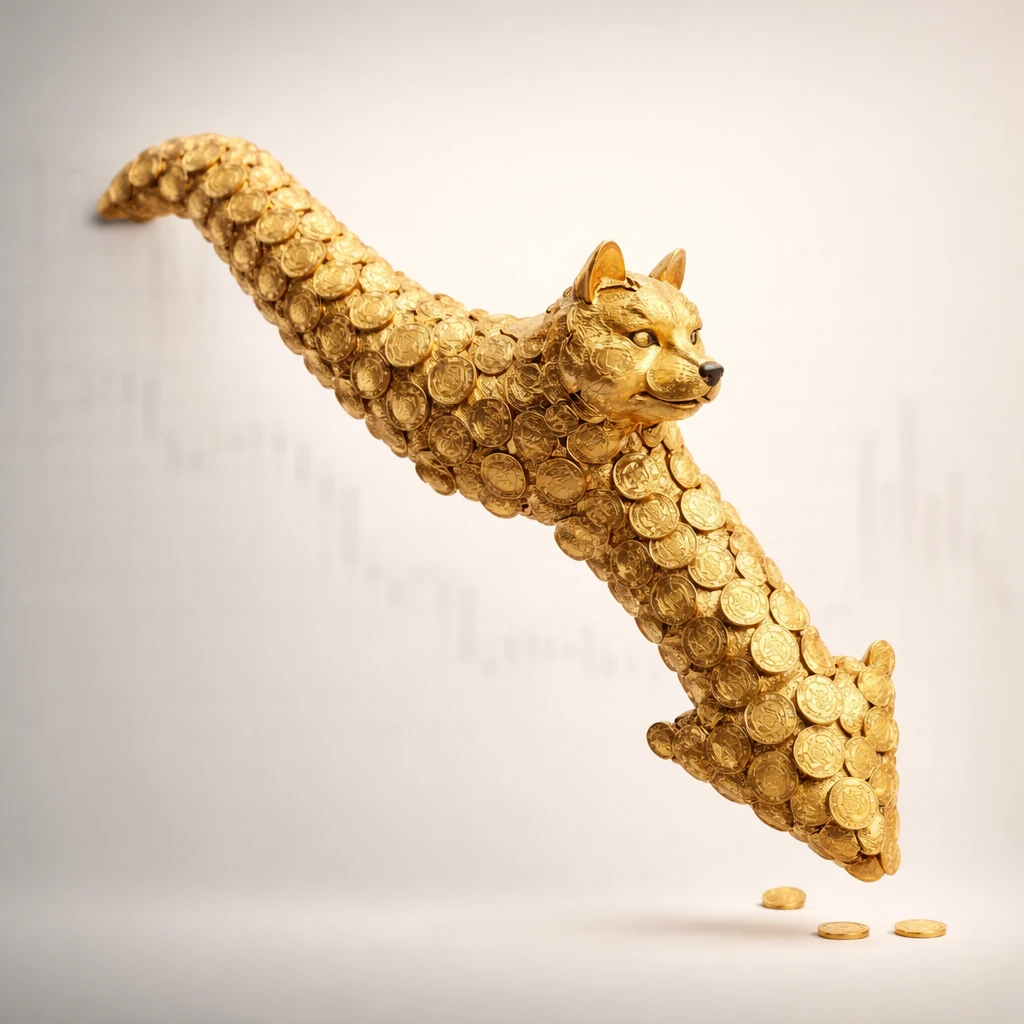

Assets typically appreciate in value for two principal reasons: either they generate income streams that can be reinvested, or their quantity diminishes while demand remains stable or increases. Meme coins, however, generally fail to satisfy either condition. Consequently, their prices often fluctuate in response to prevailing market attention and broader economic factors, rather than fundamentals.
Dogecoin (DOGE), a well-known meme coin currently trading near $0.15, exemplifies this dynamic. An analysis suggests that by the conclusion of 2026, Dogecoin's price may hover around $0.10. This projection is not a precise estimate but rather an indication of directional expectation based on current trends.
Recent Innovations and Their Limited Impact
A significant recent development in the Dogecoin investing landscape has been the introduction of spot exchange-traded funds (ETFs) dedicated to the coin, which debuted toward the end of 2025. These ETFs have been welcomed by investors, primarily because they enable exposure to Dogecoin without the need for a cryptocurrency wallet, thereby lowering barriers to entry.
The launch of these ETFs also functions as a marketing event, which can transiently bolster interest in meme coins, given their sensitivity to market sentiment. However, critical limitations exist concerning what ETFs can achieve regarding Dogecoin’s fundamental value.
Notably, ETFs do not catalyze new practical applications for Dogecoin. They neither limit the ongoing issuance of the coin nor provide mechanisms similar to a business model for generating revenue or capturing value. Without introducing substantial new utility or reducing supply growth, ETFs merely facilitate easier access rather than propelling sustained price appreciation.
Examining the Potential for Sustained Demand
For Dogecoin to diverge from being a speculative, sentiment-driven asset, it would require a consistent demand driver anchored in practical utility that incentivizes longer-term holding. Presently, such a driver remains elusive.
Proponents often cite ongoing or proposed ecosystem expansions, including projects aimed at improving the usability and integration of Dogecoin. One such initiative is GigaWallet, currently in beta, designed to simplify accepting Dogecoin payments within decentralized applications (dApps). While tools like GigaWallet may foster incremental adoption for transactional purposes, they do not inherently increase incentives to maintain sizable DOGE balances. Payments can already be executed through more established and feature-rich alternatives.
Other contemplated enhancements, such as establishing a sidechain capable of supporting smart contracts, face substantial competitive challenges. Given the availability of more mature ecosystems with advanced functionalities, a Dogecoin-branded platform struggles to present a compelling unique value proposition.
Projected Trajectory and Investment Considerations
In the absence of a clear, compelling impetus to break free from cyclic hype-induced volatility, Dogecoin is expected to undergo a gradual depreciation from approximately $0.15 to near $0.10 by the end of 2026. This forecast underscores the prevailing understanding that, without fundamental improvements or increased real-world utility, the coin's price will continue responding primarily to fluctuating market enthusiasm rather than intrinsic value growth.
Prospective investors should exercise caution, recognizing that Dogecoin currently lacks characteristics typical of assets with durable appreciation potential. The observed introduction of ETFs and ecosystem projects, while positive signals in terms of accessibility and utility attempts, are insufficient to materially alter the long-term price trend.