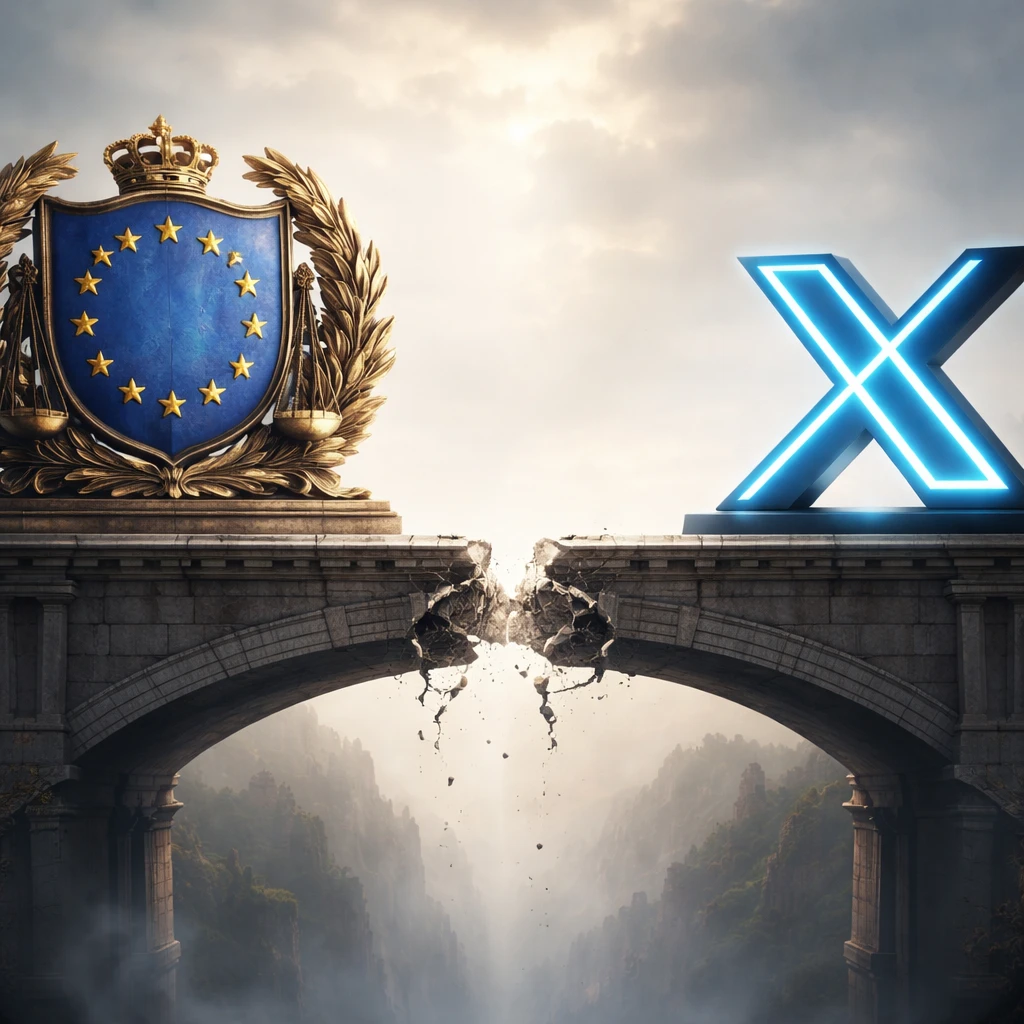

In a recent escalation of tensions between American tech leadership and European regulatory authorities, Elon Musk has publicly condemned the European Union's imposition of a $140 million fine on his social media platform, X. The sanction was levied following the EU's determination that X violated key provisions of the Digital Services Act (DSA), notably through the platform’s use of misleading design elements related to the blue checkmark verification system, insufficient transparency compliance, and failure to grant researchers adequate access to public data.
The fine, announced by the European Commission on Friday, sparked strong reactions not only from Musk but also from several senior officials aligned with the former Trump Administration, an administration historically at odds with European digital regulation efforts. These American figures framed the punitive action as a broader assault on freedom of expression, particularly targeting US-based technology companies operating within Europe’s jurisdictional reach.
Elon Musk’s immediate response included a dismissive comment beneath the European Commission’s announcement, labeling it as “bulls***.” Subsequently, on Sunday, he intensified his critique by advocating for the dismantlement of the European Union itself, arguing instead for a return to sovereignty centered on individual nation-states that could more effectively represent their populations.
Despite varying political perspectives and previous disagreements on other issues, Musk and officials from the Trump Administration have united in opposing European regulatory measures they perceive as overly restrictive or punitive towards American technology enterprises. Their collective stance emphasizes a conviction that such regulations impinge on the principle of free speech within digital platforms.
Conversely, the European Commission, which functions as the executive body of the European Union, maintains that the Digital Services Act fundamentally aims to ensure legality and transparency rather than to enforce censorship. Adopted in 2022, the DSA compels technology corporations, including US giants such as Meta and X, to actively remove unlawful content and disclose their content moderation policies. It empowers regulatory bodies to issue fines reaching up to six percent of a company’s global annual revenue for non-compliance.
Henna Virkkunen, the European Commission's tech policy chief, emphasized during press remarks that the Commission's priority is the enforcement of digital legislation and providing clear parameters that entities must follow to avoid sanctions. She underscored that the DSA’s objectives are not grounded in silencing speech, but in establishing transparent, accountable digital operations.
Attempts by TIME to obtain comment from both the European Commission and representatives of X were made but not immediately fulfilled.
The regulatory conflict occurs amid broader strains in US-European relations, extending beyond technology to issues such as immigration, free speech, and geopolitical concerns like the war in Ukraine. Members of the Trump Administration have recently voiced their opinions openly via social networks, interpreting the fine not merely as a regulatory action against X but as part of a perceived coordinated effort to undermine the American technology sector and its values.
Senator Marco Rubio condemned the European Commission’s fine in a social media post, characterizing it as an affront not only to X but to all American tech companies and, by extension, the American populace. Rubio insisted that any attempts at censoring Americans on the internet were unacceptable going forward.
Similarly, Federal Communications Commission Chairman Brendan Carr critiqued the EU’s decision, framing it as punitive for the success of an American company within the digital economy.
Notably vocal in this arena, Vice President J.D. Vance, who has cultivated relationships with Silicon Valley leaders, criticized the European regulatory approach prior to the announcement of the fine. Vance argued that rather than restraining American companies over minor infractions, the EU should be championing free speech rights. He has consistently condemned Europe’s regulatory stance during speeches and public communications.
In a pointed address at the Munich Security Conference in February, Vance labeled certain European regulatory actors as “E.U. Commission commissars,” castigating their efforts to limit social media during periods of civil disorder. He also criticized UK policies on conscience rights and rebuked European governments for what he perceived as a reluctance to confront their electorate’s concerns. Moreover, Vance identified immigration and the exclusion of far-right political parties as mounting threats to European stability, rather than external actors like Russia.
During that speech, Vance expressly defended Elon Musk amidst criticisms surrounding Musk's involvement in European political affairs. In particular, Musk's virtual appearance at a rally organized by the far-right Alternative für Deutschland (AfD) party in January, where he urged attendees to move past Germany’s historical role in the Holocaust era, drew international attention. Vance remarked that if American democratic institutions could endure sustained critique from figures like environmental activist Greta Thunberg, then European societies could withstand Musk’s confrontational style.
Following his Munich speech, Vance met directly with AfD leader Alice Weidel, underscoring his engagement with far-right European political circles.
The fine against X also coincides with the recent publication of a new US national security strategy, which revitalizes the Monroe Doctrine concept to resist European interference in American domestic matters. This document advocates fostering opposition within Europe to the current political trajectory of EU institutions.
The strategy and its language have drawn sharp rebuke from European political figures. Former Swedish Prime Minister Carl Bildt compared its rhetoric to Kremlin propaganda and claimed it positioned the US politically to the right of Europe’s extreme right-wing movements. Gérard Araud, a former French ambassador to the US, described the section dedicated to Europe as resembling a far-right manifesto, reinforcing the notion that the Trump Administration is antagonistic toward Europe.