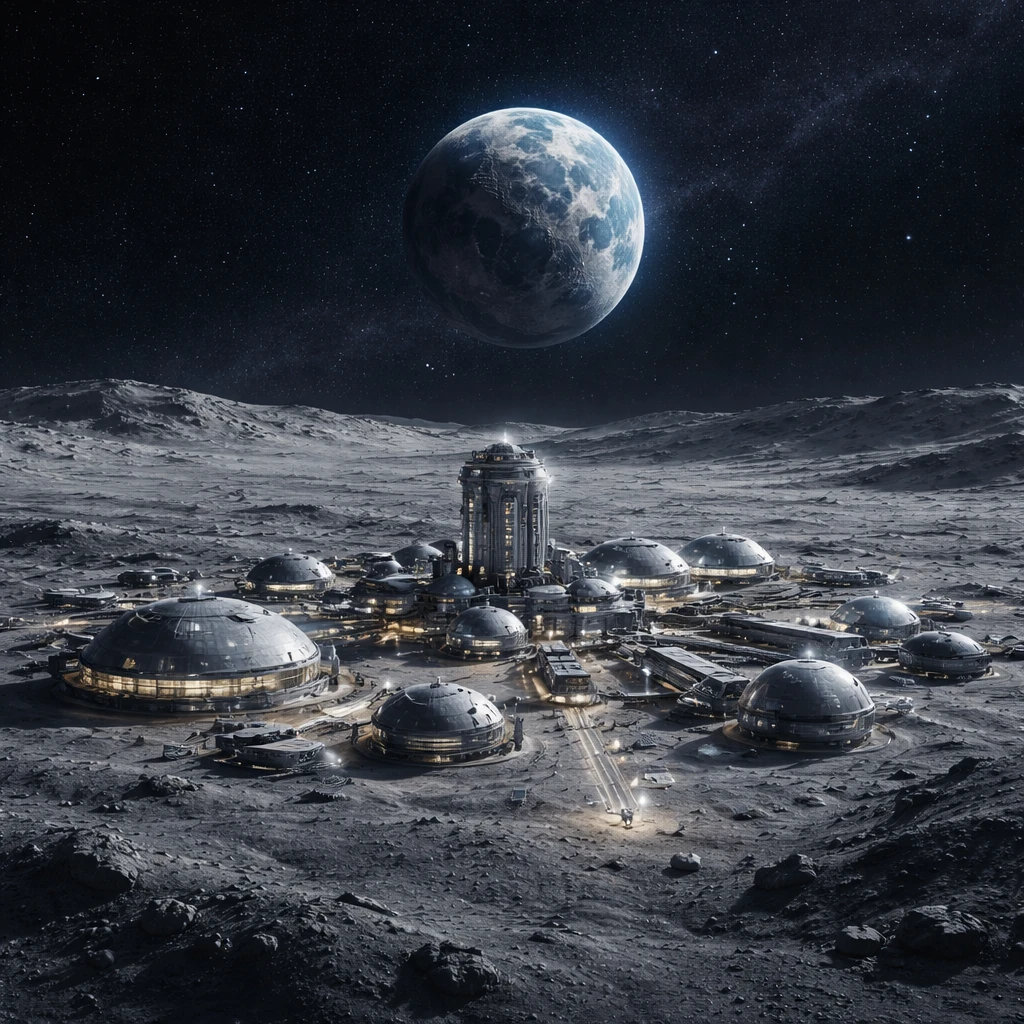

On Sunday, Elon Musk, the highly visible leader of SpaceX, revealed that the company has redirected its colonization efforts from Mars toward establishing a "self-growing city" on the Moon. He indicated this lunar endeavor could potentially be realized in under ten years, placing the Moon colony ahead in terms of execution feasibility.
While reaffirming SpaceX’s enduring commitment to Mars colonization, Musk emphasized the present imperative of securing humanity's future through a faster path—the Moon. He explained the rationale hinges on celestial mechanics and mission frequency, noting that with landings to Mars constrained to periods when Earth and Mars align every 26 months—resulting in a roughly six-month trip—progress there is considerably slower.
In contrast, lunar missions benefit from a significantly shorter travel time of about two days and launch windows opening every ten days. This rapid cycling dramatically enhances development velocity and iterative improvements necessary to build a viable settlement.
On the social platform X, Musk said, "The mission of SpaceX remains the same: extend consciousness and life as we know it to the stars." He conveyed that the Moon offers a practical interim target that aligns with the overarching goal.
This reconsideration of priorities marks a departure from Musk’s previous stances. Notably, as recent as January of the prior year, Musk dismissed lunar exploration as a distraction, asserting unequivocally that SpaceX was focusing exclusively on Mars.
SpaceX’s Mars ambitions have been foundational since the company’s inception in 2002. In 2016, Musk publicly presented plans envisaging a self-sustaining Martian city supporting around a million inhabitants, with initial crewed missions projected for 2024. The strategy involved launching rockets approximately every two years in sync with Mars-Earth proximity cycles.
At events and conferences through 2017, Musk reiterated optimistic timelines, suggesting human landings on Mars could occur as early as 2024, well ahead of NASA’s projections of 2034. Unmanned missions were anticipated as soon as 2022, though Musk acknowledged the aspiration involved significant challenges. His enthusiasm described the mission as among the most thrilling human endeavors.
Musk maintained confidence through subsequent years, estimating a manned Mars landing could be accomplished by 2026, or “maybe four years” if circumstances were especially favorable. He also reiterated plans for an uncrewed spacecraft launch within two years at that time.
In a 2021 interview with TIME magazine during his Person of the Year recognition, Musk reaffirmed expectations for landing humans on Mars within five years, amid skepticism from industry experts about the aggressive timeline.
More recently, in March 2025, Musk indicated on X that an uncrewed Starship mission to Mars was imminent, potentially paving the way for crewed missions that might commence as early as 2029, though he noted 2031 as a more probable date. By September 2025, Musk reasserted SpaceX’s long-term vision to establish a sustainable Martian colony possibly within 30 years.
TIME reached out to SpaceX to obtain remarks on Musk's latest projections and the shifted focus toward lunar settlement, but no additional comments have been furnished to date.
The announcement occurs against a backdrop of NASA’s plans to launch the Artemis II mission this year, which aims to send four astronauts on a crewed flyby around the Moon, marking humanity’s first deep-space crewed flight in over fifty years. Following Artemis II, the Artemis III mission is planned as a lunar landing operation building on previous missions’ successes.
SpaceX secured a nearly $3 billion NASA contract to develop the lunar lander known as Starship, the spacecraft designated to transfer crews from orbiting vehicles to the Moon’s surface. At present, the Starship lander remains in early developmental stages and has yet to achieve orbital flight.
Despite ongoing collaboration, Musk’s stance on lunar missions has sometimes been at odds with U.S. government priorities. He described lunar activities as a distraction in the previous year, contrasting with NASA’s renewed focus on Moon exploration.
Tensions surfaced late last year when Sean Duffy, a former NASA Administrator and then Secretary of Transportation under the Trump administration, hinted at possible shifts in the Artemis landing contract. He suggested opening up competition beyond SpaceX, citing the need to accelerate progress amid international space race concerns, particularly involving China.
Duffy explicitly mentioned intentions to allow additional companies to compete for lunar lander contracts in remarks on CNBC and Fox News in October 2025.
In related developments, Blue Origin, led by Jeff Bezos, announced a pause in its space tourism ventures to concentrate resources on NASA lunar projects. Although originally slated to contribute a lander for Artemis V planned no earlier than 2030, Blue Origin is now contending for the earlier Artemis III landing contract alongside SpaceX.
Bezos alluded to Musk’s moon city comments on X with imagery featuring a tortoise, symbolizing Blue Origin’s ethos of steady, relentless progress—"gradatim ferociter"—which differs markedly from Musk’s "fail fast" approach.