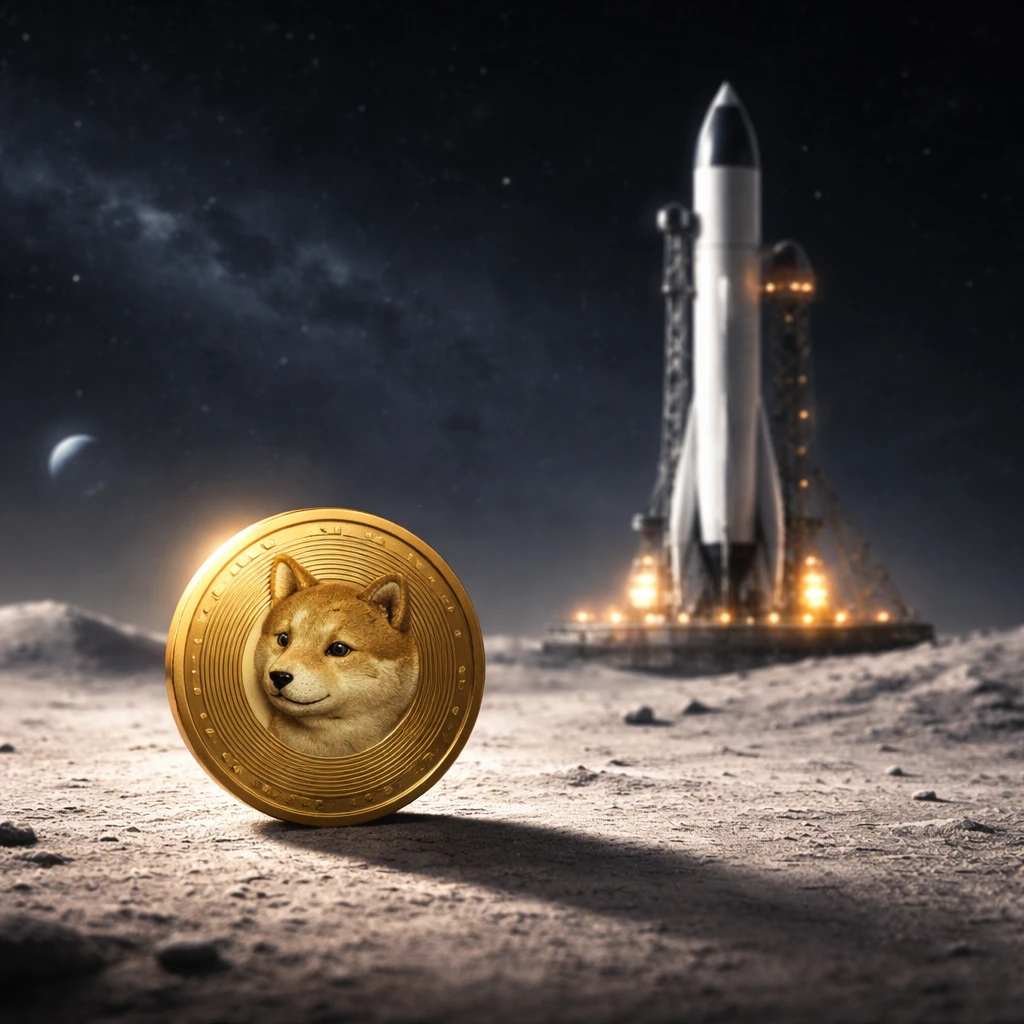

Elon Musk, the CEO of SpaceX and Tesla, recently sparked renewed interest in Dogecoin (dogecoin) by stating that SpaceX may place the cryptocurrency on the moon sometime next year. This comment followed a revived discussion on social media, where a 2021 Musk post about a literal Dogecoin being sent to the lunar surface was resurfaced. Prompted by inquiries regarding the timeline, Musk responded with "maybe next year," and affirmed the inevitability of the event when engaged by other users.
Initial market reactions to Musk's remarks were positive, with Dogecoin experiencing an intraday price increase exceeding 4%. This outperformance, relative to flagship cryptocurrencies Bitcoin and Ethereum, suggested renewed investor enthusiasm. However, the crypto market's broader weakness soon overwhelmed these gains, resulting in a roughly 5% price drop for both Dogecoin and Shiba Inu by day's end.
The mentioned lunar mission corresponds to the "DOGE-1" satellite project initiated by Canadian entity Geometric Energy Corporation. This undertaking, fully financed via Dogecoin, was initially slated to launch aboard a SpaceX Falcon 9 rocket by late 2023. Nonetheless, multiple delays have postponed the timeline considerably. Geometric Energy Corporation's CEO, Samuel Reid, now anticipates a launch window in the latter half of 2026, pushing expectations well beyond the immediate future.
Assessing Dogecoin's price action reveals critical technical considerations. The cryptocurrency is currently testing a key psychological support level near $0.10. A decisive move below this threshold could trigger intensified selling pressure, potentially depressing prices toward the $0.08 to $0.09 range. Presently, Dogecoin trades beneath all major exponential moving averages (EMAs), including the 20-day EMA at approximately $0.11988, the 50-day EMA near $0.13044, the 100-day EMA around $0.14650, and the 200-day EMA at $0.16834. This positioning situates Dogecoin in a so-called "death zone," where numerous resistance layers may inhibit upside momentum.
Furthermore, a descending trendline intersecting roughly between $0.12 and $0.13 compounds the difficulty for Dogecoin to rally. The Parabolic SAR indicator, positioned around $0.11916, corroborates the continued downward trend. Analysts suggest that a definitive reversal would necessitate breaking above the descending trendline and reclaiming price territory between $0.13 and $0.14—levels yet to be achieved given current market pressures.
In comparison, Shiba Inu, a fellow meme token, faces even more pronounced technical challenges. It declined approximately 5% and is encountering significant selling pressure. The Supertrend indicator, positioned at $0.00000806, represents a resistance level about 23% higher than current prices, emphasizing bearish sentiment. Like Dogecoin, Shiba Inu tests critical support at roughly $0.000007—a level with historical significance as a psychological floor. Failure to maintain this support could see the token dropping further to between $0.000005 and $0.000006, the next notable support zone.
The downward trend for Shiba Inu is reinforced by the confluence of a descending trendline and the Supertrend resistance, offering a dual barrier against price recovery. Any attempted upward movement is likely to encounter immediate resistance near $0.00000754 and subsequently at the Supertrend level, complicating short-term rebound prospects.
Overall, both tokens face considerable headwinds amid the broader cryptocurrency market weakness, despite sporadic optimism fueled by Musk's statements and ongoing lunar mission plans. While theDOGE-1 satellite project remains a unique and innovative application of cryptocurrency funding and promotion, delays have tempered immediate investor excitement. Until technical barriers are overcome and a clearer timeline for the mission emerges, Dogecoin and Shiba Inu may continue to experience volatility and downward pressure.