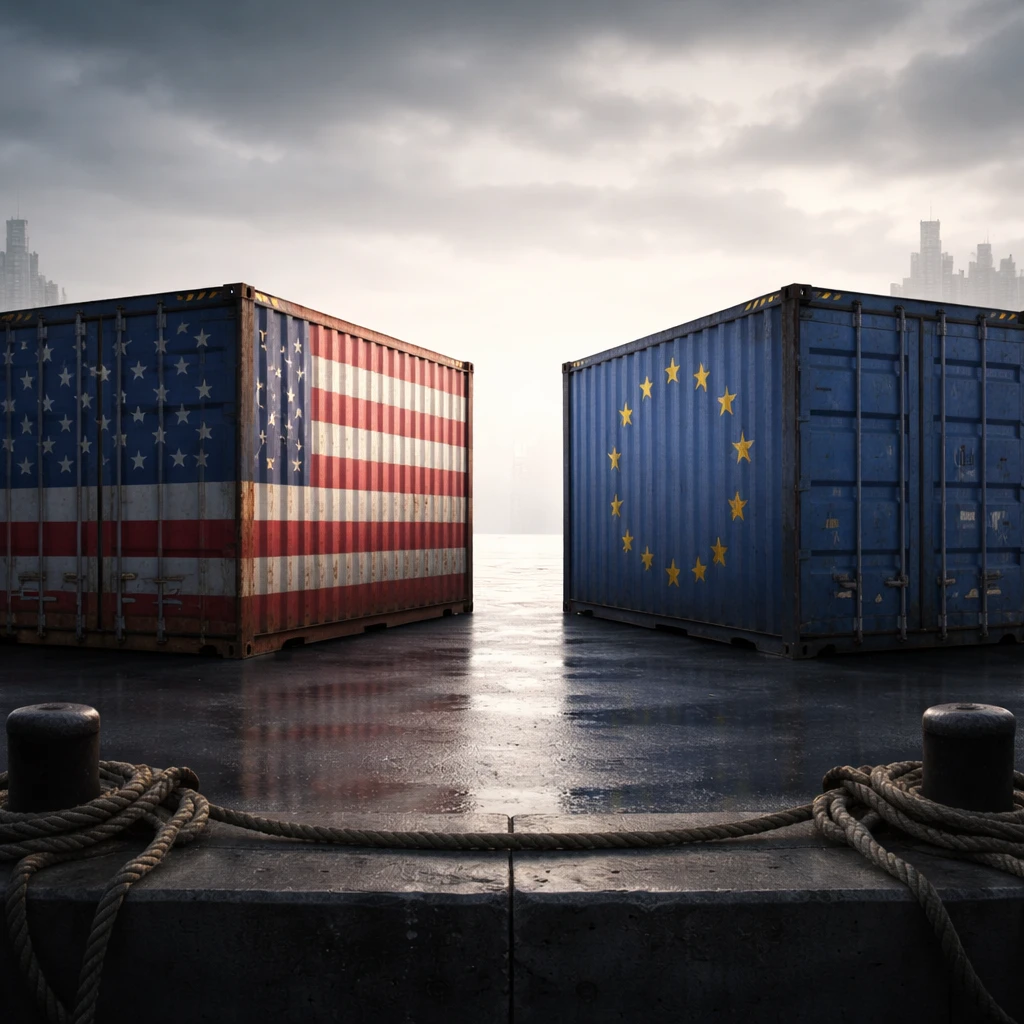

President Donald Trump intensified trade tensions by declaring on Saturday a 10% tariff on imports from Denmark, Finland, France, Germany, the Netherlands, Norway, Sweden, and the United Kingdom, set to begin February 1. He further threatened to raise this tariff to 25% if an agreement on Greenland, emerging from recent geopolitical contention, is not reached by June 1. This announcement has triggered an immediate and strong response from European nations, prompting an emergency meeting of their representatives on Sunday.
Following the tariffs announcement, French President Emmanuel Macron called on the European Union to invoke its ‘‘anti-coercion instrument,’’ informally termed the ‘‘trade bazooka.’’ This mechanism could enforce retaliatory measures against the United States, potentially blocking American companies' access to EU markets or imposing export restrictions on US products. Notably, Erica York, vice president of federal tax policy at the Tax Foundation, observed that this trade defense tool was designed with adversaries such as China in mind rather than allied nations like the US.
Moreover, the European Union is evaluating activating approximately €93 billion in retaliatory tariffs against American goods, a response deferred last year following a temporary trade truce with the US. These developments underscore the willingness of some European leaders to adopt a firm stance. Carsten Brzeski, global head of macro research at ING, noted that this escalation introduces significant uncertainties around investment decisions and export business with the US—an environment previously linked to stalled hiring in US companies during 2025 amid fluctuating tariff policies.
Brzeski projects that these tariff hikes could reduce European gross domestic product (GDP) by approximately 0.25% this year. He emphasized Europe’s ongoing economic and security interdependence with the United States, suggesting that worsening relations would inflict economic damage on both sides.
Implementation of the EU’s ‘‘trade bazooka’’—including possibilities such as suspension of US company licenses or taxation of American services—may require several months to materialize, according to Dan Hamilton, senior non-resident fellow at the Brookings Institution. Hamilton cautioned that Trump’s intensified tariff threats risk undermining trade arrangements established between the US and both the UK and the EU last summer while further straining relations with America’s closest allies.
While the EU enacted the trade agreement with the Trump administration, the accord lacks formal ratification. Although some political figures, including German Chancellor Friedrich Merz, supported the deal to avoid significant tariff escalations, many European leaders criticized the agreement upon its announcement. Trump’s recent tariff action casts doubt on the accord’s future viability. Notably, Manfred Weber of the European Parliament publicly stated that approval of the US-EU trade agreement is currently untenable given Trump’s Greenland-related tariff threats.
Economists warn that these actions degrade the credibility of American commitments, potentially generating adverse effects on the global economy, as indicated by Steven Durlauf, a University of Chicago policy professor. In 2024, American trade volumes included $236 billion in goods with Germany, $147.7 billion with the United Kingdom, $122.27 billion with the Netherlands, $103 billion with France, and substantial amounts with Sweden, Norway, and Finland.
However, Trump’s targeted tariffs are limited to selected European nations rather than the entire EU bloc. This selective approach opens a potential loophole, as goods could be rerouted through other EU member countries unaffected by the tariffs thanks to internal free trade provisions, thus circumventing the imposed duties. Joseph Foudy, a professor at New York University’s Stern School of Business, highlighted the ease with which goods can be shipped across EU borders to avoid tariffs levied on individual states.
The initial 10% tariff hike may not drastically disrupt economic activity immediately; however, the long-term repercussions of diminished trust and strained relationships with key trading partners pose serious concerns. The persistent uncertainty regarding whether tariffs will escalate further or be withdrawn may prompt trading partners to solidify alternative alliances, thereby limiting future trade with the United States.
Durlauf noted that uncertainty stifles growth and that the unprecedented nature of Trump’s tariff policies could cause damage that remains even after a potential change in administration. Furthermore, any tariffs imposed under these emergency powers might face legal challenges, with a Supreme Court decision on their legitimacy anticipated.
Meanwhile, the United States’ closest trading partners are actively strengthening their own trade ties elsewhere. For instance, Canada recently celebrated a ‘‘strategic partnership’’ with China, easing tariffs and allowing Chinese electric vehicles to enter the Canadian market. Concurrently, the EU concluded a long-standing trade deal with South America’s Mercosur after 25 years of negotiations.
Foudy warned that efforts to acquire Greenland through aggressive trade and geopolitical actions might ironically alienate America’s most important allies. He suggested these policies could embolden adversaries and weaken American export competitiveness. He further pointed out that tariff uncertainty leads companies to postpone investment decisions, resulting in the loss of potential economic opportunities. The fluctuating tariff rates create a challenging environment, ultimately leading to factories not being built due to corporate hesitation.