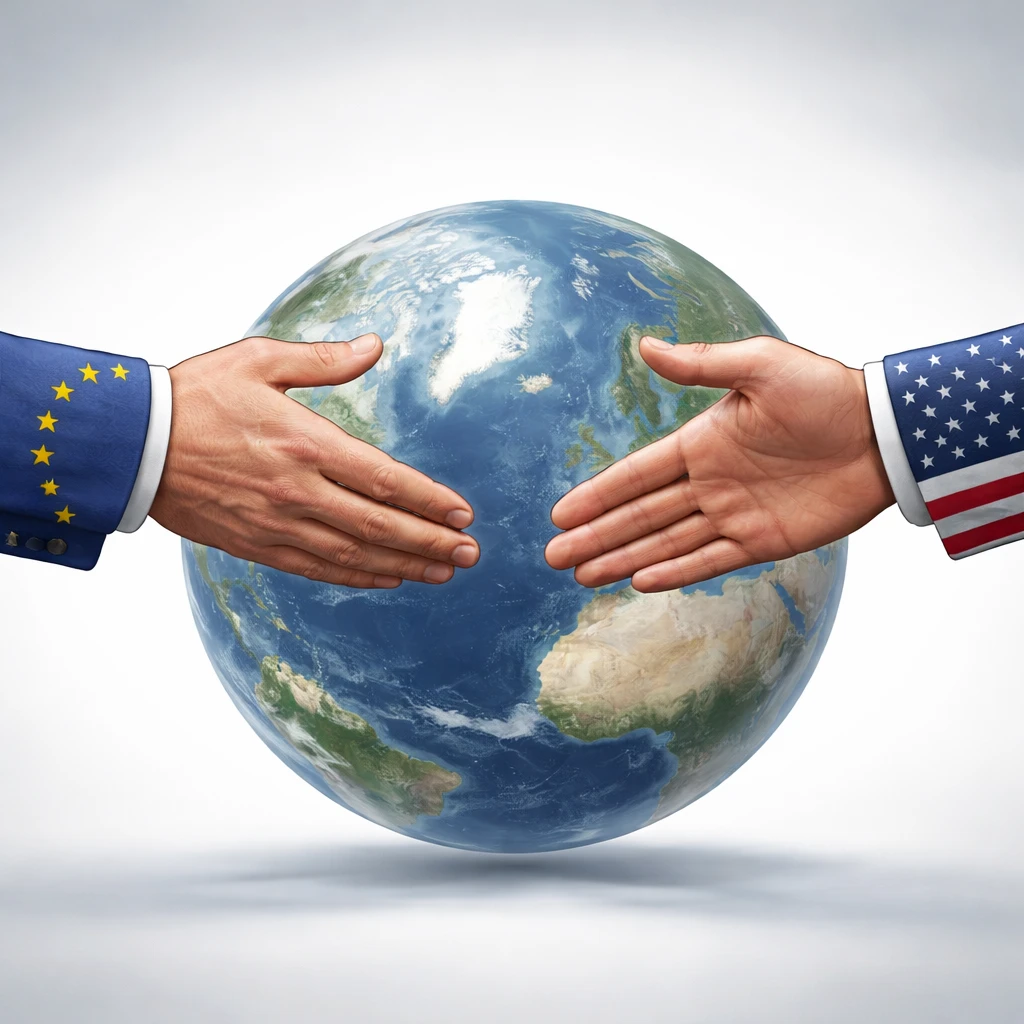

European Union efforts to ratify a pivotal trade agreement with the United States were effectively frozen on Wednesday when members of the European Parliament declined to advance the vote. This decisive action followed recent pronouncements by US President Donald Trump concerning his intention to potentially acquire the Arctic territory of Greenland and warnings to impose extra tariffs, possibly up to 35%, on nations opposing his strategy.
Bernd Lange, who leads the Parliament's trade committee, publicly announced the suspension of the US-EU trade pact, describing the deal as "on ice indefinitely" via his message on the social media platform X. The full consequences for the comprehensive trade agreement remain ambiguous; it is uncertain whether the entire deal has been terminated or if some portions, particularly those already activated, will persist as initially agreed. The preliminary agreement, reached in July, envisaged a tariff framework featuring 15% duties on European Union exports destined for the US market, with initial components entering into effect prior to the formal signing.
President Trump, addressing the World Economic Forum held in Davos, Switzerland, denied intentions to use military force to seize Greenland. Nevertheless, he reiterated a strong desire for Europe to cede Greenland to the United States, emphasizing his eagerness to negotiate the purchase price. Lange clarified the President's position, noting, "He wants to have Greenland as part of the United States as quick as possible, and he wants to have a table where we could discuss about the price he wants to buy." These statements have introduced significant diplomatic strain amid ongoing trade discussions.
Beyond tariff terms consisting of a 15% rate on certain EU exports, the deal also included commitments from the EU side to increase its procurement of American agricultural and energy commodities. Lange accused the United States of breaching these agreements by issuing threats of supplementary tariffs, asserting that such threats preclude finding a mutual compromise. He specified that the suspension of negotiations would remain in place "until the threats are over, so there will be no possibility for compromise." Despite this impasse, there is an indication that the EU intends to uphold its acquisitions of American military and energy products as outlined in the pact.
The controversy has also provoked diplomatic responses across Europe. A protest in Nuuk, the capital of Greenland, called for the island's right to determine its own fate in light of US acquisition demands. In response to the tariff threats linked to Greenland, an emergency summit involving representatives from various European countries convened over the weekend. French President Emmanuel Macron reportedly urged the European Union to deploy its anti-coercion mechanism, informally termed the "trade bazooka," which could enable actions such as revoking US company licenses within the EU or levying taxes on US-based services.
Trade volume between the United States and the European Union neared $1 trillion in 2024 according to statistics provided by the US Commerce Department, underscoring the economic weight of this relationship. Analysts recognize that a trade conflict arising from these political disputes would carry potentially profound ramifications for both economic blocs. EU leadership has scheduled a meeting in Brussels on Thursday to deliberate possible retaliatory measures should President Trump's tariff threats materialize.
Nonetheless, the actual enforcement of additional tariffs by the US administration is complicated by ongoing legal challenges. Currently before the US Supreme Court is a case contesting the legitimacy of President Trump's broad tariff policies. The timing and nature of the Court's imminent ruling are expected to play a critical role in determining the President's capacity to implement new levies.
This development represents a complex intersection of geopolitical aspirations and trade diplomacy, creating uncertainties that reverberate through international economic relations. The unfolding situation will be closely monitored as policymakers on both sides seek to navigate these challenges.