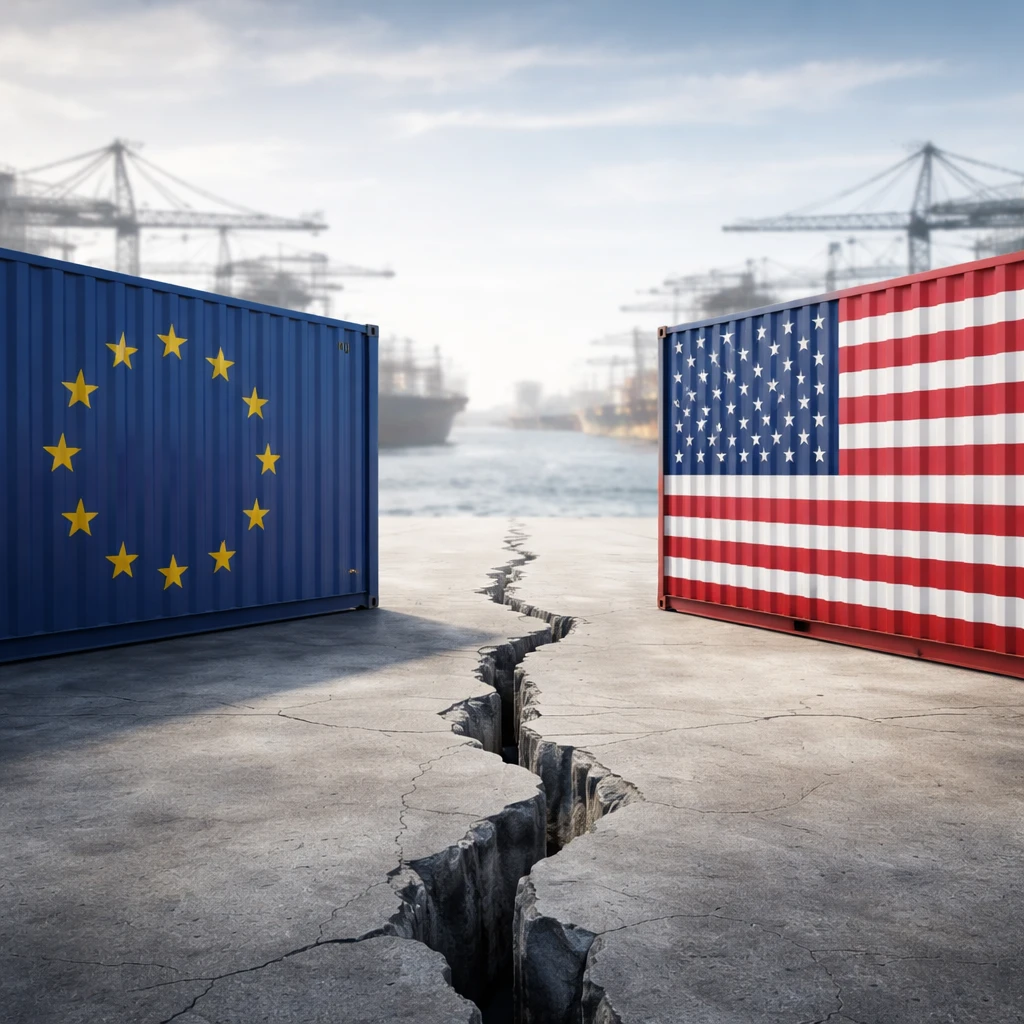

The ratification process of a significant trade agreement negotiated between the European Union and the United States is encountering substantial obstacles as the European People's Party (EPP), the largest faction within the European Parliament, announced it cannot presently endorse the accord. This outcome arises amid fresh tariff threats from the U.S. administration directed at nations supporting Greenland amid ongoing disputes with Washington.
Manfred Weber, the president of the EPP, conveyed via social media that "approval is not possible at this stage," indicating that any intended reductions of tariffs on American products proposed under the agreement must be suspended. This stance by the EPP signals a critical impasse in the ratification process, which is essential for the full enactment of the trade deal.
The agreement, initially established last summer through dialogues between European Commission President Ursula von der Leyen and then-U.S. President Donald Trump, has seen limited implementation to date but still depends on backing from the European Parliament to become fully operative. There has been longstanding skepticism among Members of the European Parliament regarding the agreement, with critics asserting that the pact disproportionately benefits U.S. interests.
Concerns escalated considerably after Washington broadened a 50% tariff originally applied to steel and aluminum to encompass hundreds of additional products exported by the EU following the signing of the accord in July. This move has aggravated tensions and fueled opposition to the trade deal among EU representatives.
Von der Leyen has publicly defended the agreement, characterizing it as a necessary measure to avert a more expansive trade war between the transatlantic partners. Nevertheless, opponents contend that the deal falls short in securing sufficient reciprocity or concessions from the United States. Additionally, a collective of left-leaning lawmakers within the Parliament stand firmly against the arrangement. Should they align with the EPP, they might generate enough votes to postpone or block the agreement's approval.
European leadership has responded strongly to the recent threats tying U.S. tariffs to Greenland issues, emphasizing solidarity and the defense of national sovereignty. Von der Leyen supported Denmark's decision to conduct an Arctic military exercise, describing it as non-aggressive, and cautioned that imposing tariffs could damage the broader transatlantic relationship. She advocated for ongoing diplomatic engagement with the United States to resolve differences.
Kaja Kallas, the EU foreign policy chief, highlighted that divisions among European allies serve the strategic interests of China and Russia. She urged that NATO take the lead in addressing security matters related to Greenland and warned that retaliatory tariffs would adversely impact both European and American economies.
From France, President Emmanuel Macron reiterated his country's commitment to national sovereignty and support for Ukraine. He defended French participation in the Greenland exercise, rejected any attempts at intimidation by external parties, and underscored that Europe would coordinate a collective response to safeguard its interests.
The evolving situation introduces considerable uncertainty regarding the future of the EU-U.S. trade agreement. The lack of parliamentary approval coupled with tariff escalation and geopolitical tensions creates an environment where the pact's full implementation may be postponed indefinitely.
Key Points:
- The European People's Party has withdrawn support for the EU-U.S. trade agreement approval at present due to recent U.S. tariff threats.
- The trade deal, partially enacted following its signing last year, still requires European Parliament ratification to become fully effective.
- Washington expanded tariffs to include numerous EU products post-agreement, intensifying opposition among EU lawmakers.
- EU leaders uphold sovereignty and unity in response to tariff threats related to Greenland and advocate for diplomatic solutions.
Risks and Uncertainties:
- The potential for the European Parliament to delay or block the trade agreement could stall or derail the pact’s full implementation.
- Escalating tariffs risk undermining transatlantic trade relations, with possible negative economic impacts on both sides.
- Geopolitical tensions surrounding Arctic security and Greenland may complicate further diplomatic negotiations.
- Internal divisions within the European Parliament may prevent consensus, prolonging uncertainty about the trade deal’s fate.