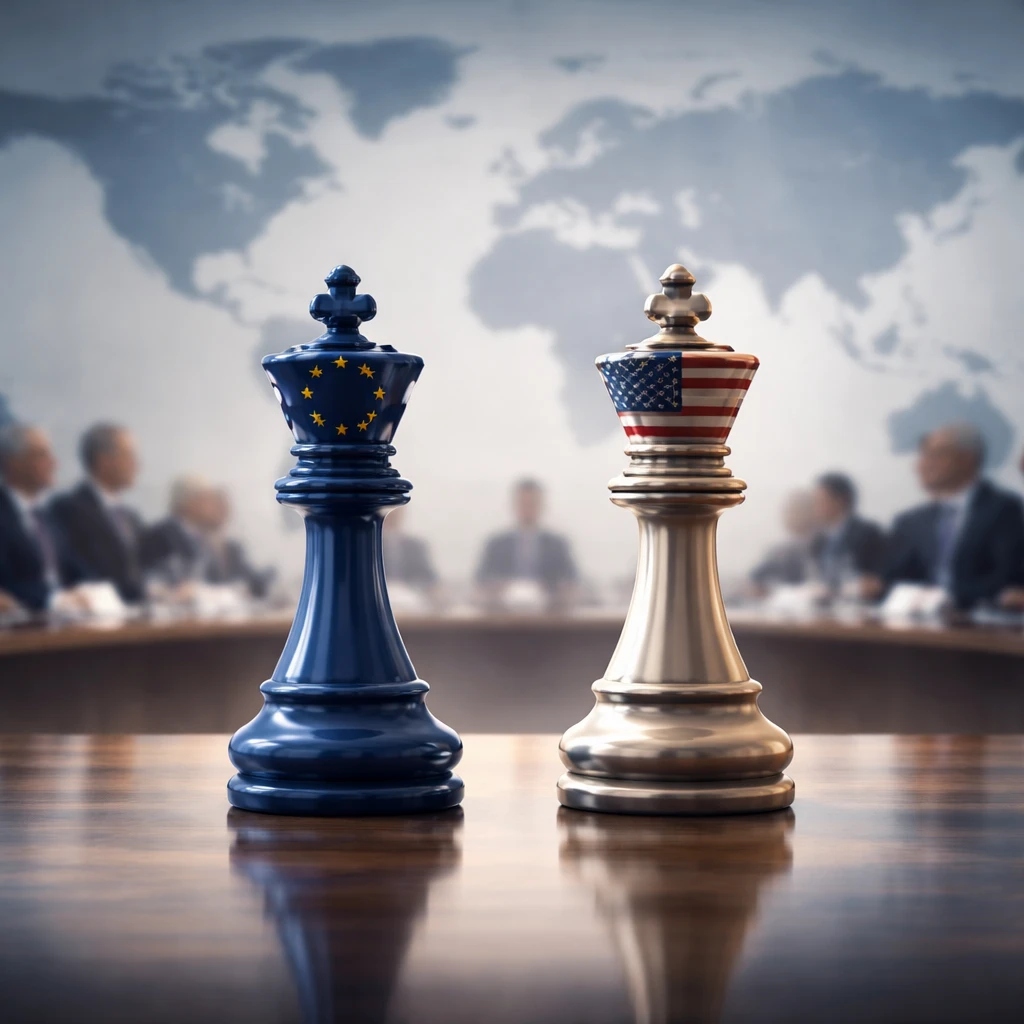

During a key international gathering in Davos, Switzerland, U.S. President Donald Trump delivered a fluctuating message that captured attention and stirred unease among European leaders. After weeks of aggressive trade posturing, including threats of additional tariffs aimed at America's European allies, Trump abruptly announced the cessation of such threats, citing the establishment of a "framework for a future deal with respect to Greenland." However, this development was marked by vagueness and a lack of concrete detail, leaving many participants puzzled about the true substance and durability of the purported agreement.
The announcement followed a pattern reminiscent of President Trump's recent diplomatic style, characterized by initial confrontation followed by a rapid retreat. This phenomenon, colloquially described as the president's tendency to threaten significant economic actions only to retract them, appeared once more when he declared an end to tariff threats after negotiating with NATO leadership, signaling a pause in escalating trade tensions.
The Danish government, whose sovereignty includes Greenland, expressed cautious relief through its foreign minister who welcomed the news that the United States would not pursue a forceful acquisition of the territory and that the planned trade disputes had been suspended. Nonetheless, this reassurance was delivered amid ongoing uncertainty about the nature and implications of the "framework" Trump referenced, which he described during a CNBC interview as "pretty much a concept of a deal" encompassing security and other unspecified matters.
U.S. financial markets reacted favorably to the softer tone, with the S&P 500 index experiencing a notable rally after a prior steep decline. This volatility underscored the deep interconnection between political developments and economic confidence. However, the optimism in the equities market has not translated into enthusiasm among European officials, many of whom regard such announcements with skepticism due to the inconsistency of the administration's trade policy and the repeated pattern of threat followed by withdrawal.
Throughout the preceding year, Trump's approach to tariffs has featured multiple instances where aggressive measures were proposed but then scaled back or abandoned altogether. Examples include the drastic reduction of "Liberation Day" tariffs following adverse bond market reactions, an unimplemented suggestion of a 200% tax on European wine imports, and fleeting considerations of tariffs on foreign-made films that failed to materialize. Moreover, before the discussions about Greenland gained prominence, preliminary trade negotiations with the European Union were underway but effectively derailed by new threats from the U.S. side involving tariff impositions.
On the day he relayed the Greenland-related concession, President Trump initially arrived in Davos with a contentious speech. He criticized European reliance on renewable energy sources and repeatedly confused the identities of Greenland and Iceland. His rhetoric included renewed tariff threats tied to the European response to his territorial ambitions in Greenland. This stance provoked a direct response from the European Parliament, where leaders publicly announced an indefinite suspension of prior trade negotiations, citing frustration over what they described as "tariff bullying." Bernd Lange, chair of the parliament’s international trade committee, emphasized that sovereignty and territorial integrity were non-negotiable and declared that "business as usual" with the United States was no longer possible.
The discord highlights fundamental differences in negotiation styles and expectations. James Angel, an associate professor specializing in international business, articulated the contrast between Trump's background in real estate deals and the complex realities of international diplomacy. He noted that while high-stakes property transactions tolerate aggressive bargaining because alternatives always exist, such tactics have far-reaching diplomatic repercussions when applied to established nations with enduring political and military institutions. He underscored that countries like Canada and Mexico, as well as European nations, remember such interactions long after they occur.
Observers at Davos are grappling with the broader consequences of the United States’ unpredictable behavior under Trump's leadership. With many U.S. allies perplexed and increasingly alienated, questions arise regarding the future of enduring transatlantic relationships and international cooperation. Yaroslav Trofimov, The Wall Street Journal's chief foreign-affairs correspondent, captured the sentiment by describing the reactions among partners as stark and at times publicly expressed, pointing to a perception that America’s conduct appears irrational and signals a profound fracture in longstanding alliances.
In sum, the recent developments surrounding the Greenland dispute and fluctuating trade policy underscore an ongoing challenge for U.S. allies: reconciling the volatile and often contradictory signals emanating from Washington with the steady demands of international diplomacy. The episode at Davos exemplifies the difficulties in maintaining trust and collaboration when foundational ideas about negotiation and agreement-remaking diverge sharply between parties.