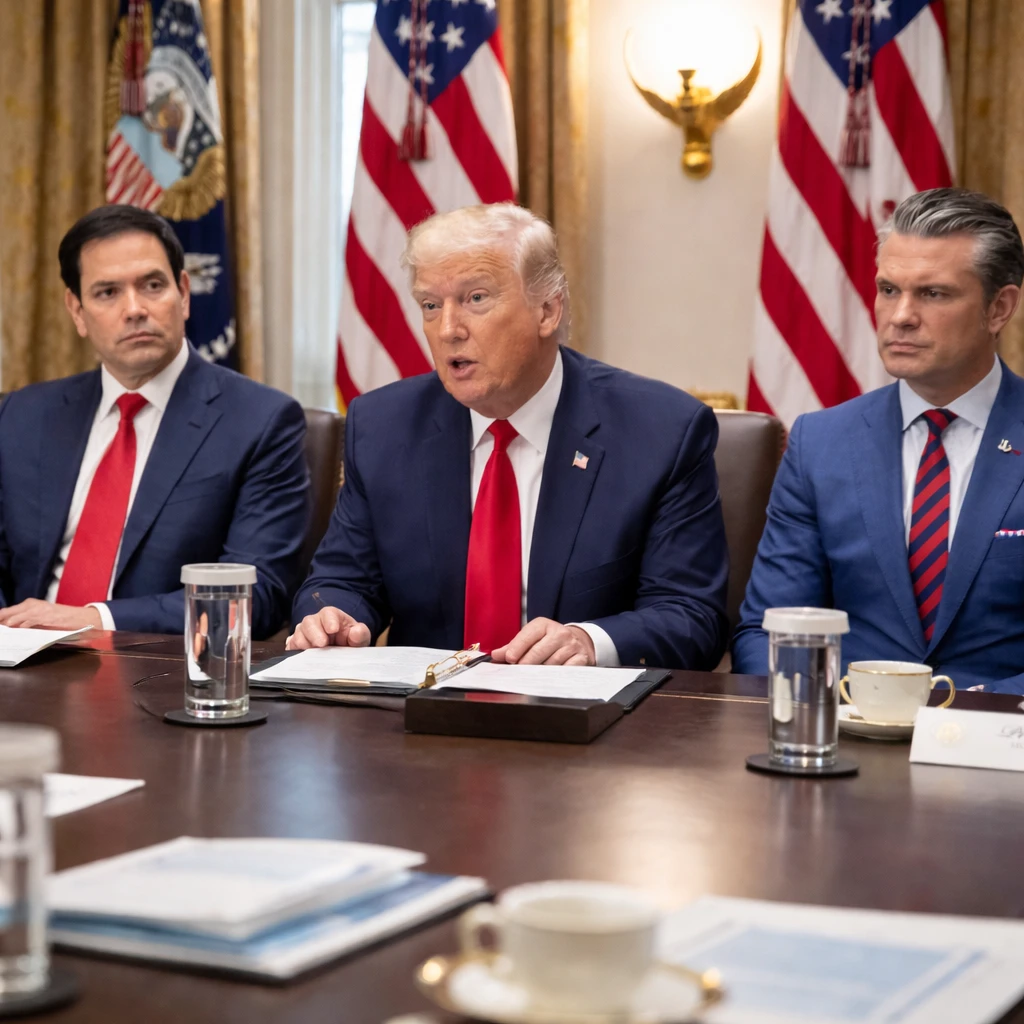

The President convened his initial Cabinet meeting for 2026 on Thursday, emphasizing progress linked to economic growth, housing, energy policies, public health initiatives, and drug pricing. Although the administration projected a favorable overview of its accomplishments, a closer examination of some remarks by the President and other officials reveals discrepancies with factual data.
Assessing Investment Figures
The President declared that $18 trillion is currently being invested domestically. Yet, no concrete evidence has been furnished to corroborate this claim. Public disclosures from corporations, statements from foreign governments, and figures presented on the White House's own platforms indicate that this dollar amount is an overestimate, likely speculative, and substantially exceeds verifiable investment sums.
According to the White House website, a markedly lower figure of $9.6 trillion is cited, a number that appears to include some commitments made during the preceding administration. Moreover, a recent study has cast doubt on the likelihood that more than $5 trillion in investment pledges from significant U.S. trade partners last year will come to fruition, as well as questioning the allocation strategies if realized.
Housing Market Overview
Scott Turner, Secretary of Housing and Urban Development, attributed a sharp increase in home sales during December to the current administration's policies, stating these figures reached their strongest in three years. Analyzing the data from the National Association of Realtors confirms a seasonally adjusted annual rate of 4.35 million home sales for December, described as nearly a three-year high by the group. However, this represented only a modest 1.4% increase compared to the prior year, signaling tempered growth in the real estate sector.
The increase may be a transient peak, as pending home sales reportedly declined by 3% year-over-year in December. The administration's approach to maintaining higher home prices is designed to enhance household net worth but may inadvertently suppress new construction activity and limit access for first-time buyers.
Wildfire Recovery and Permitting Challenges
The President criticized local authorities for slow permitting of housing reconstruction following the extensive 2025 wildfires in the Los Angeles area, indicating that only a few homes have been rebuilt despite thousands destroyed. Subsequent executive actions direct federal agencies to facilitate an alternative permitting process, including a self-certification method to comply with health, safety, and building standards, circumventing traditional state and local procedures.
Data from Los Angeles county and city records show that approximately 3,100 permits have been issued in the affected fire zones, with close to 900 homes actively under construction. While only a limited number of residences have been fully rebuilt, the current pace indicates ongoing recovery efforts.
California's Governor has publicly responded, highlighting the rapid movement of local officials and urging federal approval of the state's nearly $34 billion disaster aid request. Survivor advocacy groups note that permit acquisition is not the primary bottleneck; many households face significant obstacles related to insurance payouts and funding shortfalls relative to rebuilding costs. Historical patterns suggest that permitting processes after major wildfires typically intensify around 18 months post-incident, with cleanup and applications preceding permit issuance by roughly six months.
Water Management During Wildfires
The President attributed wildfire impacts to a failure to release abundant water from the Pacific Northwest, implying that such action could have mitigated fire damage. This assertion conflicts with established infrastructure facts; California's water supply primarily originates from in-state sources, flowing through river systems and man-made canals that are not connected to the Pacific Northwest water system.
Instances of local Los Angeles fire hydrants running dry were reported, but officials attribute these outages to the municipal system's inability to accommodate the scale of the disaster rather than water supply deficits. An executive order cited for facilitating water delivery early in the administration's term directed water to a dry lake basin located over 100 miles from Los Angeles, challenging the claim of timely provision of firefighting water.
Additional Claims and Context
The President also asserted unprecedented accomplishments in foreign conflict resolution, specifically referencing the cessation of eight wars in his first year. This claim overstates the administration's impact, as historical contexts and outcomes are more nuanced.
Regarding energy policy, the President emphasized the production of "clean, beautiful coal," alluding to improvements in coal production methods. While coal mining has indeed become cleaner compared to earlier eras, it remains environmentally impactful rather than fully "clean." Additionally, comments about China's wind energy sector suggested a disconnect between manufacturing and domestic utilization of wind turbines. In reality, China leads the world in wind turbine production and is rapidly expanding its wind farm installations.
Collectively, these statements reflect a mix of aspirational messaging and data misrepresentations, with tangible implications for industries such as real estate development, energy infrastructure, disaster recovery, and international trade relations.