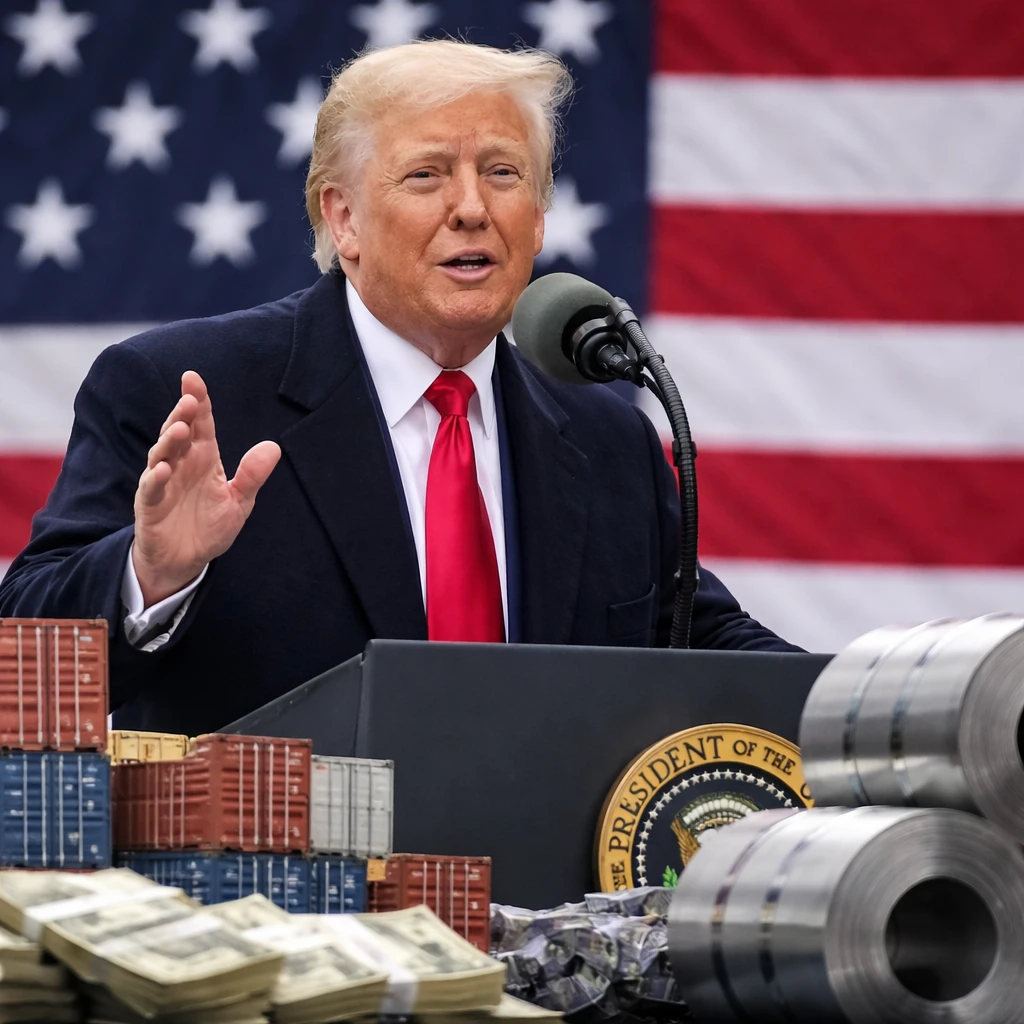

In assessing the unfolding economic trajectory during President Donald Trump's second year in office, the president has credited his tariff policies for revitalizing the American economy. He stated in a recent editorial that despite criticism from economists predicting that tariffs would elevate prices and stunt growth, the measures have instead fostered a so-called "American economic miracle." An examination of empirical evidence, however, offers a more complex picture.
GDP Growth Context
Trump’s repetitive characterization of the U.S. economy as "dead" before his tenure and now the "hottest" globally overlooks key details. Before his return, the economy was not stagnant but demonstrated steady activity. From 2021 through 2023, even amidst challenges, the U.S. maintained robust economic expansion, with inflation-adjusted GDP in 2024 climbing 2.8% — outperforming all wealthy nations except Spain.
However, 2025's initial quarterly data reflect mixed outcomes linked to tariffs. The first quarter saw GDP contraction due largely to a sharp rise in imports; this surge was triggered by domestic firms accelerating purchases ahead of impending tariffs—a factor subtracting from GDP calculations. Subsequently, the economy gained momentum, achieving 3.8% growth in the second quarter and 4.4% in the third, buoyed by diminished imports and sustained consumer spending.
Stock Market Performance
President Trump highlights unprecedented stock market highs with 52 milestones reached in 2025; while accurate, the S&P 500’s 17% increase lags considerably behind pronounced gains in several foreign markets—South Korea, Hong Kong, Japan, Germany, and the UK all recorded significantly larger upticks.
Inflation Measurements
The president asserts that annual core inflation has plummeted to 1.4% over the past three months, a figure he claims few anticipated. However, this statistic excludes food and energy prices and is impacted by data irregularities caused by a government shutdown in October and November that led to estimations dampening reported inflation levels. A longer view shows core inflation averaging 2.6% during the latter half of 2025, consistent with prior levels, suggesting stabilization rather than dramatic reduction.
While inflation levels have refrained from surging as dramatically as feared amid tariff impositions, this is partially attributable to the rollback, reduction, or exemption from duties on items such as coffee, beef, and kitchen cabinets in response to affordability concerns raised during last year’s elections.
Price analyses exclude volatile components to gauge "core goods" inflation. Normally stable or declining, core goods costs increased by 1.4% as of December 2025 — the largest jump since 2011 outside pandemic effects—underscoring tariff influence on price pressures.
Harvard economist Alberto Cavallo’s research, cited for supporting tariff benefits, paradoxically estimates these tariffs have contributed approximately 0.75 percentage points to overall inflation.
Tariff Cost Burden Distribution
Contrary to President Trump's claim that foreign producers and non-U.S. intermediaries bear the majority of tariff burdens, the Harvard Business School study referenced concludes that U.S. consumers absorb about 43% of tariff-related cost increases, with the balance mostly handled by U.S. firms. Cavallo notes minor price adjustments from foreign exporters, indicating limited offloading of tariffs from foreign entities.
Trade Deficit Trends
The president's claim of a 77% reduction in the monthly trade deficit is grounded in selective comparison—from a high baseline in January 2025 to low figures in October. The overall trade deficit, however, has actually grown by about 4% during the first eleven months of 2025 relative to the prior year, reaching nearly $840 billion. The import surge concentrated in early 2025 skewed the annual total upward, though subsequent months saw some improvement.
Investment Commitments
Trump points to unprecedented foreign investment interest, suggesting tariff policy has unlocked over $18 trillion in committed investments, a figure not substantiated by official sources. The White House cites $9.6 trillion, including various investments pledged by foreign partners. Independent analysis estimates these pledges closer to $5 trillion, spanning commitments from entities in Europe, Asia, and the Persian Gulf. Despite the scale, these commitments are noted to be somewhat vague, and researchers express skepticism on whether all projected investments will materialize.
By comparison, U.S. private investment stands at around $5.4 trillion annually, and foreign direct investment into the U.S. totaled $151 billion in 2024.
Summary
President Trump’s overview of tariffs and economic outcomes presents a selectively optimistic narrative. While certain indicators such as quarterly growth rates and stock market milestones reflect positive developments, a fuller scrutiny reveals mixed results concerning trade deficits, inflation, and tariff cost distribution. Investment commitments are substantial but clouded by uncertainty.