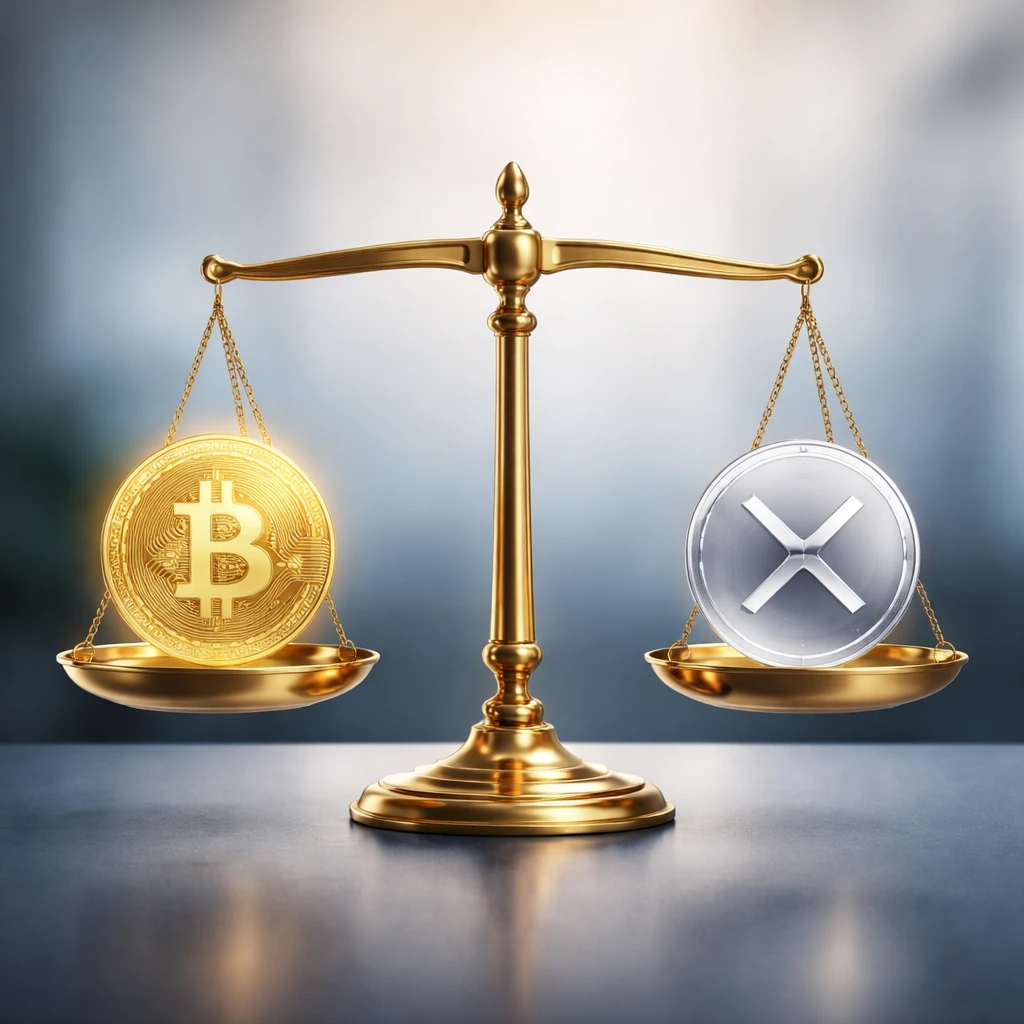

Bitcoin stands as the foremost digital currency by market capitalization, valued close to $2 trillion as of January 14. Its substantial price per single unit presents a high entry cost for investors, leading many to explore alternative cryptocurrencies, known collectively as altcoins. Among these, XRP emerges as a notable contender, holding a market capitalization of about $127 billion. Such a valuation suggests potential for greater relative price appreciation, a premise supported by XRP’s impressive 666% increase over the past five years compared to Bitcoin’s 169% growth during the same timeframe.
Understanding whether XRP warrants preference over Bitcoin in a crypto portfolio necessitates a detailed look at their fundamental differences and the respective roles they fulfill.
Core Differentiators Between Bitcoin and XRP
Both Bitcoin and XRP function as decentralized digital currencies leveraging blockchain technology to authenticate transactions. Bitcoin, inaugurated by an anonymous figure in 2009, was designed as a peer-to-peer digital payment system eschewing central banking frameworks. Its primary objective was to establish a payment network independent of traditional financial institutions.
In contrast, XRP’s origin traces to Ripple, a private enterprise responsible for its 2012 launch. Rather than aiming to bypass banks, Ripple envisioned XRP as a tool to enhance banking operations by expediting and economizing cross-border money transfers. This collaboration model between XRP and established financial entities distinctly separates it from Bitcoin’s original ethos.
Regarding payment efficiency, XRP distinctly outperforms Bitcoin. Transactions with XRP can finalize within three to five seconds, costing typically less than one cent. Bitcoin transactions, by comparison, average around ten minutes for confirmation and incur fees exceeding 80 cents. Despite these practical advantages, Bitcoin’s present role aligns predominantly with investment rather than transactional usage, often likened to digital gold due to its capped supply of 21 million coins fostering scarcity.
XRP's Integration Within Global Banking Systems
XRP’s valuation is intricately linked to Ripple’s operations, which provide the Ripple Payments platform—a blockchain-based system enabling banks to conduct swift, cost-effective international transfers. A key component, On-Demand Liquidity (ODL), integrates XRP to eliminate the need for maintaining pre-funded foreign currency accounts.
Under ODL, financial institutions convert their local currency into XRP to facilitate transfer, with recipients converting XRP back into their domestic currency. This mechanism aims to amplify efficiency, decrease capital tied up in pre-funding, and potentially bolster demand for XRP should ODL adoption rise.
Nonetheless, actual usage figures underscore limited current impact. While over 300 financial institutions associate with Ripple Payments, a majority utilize only basic payment functions without employing ODL. Records from the second quarter of 2025 indicate $1.3 billion in transaction volumes via ODL—a scale insufficient to substantially influence XRP’s market demand or price trajectory.
Additionally, Ripple's December 2024 launch of Ripple USD, a stablecoin pegged to the U.S. dollar, presents a practical alternative in the ODL framework. Such stablecoins offer less volatility than XRP, potentially constraining XRP's appeal for banks favoring price stability in liquidity instruments.
Recent Catalysts for XRP and Prospects for Growth
XRP experienced notable positive momentum starting late 2024, partly driven by external political developments and significant regulatory resolutions. The conclusion of Ripple’s protracted lawsuit with the Securities and Exchange Commission in August 2025, followed by the Commission’s approval of the initial spot XRP exchange-traded funds in November 2025, marked pivotal regulatory progress.
Despite these advancements, scaling XRP usage among financial institutions remains essential for it to realize its full potential as a transactional currency and investment asset. Without broader adoption of ODL or similar applications, XRP’s growth potential may not be fully reflected in market valuations.
Comparing Investment Considerations: Bitcoin Versus XRP
From an investment standpoint, sidelining Bitcoin in favor of alternatives like XRP may not align with portfolio optimization strategies. Bitcoin’s dominance, representing nearly 60% of the total cryptocurrency market capitalization, combined with its consistent performance during crypto market cycles, underscores its leading position as a foundational asset.
Conversely, XRP has yet to surpass its historical peak attained in 2018. However, its distinctive position bridging payment utility and investment value merits consideration for investors seeking exposure to altcoins with substantive use cases.
Therefore, investors may find merit in maintaining Bitcoin holdings as a core asset supplemented by targeted investments in XRP to leverage its banking integration and transactional efficiencies.