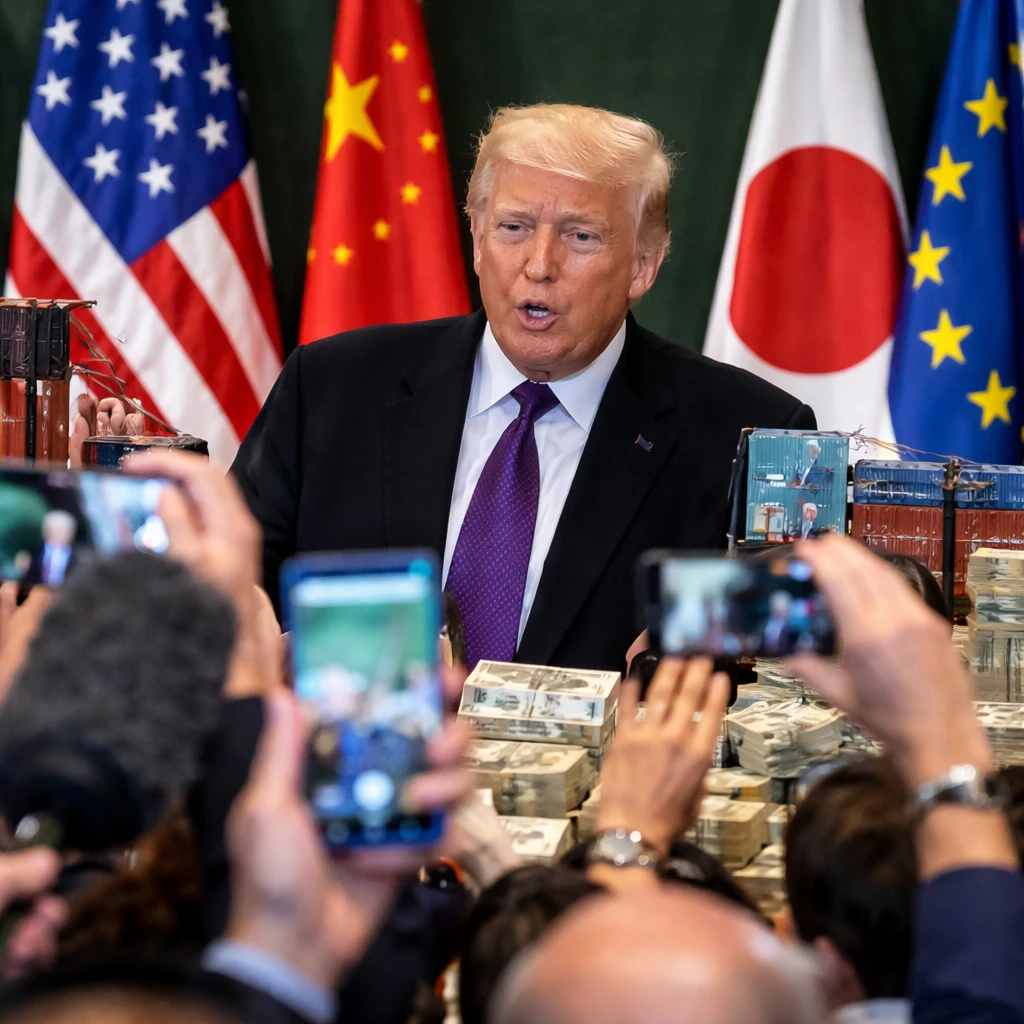

In efforts to boost domestic economic growth, the Trump administration engaged its largest international trade partners to commit substantial investments in the United States. Through the strategic use of threat-induced tariffs, the administration sought to secure investment agreements reportedly totaling trillions of dollars. Yet, a report published by the Peterson Institute of International Economics on Tuesday challenges the likelihood and timing of these investments materializing.
Authors Gregory Auclair and Adnan Mazarei analyze over $5 trillion in pledged investments from entities including the European Union, Japan, South Korea, Taiwan, Switzerland, Liechtenstein, and Gulf countries such as Saudi Arabia, Qatar, Bahrain, and the United Arab Emirates. This analysis scrutinizes the nature of these commitments and their prospective execution.
The administration has touted a comprehensive investment figure as high as $9.6 trillion, encompassing both public and private sector commitments, while the president himself has cited figures reaching $17 to $18 trillion — figures that the researchers note lack transparent substantiation.
The scale of these pledges is substantial when contextualized against typical U.S. investment metrics. Private domestic investment recently tracked at an annualized figure of $5.4 trillion, whereas total foreign direct investment into the U.S. totaled $151 billion in 2024, the most recent year with available data. It is important to note that foreign direct investment includes capital placed into physical assets like factories and offices rather than financial instruments.
Auclair and Mazarei emphasize that while the pledged sums are sizable, their associated timelines vary considerably, and the benchmarks to monitor and verify these commitments are not clearly defined. Notably, they point out that specific promises, such as the European Union's $600 billion investment pledge, are not legally binding, raising questions about enforceability.
The report further identifies financial constraints among certain Gulf states, suggesting difficulties in realizing their investment commitments without incurring debt. Saudi Arabia, according to the report, appears positioned to meet its objectives with some strain, whereas the United Arab Emirates and Qatar may require borrowing to fund their commitments. The non-binding nature of these agreements allows for significant variability in actual investment volumes.
Auclair and Mazarei also highlight that these agreements were secured under duress. Mazarei, a former IMF deputy director, indicated in an interview that these commitments are not necessarily made voluntarily. Consequently, there may be efforts by countries to circumvent these obligations, particularly pending a U.S. Supreme Court decision expected starting in February, which could invalidate the tariffs underpinning these agreements.
Even if current tariffs are struck down, the Trump administration retains the option to impose alternative tariffs to maintain pressure, as stated by White House spokesperson Kush Desai, who reaffirmed the administration's readiness to enforce commitments through actions if necessary.
The study acknowledges that, if realized, increased foreign investment could generate jobs, stimulate economic growth, and strengthen supply chains by encouraging domestic manufacturing. This approach aligns with certain facets of industrial policy also endorsed by the Biden administration, which has invested taxpayer funds into infrastructure and green technology incentives. However, the Trump administration notably contrasts with Biden's strategy by leveraging tariffs to prompt foreign investment and primarily prioritizing fossil fuel industries over renewable energy development.
Concerns are expressed regarding the likelihood of these investments reflecting underlying economic robustness. The potential for a policy environment characterized by opaque project selection, limited accountability, and political influence overshadowing economic efficiency underscores the risks inherent in this strategy.