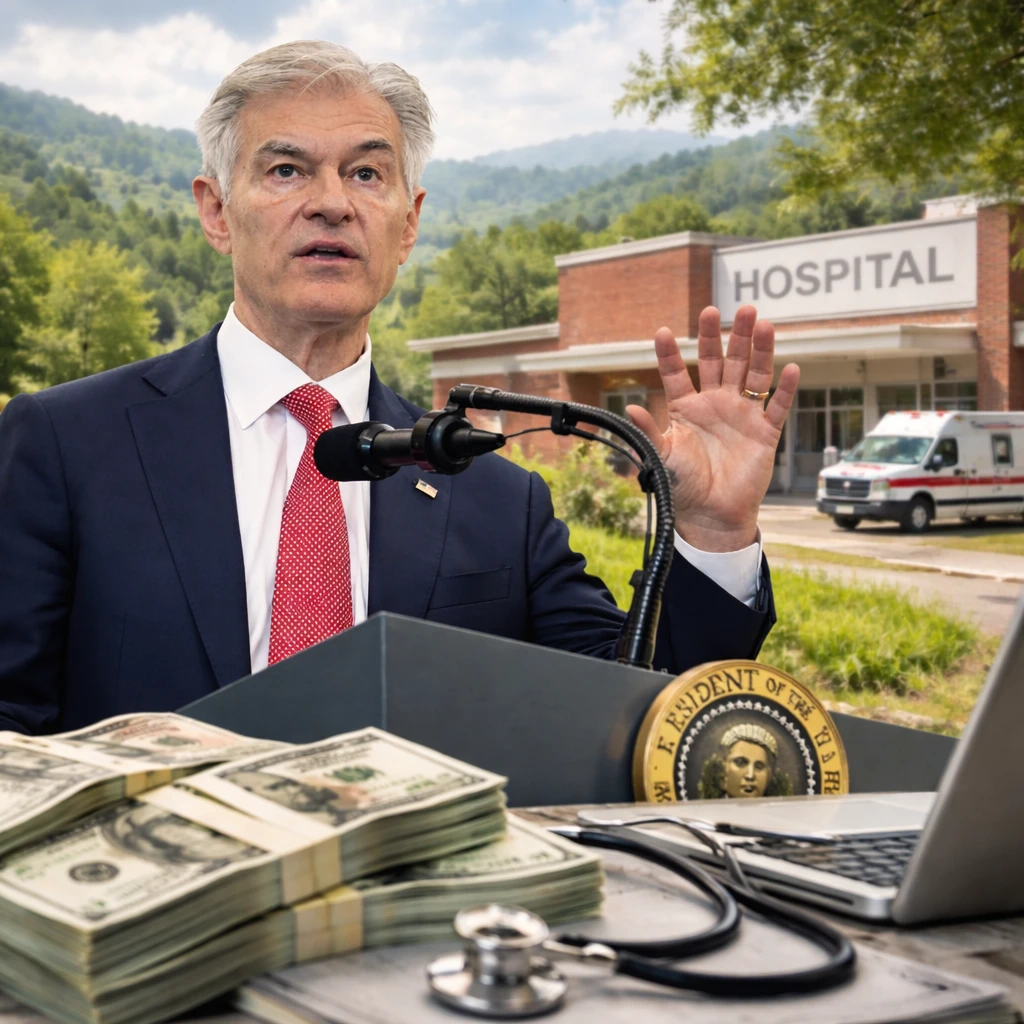

The federal government is set to distribute $10 billion to states in 2026 as part of a Rural Health Transformation Program designed to counterbalance substantial budget cuts imposed on rural hospitals during the previous administration. This initiative, announced on Monday, involves all states applying for these funds; however, allocations will not be uniform, sparking concerns among critics regarding the potential for funding withdrawal if states' policy choices diverge from the administration's priorities.
Officials indicated that the average disbursement per state will be approximately $200 million, with the program dedicating a total of $50 billion to rural health initiatives over a five-year span. States have the responsibility to propose expenditure plans, and the Centers for Medicare and Medicaid Services (CMS) will assign dedicated project officers to provide oversight and assistance. Dr. Mehmet Oz, CMS administrator, characterized the fund's creation as part of the "One Big Beautiful Bill" enacted merely six months prior, emphasizing the objective to stimulate state-level creativity.
Distribution methodology divides the funds evenly for half of the amount among states, while the remaining half is allocated pursuant to a CMS-devised formula. This formula accounts for variables such as rural population size, the financial viability of medical institutions within the state, and health outcomes experienced by the populace.
Notably, $12 billion of the funding over the five years is linked to whether states enact health policies aligned with the Trump administration's "Make America Healthy Again" agenda. Examples of these policy priorities include mandates for nutrition education for healthcare providers, participation of schools in the Presidential Fitness Test, and restrictions on Supplemental Nutrition Assistance Program (SNAP) benefits being used for so-called 'junk foods,' as outlined by Dr. Oz.
Several states led by Republican administrations, such as Arkansas, Iowa, Louisiana, Nebraska, Oklahoma, and Texas, have implemented regulations banning the purchase of certain food items like candy and soda with SNAP benefits. The program stipulates that funding allocations are recalculated annually, permitting the federal government to reclaim funds if states fail to enact the policies they committed to. Dr. Oz clarified that these 'clawbacks' are designed not as punitive measures but as leverage to encourage policy adoption, with potential financial consequences serving as an incentive for governors to implement the recommended measures.
According to Dr. Oz, some governors regard this provision as empowering rather than threatening, viewing it as a mechanism to advance the aims of the comprehensive bill. Conversely, Carrie Cochran-McClain, chief policy officer at the National Rural Health Association, reported receiving feedback from Democratic-led states that have declined to incorporate these SNAP restrictions, even though their refusal might reduce their access to increased funding. She remarked that such policies are inconsistent with the directions of their state leadership.
The administration heralds the program as representing a 50% uptick in Medicaid investments targeting rural healthcare. Representative Don Bacon of Nebraska, a Republican who has critiqued multiple administration policies yet supported the budget bill responsible for the Medicaid cuts, referenced the fund as a critical supplement intended to assist struggling hospitals. "This money is meant to keep hospitals afloat," he stated, highlighting its intended purpose in cushioning the blow from the broader budget reductions.
However, industry experts contend that the fund's scale is insufficient when juxtaposed with the projected financial challenges rural hospitals face due to the budget legislation, which includes a $1.2 trillion reduction in federal spending over the next decade, primarily impacting Medicaid. It is anticipated that millions will lose Medicaid benefits as a consequence, with estimates signaling potential losses for rural hospitals of approximately $137 billion over 10 years. The Cecil G. Sheps Center for Health Services Research at the University of North Carolina at Chapel Hill projects that up to 300 rural hospitals are at risk of closure following this spending package.
Cochran-McClain emphasized the disparity between the fund's contributions and the overall needs, stating, "When you put that up against the $50 billion for the Rural Health Transformation Fund, you know — that math does not add up." She also raised concerns about the allocation of funds, noting uncertainty as to whether the money will be directed specifically toward rural hospitals facing distress. For instance, she pointed out that some state applications include initiatives such as offering healthier, locally sourced school lunch options in rural areas.
Although fostering innovation is a stated goal of the program, Cochran-McClain observed the practical challenges rural hospitals encounter in pursuing new initiatives while already struggling to break even financially prior to Medicaid cutbacks. She shared that rural healthcare providers often express desires to undertake specific improvements but remain constrained by fundamental operational concerns, particularly the imperative to cover payroll and other essential costs. As a result, she asserted that engaging in substantive innovation is near-impossible amid such financial pressures.