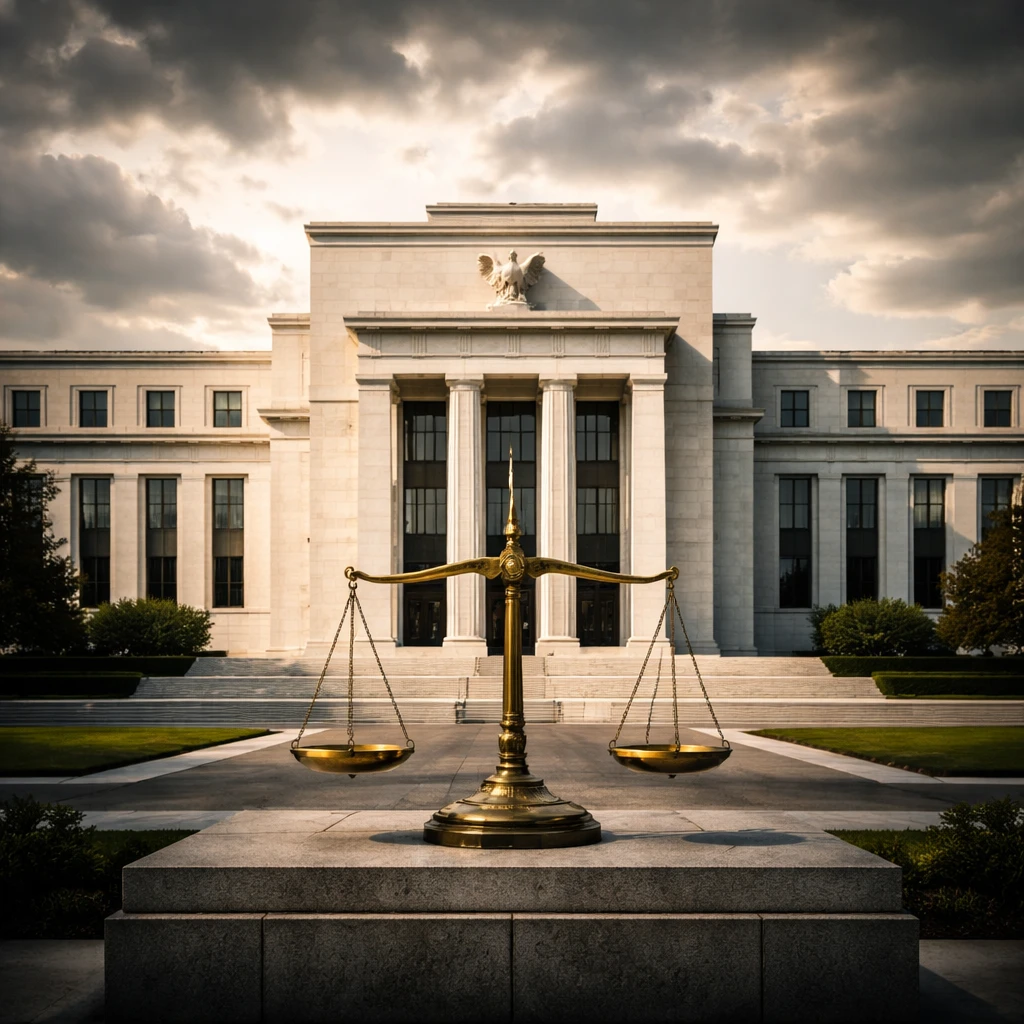

In an extraordinary development within the U.S. economic and political landscape, Federal Reserve Chair Jerome Powell faces a potential criminal indictment connected to the Federal Reserve's multibillion-dollar headquarters renovation. The Justice Department's involvement in threatening legal action against the central bank's chair marks an unprecedented moment in the country’s financial governance history.
Prominent economist Justin Wolfers criticized this maneuvre as a severe escalation of the ongoing tensions between the Federal Reserve and the presidential administration. Speaking on MS Now on Tuesday, Wolfers described the situation as "unprecedented," emphasizing that it involves the President openly threatening the incarceration of the Fed Chair, a first in the annals of American history. Wolfers underscored the gravity of this act, noting its alignment with tactics typically observed in nations with authoritarian leadership, including Argentina, Russia, Turkey, Venezuela, and Zimbabwe.
Wolfers further characterized these actions as traits of what he called "tin-pot dictators." He cautioned that such political interference in central banking operations typically precedes economic turmoil, notably the onset of hyperinflation. His remarks suggested a stark warning about the consequences of undermining the Federal Reserve's operational independence, highlighting that such scenarios historically "never end well." Despite the significant implications of this threat, financial markets have responded with caution rather than dramatic shifts. Wolfers attributed this measured market reaction to uncertainty surrounding the seriousness of the President’s threats, describing it as part of "the old Trump two-step" where markets anticipate a possible retreat or de-escalation following political brinkmanship.
On social media, Wolfers referred to the present climate as a "volatility tax," emphasizing that even if the current threat dissipates, the mere occurrence elevates the perceived risk associated with future political interference in the Federal Reserve’s affairs.
In response to these developments, several former Federal Reserve Chairs have voiced their concerns to defend the institution’s autonomy. Janet Yellen, ex-chair of the Fed, described the Justice Department's inquiry into Powell’s involvement as "extremely chilling." Ben Bernanke and Alan Greenspan, also former Fed Chairs, echoed the call to safeguard the central bank’s independence, stating that judicial probes of this nature have no precedent or justification in the United States.
International central bank leaders have similarly congregated in their show of support. Christine Lagarde, President of the European Central Bank, announced solidarity with Powell and the Federal Reserve on behalf of twelve central banks, underscoring the global resonance of threats to central bank autonomy.
Adding to these concerns, U.S. Treasury Secretary Scott Bessent reportedly cautioned the President via a telephone conversation that launching a federal investigation into Powell would be detrimental to financial market stability. This warning, revealed by Axios citing sources familiar with the dialogue, underscores internal apprehensions regarding the consequences of the President's actions.
The U.S. financial markets have exhibited volatility amid this backdrop, though key indexes such as the S&P 500, Nasdaq, and Dow Jones have remained largely flat with minor fluctuations of -0.02%, +0.16%, and -0.62%, respectively. In contrast, precious metals have experienced notable gains; gold has surged 3.16%, and silver has climbed an impressive 14.23%, reaching unprecedented price levels amid the ongoing Federal Reserve unease.
The U.S. Dollar Index has rebounded after a sharp drop on Monday, currently trading slightly down by 0.07% for the week at 99.1475, reflecting the dynamic responses of currency markets to political developments around the Federal Reserve.
This episode represents a significant challenge to the long-established principle of Federal Reserve independence in the United States. The unusual threats reportedly issued by the President signal a concerning level of political interference in a federal institution tasked with managing monetary policy and ensuring economic stability.
The convergence of support from past Federal Reserve leadership and international central banks highlights the broad consensus regarding the importance of protecting the Fed from political coercion. As this situation evolves, market participants and policymakers alike will closely monitor the potential repercussions for domestic economic stability and global financial systems.
Ultimately, the unfolding dispute underscores a pivotal moment in the relationship between the executive branch and the Federal Reserve, with implications extending beyond immediate legal questions to the foundational structures of economic governance in the United States.