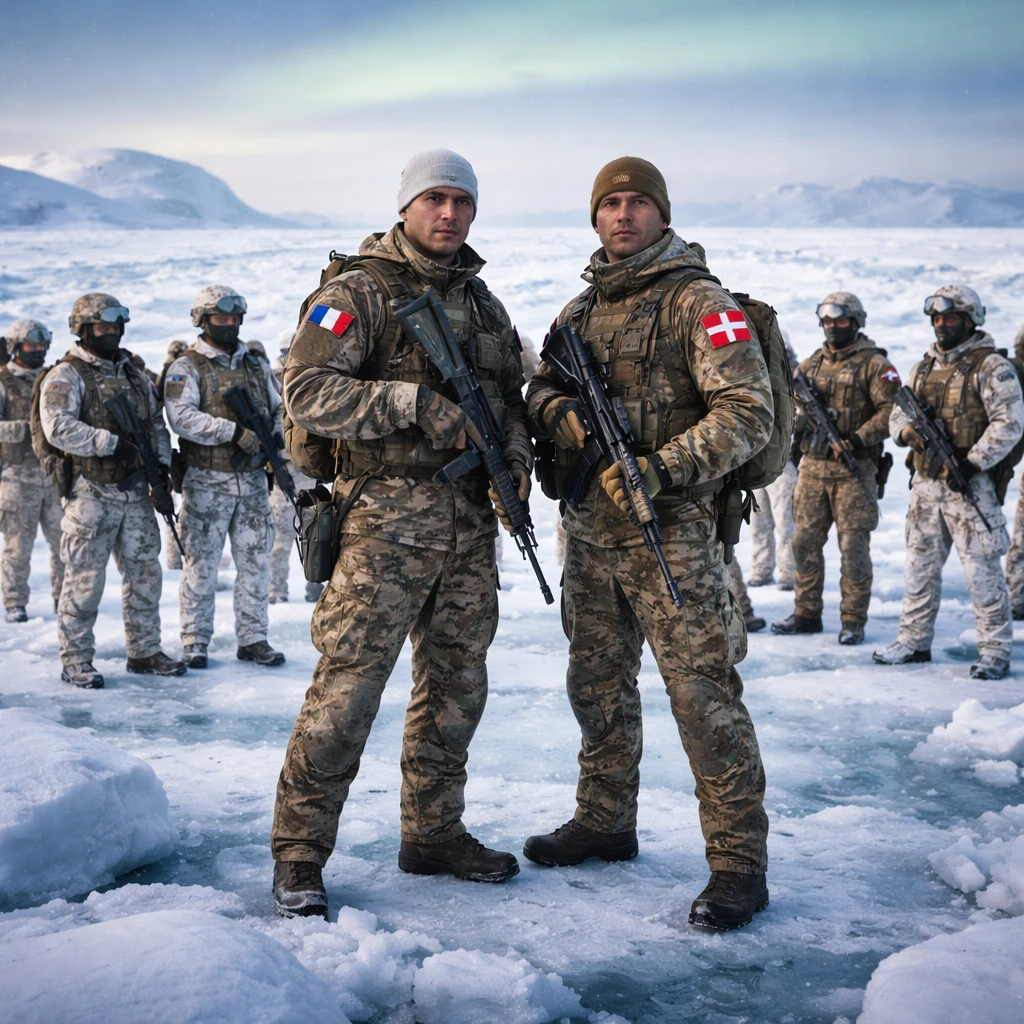

In a significant development in Arctic geopolitics, French President Emmanuel Macron declared that France would contribute troops to a large-scale military exercise in Greenland known as Operation Arctic Endurance. The exercise, orchestrated by Denmark, seeks to enhance multinational military cooperation in the Arctic region.
President Macron made the announcement through his social media platform, X, stating: "At the request of Denmark, I have decided that France will participate in the joint exercises organized by Denmark in Greenland, Operation Arctic Endurance. The first French military elements are already on their way. Others will follow." This move is part of a broader coalition of European and North American allies, with Denmark confirming that Germany, Sweden, Norway, the Netherlands, and Canada will also deploy forces to the operation.
This announcement comes on the heels of very public comments from United States President Donald Trump, who has reiterated American interest in Greenland. Trump emphasized the island's strategic importance, stating that the "United States needs Greenland," highlighting concerns about Denmark's capacity to defend the territory amid rising influence from global powers such as Russia and China.
During a press interaction following high-level discussions involving Vice President J.D. Vance, Secretary of State Marco Rubio, and Danish Foreign Minister Lars Løkke Rasmussen, President Trump remarked: "Greenland is very important for the national security, including of Denmark. And the problem is there's not a thing that Denmark can do about it if Russia or China wants to occupy Greenland, but there's everything we can do. You found that out last week with Venezuela." These statements underscore the administration's perception of vulnerability regarding Greenland's defense.
Contrasting the US stance, Danish Foreign Minister Rasmussen described the talks as "frank but also constructive," while reaffirming Denmark and Greenland’s rejection of US efforts to gain control over the island. He acknowledged a "fundamental disagreement" persists between the two nations regarding Greenland's governance and sovereignty.
Prior to the talks, President Trump had publicly expressed that integrating Greenland into US jurisdiction would make NATO "far more formidable and effective," and that not acquiring Greenland was "unacceptable." However, Denmark and Greenland maintain that the island is not for sale and have condemned any threats of force as reckless. They insist that any security concerns should be resolved through cooperation among allies and partners.
Support for Denmark’s position has garnered backing from several European governments, including key members of the European Union and NATO, warning that US attempts to annex Greenland could potentially disrupt or damage these crucial alliances. The evolving situation highlights sensitive dynamics in Arctic security and international diplomacy, particularly involving territorial rights and military strategy in a region of increasing strategic importance.
France’s decision to deploy forces to Operation Arctic Endurance demonstrates a strengthening of European military cooperation in the Arctic amidst tension with the United States. The multi-national exercise is designed to enhance interoperability among allied forces and to assert a collective presence in the region.
As Greenland's strategic importance grows amid geopolitical competition, the debate around territorial control and defense capabilities remains acute. Denmark’s firm stance on sovereignty, alongside France’s reaffirmed commitment to joint defense efforts, contrasts with the more assertive American approach emphasizing control and unilateral action.
Looking ahead, the persistence of fundamental disagreements between the US and Denmark over Greenland’s status suggests ongoing diplomatic challenges. Alliances such as NATO may face test cases in balancing strategic interests with alliance cohesion.
The situation remains fluid, with military deployments proceeding and diplomatic dialogues continuing against the backdrop of significant regional and international security considerations.