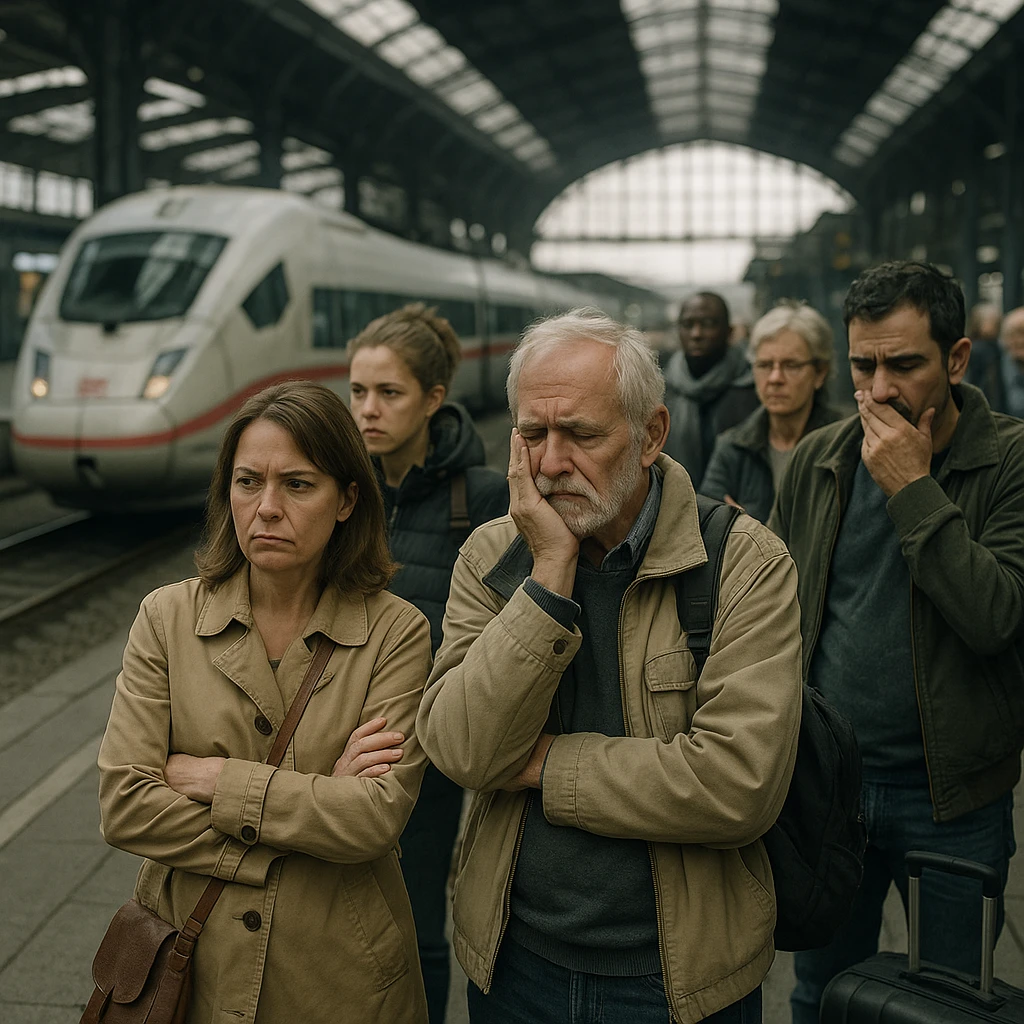

As an Intercity Express train crosses from Switzerland into Germany, passengers immediately sense a departure from the punctual precision characteristic of Swiss railways. For Elisabeth Eisel, a regular traveler on the seven-hour route from Bern to Berlin, this deterioration in German train reliability is a recent and unfortunate development. "Trains in Switzerland are always on time, unless they're arriving from Germany," she observes with a mix of disappointment and resignation.
Once celebrated for its efficiency, the German rail service has suffered from decades of neglect. Deutsche Bahn, the state-owned operator responsible for long-distance and high-speed trains within Germany, is now counted among the least punctual in Europe. Recent statistics reveal that barely half of its long-distance trains arrive without delay, a performance record that hit a new low this past October.
These punctuality challenges are only one facet of Deutsche Bahn's broader operational troubles. Passengers often encounter inconsistent or absent Wi-Fi connectivity, complications in seat reservations, unexpected removal of train cars, and frequent technical difficulties, a generic explanation commonly provided over the train's public address system.
In response to these mounting issues, the German government has committed to a substantial 100-billion-euro investment in rail infrastructure, aimed at revitalizing tracks, signals, and stations. Lukas Iffländer, vice chairman of the passenger advocacy group Pro Bahn, stresses that financial injection alone will not suffice to remedy the systemic problems.
"We are paying the price for extensive neglect dating back to 1998," Iffländer explains. Beyond deteriorating physical infrastructure, he highlights the excessively bureaucratic nature of the network operator, complicating any attempts at swift and effective reforms. "Every process at Deutsche Bahn is really complicated," he notes, underscoring how institutional inertia inhibits improvement efforts.
Adding to these issues, the workforce composition presents imbalances. Despite insufficient numbers of train engineers and signal operators, Deutsche Bahn maintains a surplus of managers in administrative roles, contributing to operational inefficiencies. Reports in German media have suggested that some managers have considered canceling long-distance trains strategically to improve punctuality statistics, an accusation Deutsche Bahn has officially denied, claiming such reports rely on informal communications rather than factual data.
The passenger experience reflects these systemic faults vividly. On a recent midday journey from Munich to Berlin, a train operated at double its intended capacity due to a last-minute cancellation of another fully booked service. Despite the overcrowding and prolonged periods without access to facilities, the atmosphere among passengers remained surprisingly upbeat. Catherine Launay, a French traveler seated aboard this packed train, mused on the relative calmness, comparing it to what she perceives would be a stormier response on French services.
Deutsche Bahn has attempted to address rising passenger frustration and prevent aggressive behavior towards staff by launching a satirical web series on social media platforms. The mockumentary portrays a train crew enduring increasingly absurd challenges, using humor as a coping mechanism. However, the effort is hampered by the very connectivity issues passengers face on board—many cannot stream the content due to inadequate Wi-Fi performance.
Despite the levity provided by such initiatives, the reality remains stark. Train conductors sometimes offer passengers subtle warnings about the likelihood of delay, acknowledging the precariousness of schedules. This frankness contrasts sharply with the German public's expectations of reliability and efficiency.
Federal Transport Minister Patrick Schnieder recently remarked that the rail network's malfunctioning reflects broader failures within state operations. Expectations now rest heavily on the newly appointed Deutsche Bahn CEO, Evelyn Palla, whose leadership experience includes a tenure at Austrian Federal Railways. Palla has initiated measures to streamline management by reducing executive positions, but she cautions that the scale of required reforms means progress will be gradual.
As trains enter Berlin's central station, passengers continue their journeys resigned to a system fraught with challenges — from infrastructural decay and administrative complexity to public disappointment. The hope is that the planned investments and organizational reforms will eventually restore Germany's railways to their former standing.