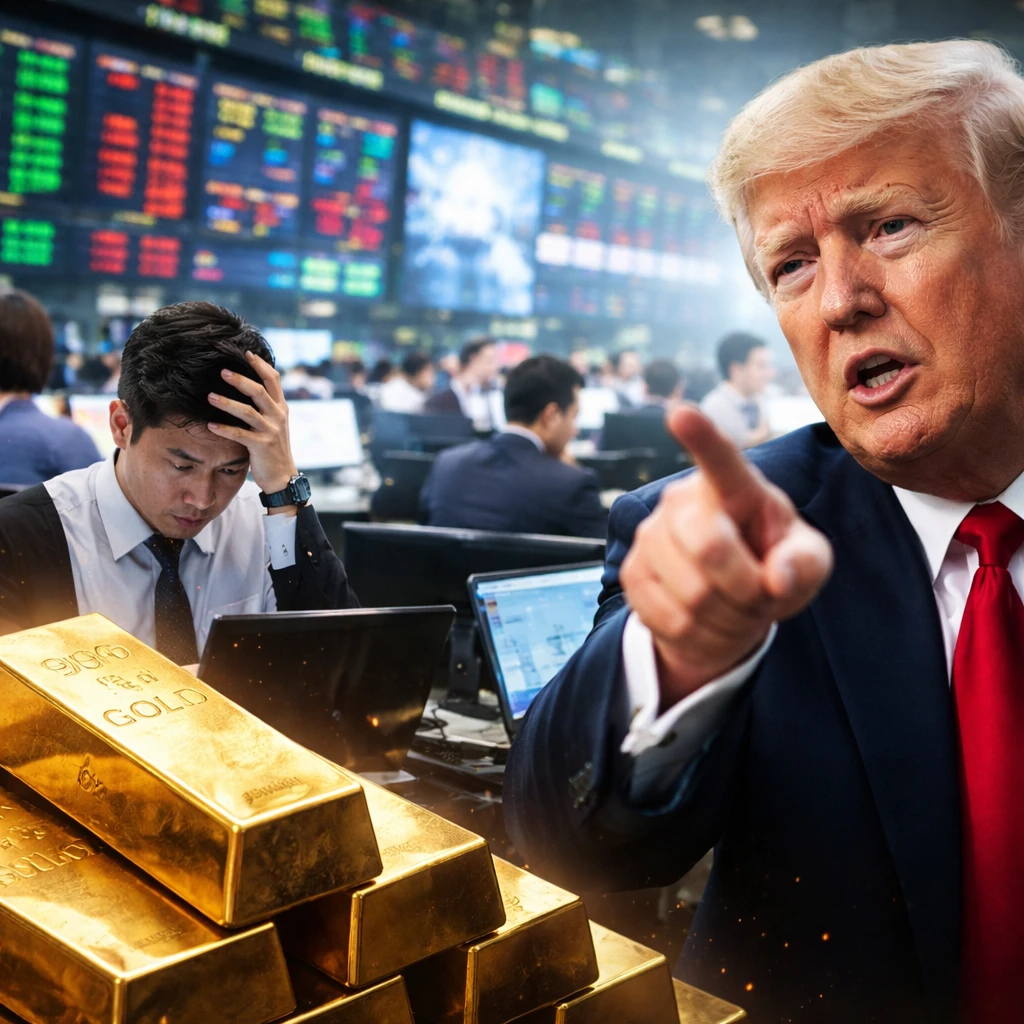

Asian financial markets exhibited varied movements on Wednesday, reflecting a complex investor sentiment influenced by mounting concerns over United States tariff initiatives targeting Greenland-related trade. While some indices gained traction, others receded, illustrating the uneven impact of geopolitical developments and domestic factors within the region.
Concurrently, gold prices ascended to a historic peak, surpassing the $4,800 per ounce threshold for the first time. This surge, amounting to a 1.7% increase, underscores investors' gravitation toward traditional safe-haven assets amid prevailing uncertainties. Such behavior suggests apprehension surrounding international trade dynamics and potential economic repercussions stemming from policy shifts.
Market participants awaited a scheduled address by U.S. President Donald Trump at the World Economic Forum in Davos, Switzerland. This annual event gathers global leaders and financial elites to deliberate on economic trends and policy agendas. President Trump indicated plans to underscore his administration's achievements during his remarks.
Notably, President Trump's travel to Davos encountered a minor disruption when Air Force One returned to Washington following the identification of an electrical issue mid-flight. After addressing the technical concern, he resumed the journey aboard an alternate aircraft, ensuring his presence at the economic forum.
Within the Asian trading session, equities in China advanced despite previous declines seen in global markets. The Hang Seng index in Hong Kong appreciated by 0.4%, reaching 26,584.57, while the Shanghai Composite index marginally increased by 0.1% to 4,116.94.
Contrastingly, Japan's benchmark Nikkei 225 declined by 0.4%, settling at 52,774.64. This downturn reflects both geopolitical uncertainties and internal political developments, notably Prime Minister Sanae Takaichi's announcement of a snap general election scheduled for February 8. The anticipated electoral campaign has influenced sovereign bond yields, with the 40-year Japanese government bond yield retreating slightly to 4.095% from a recent record high of 4.22%. Policy expectations include potential tax reductions and increased government spending, factors complicating the management of Japan's substantial national debt.
Elsewhere in the region, South Korea's Kospi index rose by 0.5%, touching new highs this month at 4,909.93. Meanwhile, the Australian S&P/ASX 200 index decreased by 0.4% to 8,782.90. Taiwan's Taiex index experienced a more notable decline of 1.6%, and India's Sensex edged down slightly by less than 0.1%.
The backdrop to these mixed market responses centers on President Trump's declaration of forthcoming 10% tariffs imposed on eight European countries, including Denmark, Norway, Sweden, Germany, France, the United Kingdom, the Netherlands, and Finland, starting in February. These punitive measures would augment an existing 15% tariff envisaged under a pending trade agreement with the European Union. The threatened tariffs have provoked European leaders to consider retaliatory strategies, such as delaying the ratification of the trade pact or implementing their own tariffs, thereby intensifying tensions within transatlantic relations.
President Trump's negotiation stance on Greenland appears intertwined with his sentiments over not receiving the Nobel Peace Prize the previous year. As communicated to Norway's prime minister, the president signaled a diminished commitment to prioritizing peace in policy considerations.
The market reaction to these escalations was evident on Wall Street Tuesday, where the S&P 500 index declined by 2.1% to 6,796.86, marking its steepest daily loss since October. The Dow Jones Industrial Average similarly dropped by 1.8% to 48,488.59, while the Nasdaq composite slipped 2.4% to 22,954.32.
Within individual sectors, major technology firms and retailers faced significant setbacks. Nvidia, recognized as one of the world's most valuable corporations, decreased by 4.4%, while Apple shares fell by 3.5%. Retailers including Lowe's declined by 3.3%, financial institutions such as JPMorgan Chase dropped 3.1%, and industrial conglomerates exemplified by Caterpillar saw a 2.5% reduction.
Investor focus is also shifting to forthcoming central bank meetings, notably the Federal Reserve's policy review next week, where markets anticipate a hold on benchmark interest rates. Japan's central bank is set to conclude its initial monetary policy session on Friday. Concurrently, commodity prices reflected subdued activity, with U.S. benchmark crude oil losing 56 cents to $59.80 per barrel, and Brent crude falling 70 cents to $64.22 per barrel.
Currency markets demonstrated limited volatility, with the U.S. dollar declining slightly against the Japanese yen to 158.08 from 158.16 and remaining almost unchanged against the euro at $1.1719.