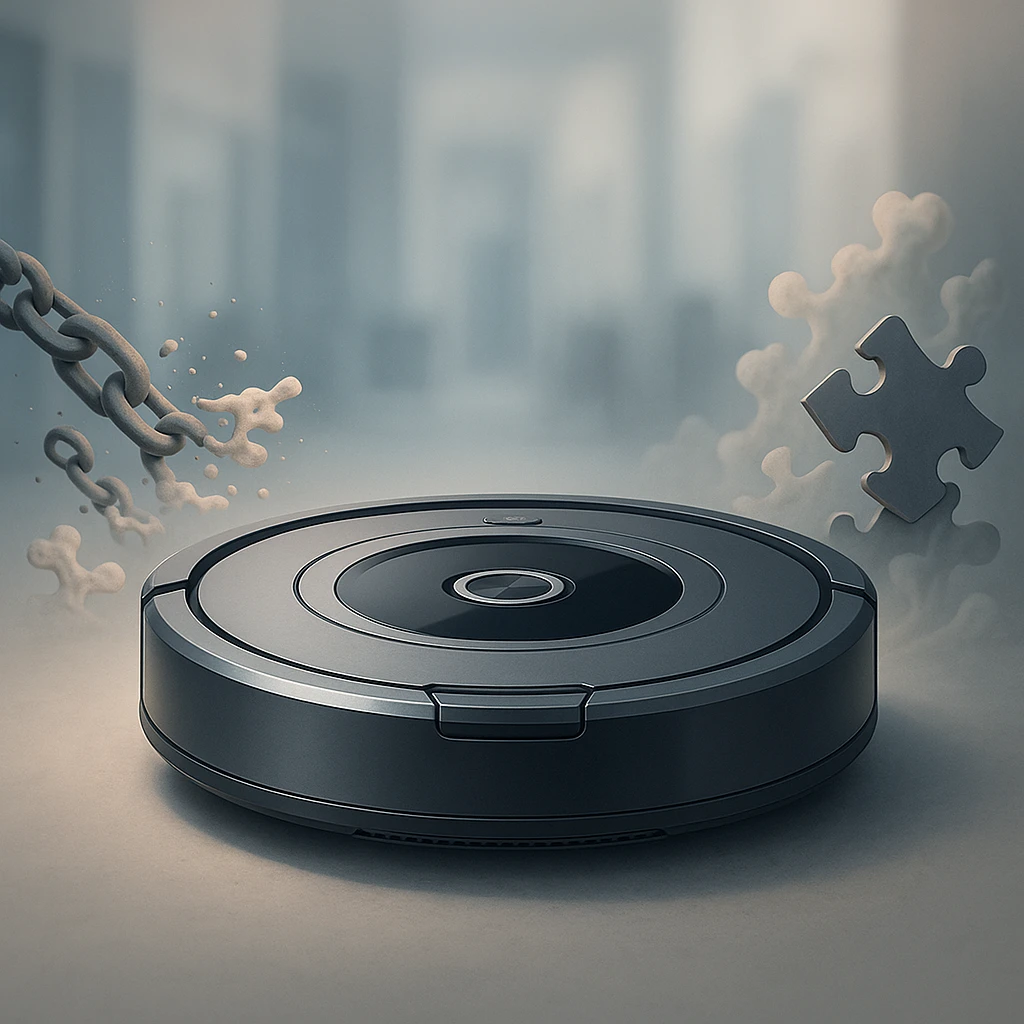

iRobot's Financial Decline Leads to Bankruptcy and Ownership Shift Amid Cost Pressures
December 15, 2025
Technology News

iRobot's Financial Decline Leads to Bankruptcy and Ownership Shift Amid Cost Pressures

Robot vacuum pioneer iRobot succumbs to mounting debt and tariffs, transferred to Chinese manufacturer Shenzhen Picea Robotics

Summary

iRobot, the Massachusetts-based innovator behind the popular Roomba robot vacuum, has filed for bankruptcy approximately two years after a failed acquisition attempt by Amazon. Confronted by intensifying competition from overseas manufacturers, substantial debt obligations, and increased tariff costs, the company is now transferring ownership to its primary Chinese supplier, Shenzhen Picea Robotics. The transition assures Roomba users that their devices will continue to function without disruption.

Key Points

iRobot was established in 1990 by MIT researchers and initially developed robotics for military and exploratory purposes before successfully entering the home cleaning market with the Roomba.
The company faced increased competition from foreign manufacturers, especially Chinese firms, offering smart vacuum products at lower prices.
Amazon's $1.4 billion bid to acquire iRobot was withdrawn following regulatory scrutiny in the U.S. and Europe, leaving iRobot with a $200 million loan taken during the merger attempt.
In the latest quarter, iRobot reported a 33% decrease in U.S. revenue, reflecting ongoing financial difficulties and reduced consumer demand.
Tariffs imposed on imports under U.S. trade policies led to increased costs for iRobot, which has $3.4 million in unpaid tariffs owed to U.S. Customs and Border Protection.
iRobot owes nearly $100 million to Shenzhen Picea Robotics, a Chinese manufacturer and supplier, which is acquiring iRobot through the bankruptcy process.
Following bankruptcy, iRobot will become a private company under Shenzhen Picea Robotics, which also produces competing brands such as 3i, Shark, and Eufy.
Current Roomba owners have been assured that their products will continue to operate as usual despite the ownership change.

Founded in 1990 by researchers at the Massachusetts Institute of Technology (MIT), iRobot emerged as a pioneering enterprise in robotics, initially developing products for the U.S. military, conducting explorations such as scanning the Great Pyramid of Giza, and responding to environmental emergencies like oil spills in the Gulf of Mexico. Later, iRobot expanded its portfolio to include consumer-focused robotic devices capable of cleaning floors and pools, most notably through its flagship product, the Roomba.

Despite establishing itself as a household name in the United States, iRobot's financial performance has declined considerably in recent years. One significant challenge has been intensified competition from foreign manufacturers, predominantly Chinese companies, offering smart vacuum alternatives often priced below iRobot's offerings.

The company faced a major setback when Amazon's proposed acquisition bid of $1.4 billion was abandoned last year following reviews by regulatory authorities in Europe and the U.S., who raised competition concerns. In response to the prolonged merger process and resulting uncertainty, iRobot had secured a $200 million loan to support operations during the assessment period.

Over the course of the current year, iRobot has struggled with profitability. The most recent quarterly report highlighted a 33% revenue drop in its U.S. markets. Earlier in the year, the company warned stakeholders about a potential bankruptcy due to apprehensions surrounding customer demand, market competition, and the financial impact of tariffs on imported products.

A significant component of iRobot's cost challenges stemmed from manufacturing practices and evolving trade policies. Although a majority of Roomba devices are produced in Vietnam, the company incurred additional expenses in response to import tariffs instituted during the administration of President Donald Trump. In its bankruptcy filing, iRobot revealed an outstanding debt of $3.4 million owed to U.S. Customs and Border Protection for unpaid tariffs.

Moreover, iRobot owes nearly $100 million to Shenzhen Picea Robotics, a China-based supplier responsible for manufacturing many of its products. Under the terms of the bankruptcy proceedings, Shenzhen Picea Robotics is set to acquire iRobot, transitioning the company from a publicly traded U.S. entity to private ownership under Picea's control.

Shenzhen Picea Robotics itself produces competing household robotic devices, marketing them under its own brand, 3i. Its product range also includes brands such as Shark and Anker, the latter known for manufacturing the Eufy line of robotic vacuums. While the takeover changes iRobot's ownership and corporate structure, assurances have been given to assure current Roomba owners that their devices will continue to function normally without service interruptions.

In summary, iRobot’s journey from a trailblazer in robotic technology to bankruptcy underscores the financial pressures induced by intense foreign competition, regulatory hurdles, tariff-related cost increases, and substantial debt burdens. As the company integrates into Shenzhen Picea Robotics, the future operational dynamics will likely reflect these profound shifts in ownership and market competition.

Risks
  • Ongoing competition from lower-cost foreign manufacturers, particularly in China, threatens iRobot's market share and profitability.
  • Regulatory interventions, as exemplified by the failed Amazon acquisition, can disrupt strategic plans and exacerbate financial strain.
  • Tariff obligations contribute to rising operational costs and unpaid tariffs pose regulatory compliance risks.
  • High debt levels, including a substantial loan and money owed to key suppliers, increase financial vulnerability.
  • Declining consumer demand in primary markets, specifically the U.S., negatively impacts revenue streams.
  • The bankruptcy and ownership shift could cause uncertainty among customers and business partners.
  • Integration challenges may arise as iRobot transitions from a U.S.-based public company to a private entity under foreign ownership.
  • Potential disruptions in the supply chain or brand perception might occur due to changes in corporate structure and control.
Disclosure
Education only / not financial advice
Search Articles
Category
Technology News

Technology News

Related Articles
Eddie Bauer Seeks Chapter 11 Protection Amid Rising Tariff and Inflation Challenges

Eddie Bauer LLC has filed for voluntary Chapter 11 bankruptcy protection in the District of New Jers...