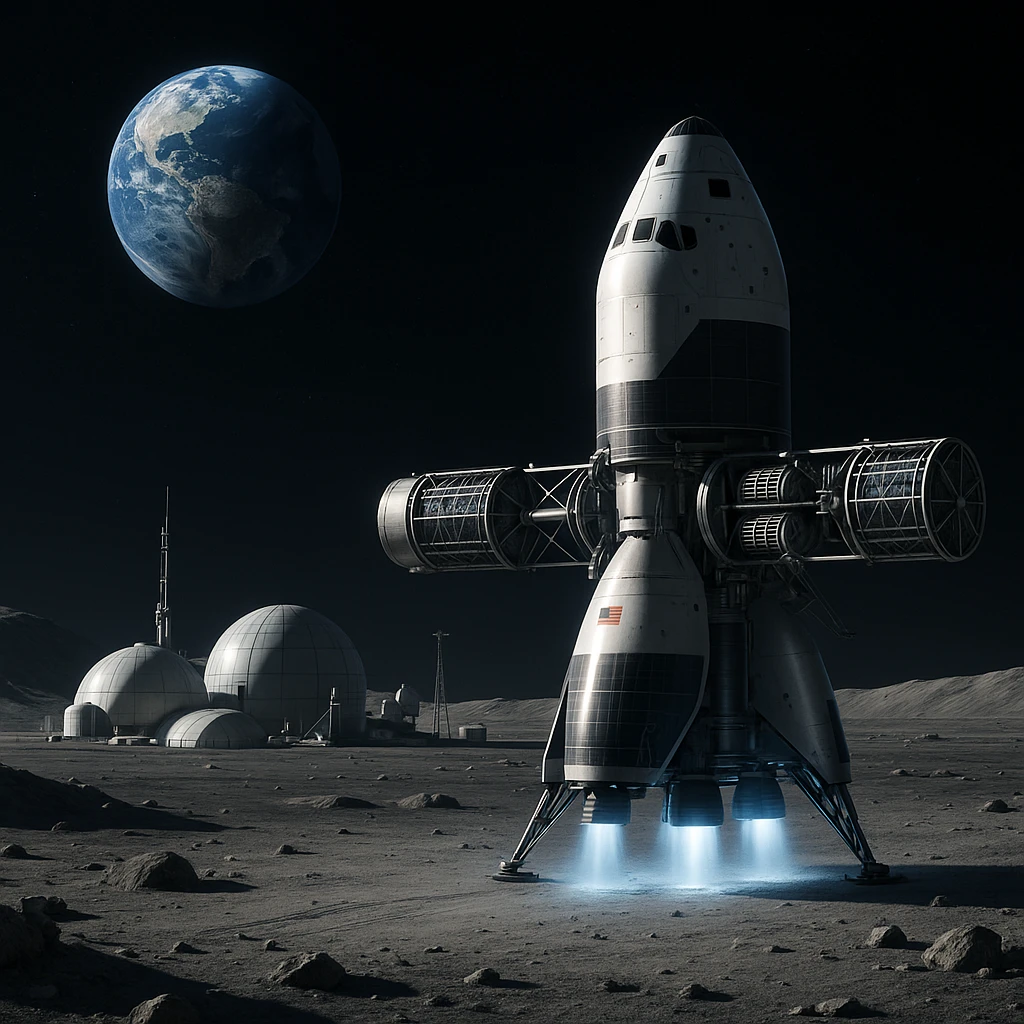

In a significant declaration on Friday, Jared Isaacman, the newly appointed Administrator of NASA, announced the United States’ intention to return to the moon during what would be President Donald Trump's second term in office. Isaacman's statements, made during a CNBC interview, represent some of his initial public remarks following his Senate confirmation last week.
Isaacman, who shares a longstanding professional affiliation with SpaceX CEO Elon Musk, stressed the renewed focus by the Trump administration on lunar exploration. He described this focus as a pivotal effort to unlock diverse opportunities on the lunar surface spanning scientific research, economic potential, and national security imperatives.
Trump's administration has underscored space exploration as a critical frontier, exemplified by the 2024 executive order known as "Ensuring American Space Superiority," which seeks to maintain and strengthen U.S. leadership in outer space domains. Against this backdrop, Isaacman’s appointment as NASA Administrator and his public emphasis on lunar initiatives signal a reinvigorated federal priority towards ambitious space goals.
Isaacman’s journey to this role included an initial nomination in December 2024, followed by a withdrawal in May due to unspecified prior associations. He was subsequently renominated in November prior to his recent confirmation.
During the CNBC interview, Isaacman outlined several components essential to achieving sustained lunar presence and exploration. Central to this strategy are plans for developing substantial infrastructure on the moon, which would encompass facilities such as space data centers to support expanded scientific activity and operations.
Additionally, Isaacman highlighted the prospect of mining helium-3, a rare isotope present on the moon's surface, which carries potential for future energy applications, although such ventures remain in conceptual stages.
Key to advancing the lunar mission will also be the establishment of a "moon base," functioning as a forward operating platform for further exploration. To power such installations and propulsion for space travel, Isaacman mentioned investments in nuclear power technologies and space nuclear propulsion systems.
The space sector is currently witnessing evolving dynamics with robust momentum observed in several publicly traded companies. Isaacman’s remarks, together with the administration’s renewed policy focus, could catalyze greater industry interest toward 2026, possibly driving further market activity within space-related equities.
While these ambitions chart a roadmap for reestablishing the U.S. presence on the moon, the realization of such goals will depend on the interplay of technological development, sustained policy commitment, and financial resources.