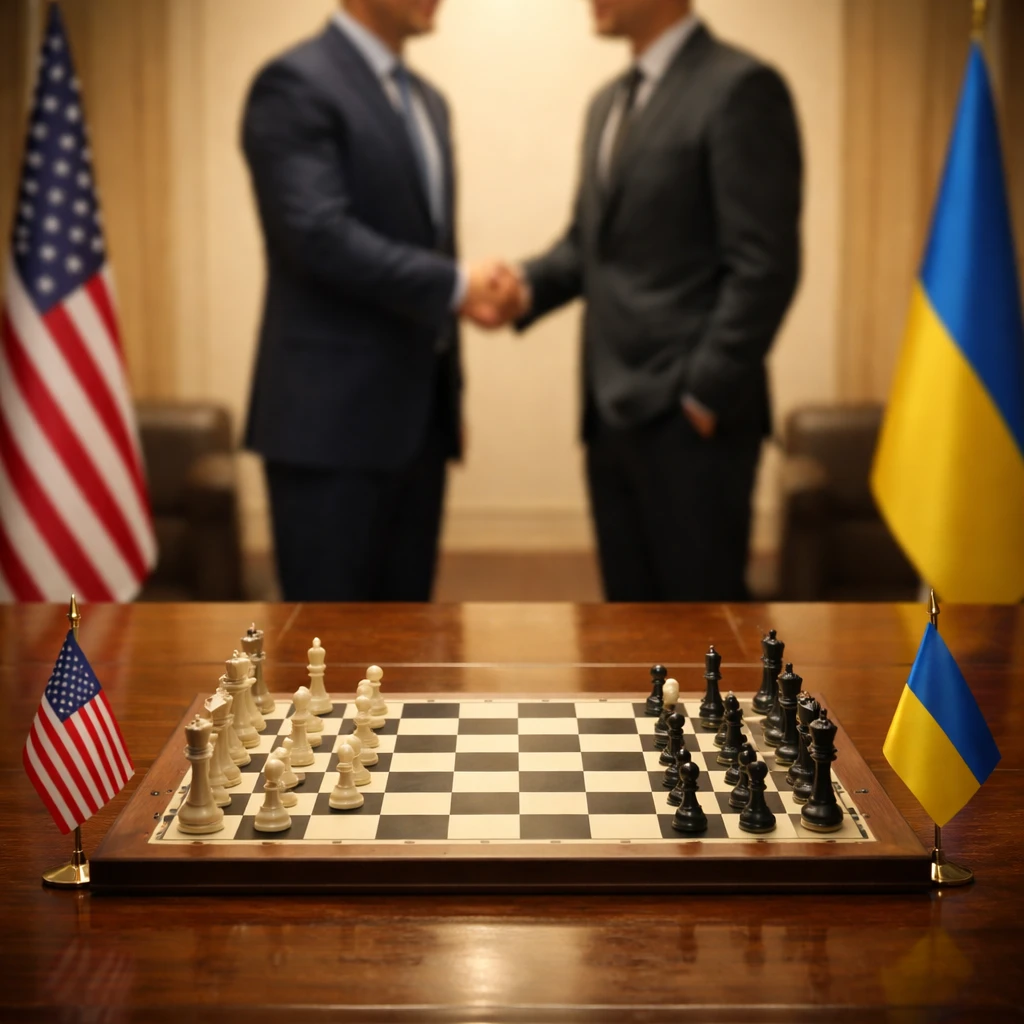

In the aftermath of a high-profile dialogue involving United States President Donald Trump and Ukraine’s President Volodymyr Zelenskyy, Garry Kasparov, the esteemed Russian chess Grandmaster and political commentator, has voiced significant disapproval regarding the nature of US representation during the discussions. Kasparov articulated his concerns over the personnel present from the American side and subsequently commended Zelenskyy for his exceptional composure amidst the intense geopolitical challenges facing Ukraine.
The meeting convened at Mar-a-Lago included several figures closely associated with President Trump, specifically Steve Witkoff, Stephen Miller, Pete Hegseth, and Jared Kushner. Kasparov took to the social media platform X to question the legitimacy of these participants as representatives of US government interests, posing the rhetorical question, “Is anyone going to come to represent America?” This statement underscored the former chess champion’s apprehension that the United States was not adequately represented by official governmental officials during these critical discussions.
Further amplifying issues of US-Ukraine relations, Kasparov shared content from an open-source intelligence post quoting President Trump stating, “Russia wants to see Ukraine succeed.” Kasparov juxtaposed this quote with his own reflection, “We are all Zelenskyy. But no one on Earth has his self-control.” This remark served to highlight the exceptional restraint and leadership qualities demonstrated by President Zelenskyy in navigating the pressures applied by both internal and external forces amid the ongoing conflict involving Ukraine.
These comments from Kasparov provide a nuanced critique of the US political stance, implicitly suggesting a disconnect between the high-stakes diplomatic interactions and the competence and resilience exhibited by Ukraine’s leadership during this critical period.
Parallel to Kasparov’s statements, President Trump announced through his social media outlet Truth Social that prior to meeting President Zelenskyy, he had engaged in a conversation with Russian President Vladimir Putin. Trump invited the press to witness the meeting at Mar-a-Lago, signaling a step toward transparency in these diplomatic exchanges.
President Trump conveyed optimism regarding the peace process, indicating that the United States and Ukraine were “a lot closer, maybe very close” to finalizing a peace agreement. Trump highlighted “very significant” progress particularly concerning security assurances for Kyiv and the establishment of a ceasefire. Despite these advances, territorial disputes within the Donbas region remain a potential stumbling block that could impede the ratification of a formal accord.
In response to the meeting, President Zelenskyy expressed appreciation on X for the productive nature of the encounter at Mar-a-Lago. Both leaders have set plans for continued engagement, with teams from the United States, Ukraine, and European entities scheduled to reconvene in the following week. Moreover, an additional session has been arranged for January in Washington, D.C., to sustain momentum on the peace framework and deliberate on subsequent steps.
This diplomatic dialogue is unfolding against the backdrop of complex geopolitical tensions, with all parties seeking to outline effective strategies to mitigate conflict and secure stability in the region.