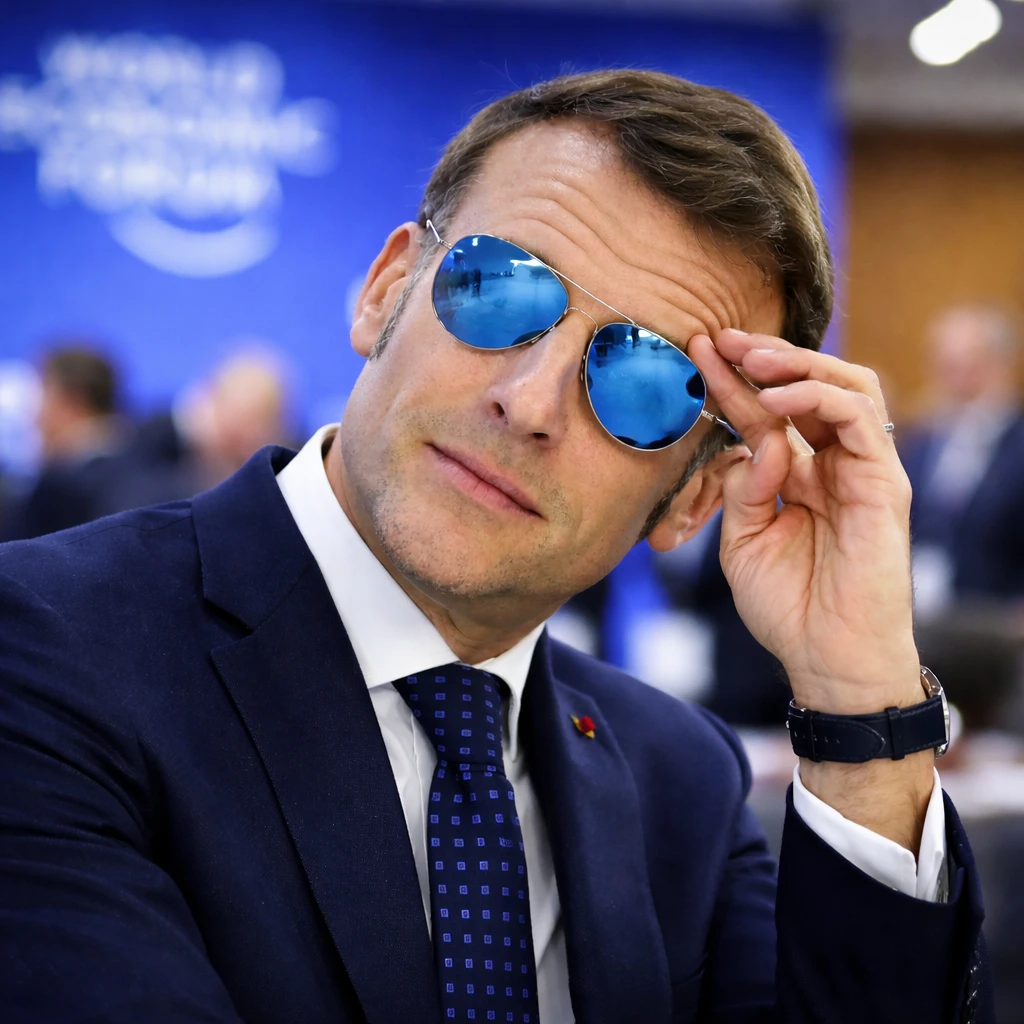

At the annual congregation of global leaders in Davos, Switzerland, French President Emmanuel Macron's reflective aviator sunglasses managed to capture more attention than his speeches. The glasses, which obscure a benign medical condition affecting Macron's right eye, quickly became a viral sensation, eliciting commentary from key figures including U.S. President Donald Trump, and inspired creative content such as an AI-enhanced spoof depicting Macron as a fighter jet pilot, complete with the iconic "Danger Zone" soundtrack from the film "Top Gun."
During his Davos address, President Trump pointedly remarked, "Those beautiful sunglasses. What the hell happened?" This moment underscores the sunglasses' unexpected centrality to discussions at the summit.
The Eyewear and its Origins
Macron’s sunglasses come from the French luxury eyewear company Henry Jullien, specifically the Pacific S 01 model. These frames retail at a premium price of 659 euros (approximately US$775). Following Macron's public appearance sporting these glasses at Davos, Henry Jullien experienced a surge in demand that overwhelmed its online platform, prompting the company to establish a dedicated webpage to manage the influx of inquiries.
The populating buzz provided Henry Jullien's Italian parent company, iVision Tech SpA, with notable stock market momentum on Milan's exchange. The shares climbed from 1.51 euros ($1.78) at the time of Macron's speech on Tuesday to a peak of 2.63 euros ($3.10) by Friday.
Stefano Fulchir, CEO of iVision, expressed both honor and amazement at the attention generated. He confirmed that Macron selected these glasses in 2024 after ensuring their French-made provenance, reflecting an intentional choice connected to national pride. Fulchir also conveyed the challenges of meeting global interest, admitting to reduced sleep as the company fielded extensive media and consumer attention.
Fashion Statement and Public Perception
Macron's decision to wear sunglasses indoors embodies a notable degree of confidence. Cristina Archetti, a political communication expert from the University of Oslo and author on political image construction, praised Macron's style. She described the French leader, aged 48, as looking "relatively young and super cool," especially considering the photogenic quality of the blue-tinted lenses against Davos's blue backdrop. Archetti highlighted how compelling visual impressions are vital for politicians, suggesting Macron's eye-wear choice effectively met these criteria.
The sunglasses also triggered cultural associations in popular memes, likening Macron to iconic figures such as the Terminator and James Bond, visualizing him as a suave casino patron savoring champagne.
Political Dynamics of Sunglasses
While stylish, sunglasses on politicians can introduce challenges due to perceptions of detachment or concealment. Historical use among leaders varies; for example, U.S. President Joe Biden has been seen wearing aviators, which he even gifted to Russian President Vladimir Putin prior to heightened tensions following the Ukraine conflict. In contrast, effective justification such as medical necessity is often essential for such accessories in political contexts to maintain voter trust.
Political analysts note that sunglasses tend to symbolize separation, which can contrast with a politician’s aim to connect authentically with the public. Marco Bohr, a design and digital arts educator, pointed out that sunglasses diverge from politicians' common efforts to create warmth and approachability.
Notably, even autocratic leaders have adopted sunglasses. Former North Korean leader Kim Jong Il was known for his dark, large sunglasses during official visits. Archetti speculated that the use of sunglasses might sometimes mask underlying vulnerabilities or secrets, suggesting a complex relationship between transparency and perception in political imagery.
Macron Amidst Political Tensions
Against the backdrop of heightened tensions between the United States and Europe, particularly stemming from disagreements over Greenland and other issues dominated by President Trump, Macron's eyewear emerged as a distinctive symbol. Fulchir emphasized this point, framing it as a memorable emblem of the summit.
Bohr noted that alternative eyewear choices could have sent different signals. Macron could have opted for an eye patch, evoking the pirate archetype, or more mainstream sunglasses like Ray-Ban Wayfarers, which are associated with jazz culture and a relaxed elegance. By choosing aviator-style glasses, often linked with pilots and control, Macron projected an image of authority and command.