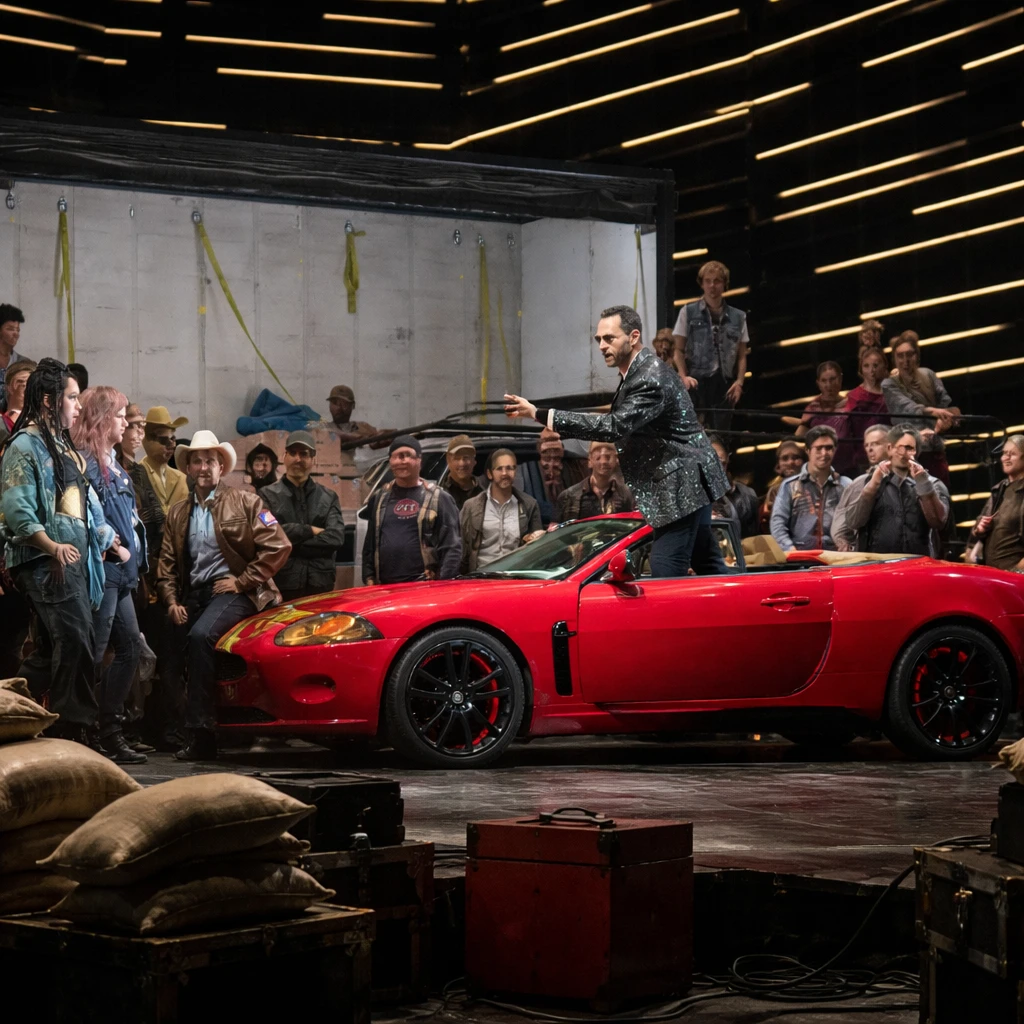

At the Metropolitan Opera in New York, conflict has emerged between the institution and the creative team behind the latest rendition of Georges Bizet’s classic opera "Carmen." The production, making its debut on December 31, 2023, under director Carrie Cracknell's vision, transported the narrative from its early 19th century Spanish origins in Seville to a contemporary American industrial township. This modern adaptation notably recast the famed bullfighter Escamillo as a rodeo star, entering the stage in a striking red Jaguar convertible accompanied by three pickup trucks, all mechanically operated via computer-guided wires.
Shortly before the opening, prompt financial assessments at the Met prompted decisions to curtail expenses by eliminating much of the original vehicular automation. This led to the removal of the Jaguar and two of the trucks during a restaging phase. Instead of a motored entrance, Escamillo was reimagined walking alongside allies, some pushing a motorcycle, with only one truck remaining on stage but fixed in place throughout the act.
The alterations provoked strong dissent from the creative team. Michael Levine, the production's set designer, expressed profound dissatisfaction, stating, "We were furious. I did not want my name associated with the altered production because it no longer represented the original artistic intention. I've never encountered such fundamental changes to a concept post-opening night." Levine and director Cracknell communicated their concerns to the production's assistant general manager, John Sellars, who cited severe financial constraints necessitating cost-cutting measures including the cessation of the vehicles’ automation.
According to Levine, his contract explicitly prohibited changes after opening night, but the Met proceeded with modifications regardless. In response, Levine removed his name from the program listings. The Met then offered the remaining production team members a single day to decide whether to follow suit. Alongside Levine and Cracknell, costume designer Tom Scutt, lighting designer Guy Hoare, projection specialist rocafilm/Roland Horvath, and choreographer Ann Yee also requested their names be omitted.
Consequently, post their withdrawal, only revival stage director Melanie Bacaling remained credited in the program following the conductor and chorus master, accompanied by a significant blank space where other credits would have appeared.
Met General Manager Peter Gelb characterized the decision to scale back the production’s mechanical complexity as an economic necessity, stating the prior setup was extremely costly, exceeding $300,000 in savings by removing automation which he deemed not particularly effective. Gelb concurrently announced broader budgetary measures including 22 layoffs within an administrative staff of 284, temporary salary reductions ranging from 4 to 15 percent, and the reduction of the upcoming season repertoire by one opera, from 18 to 17 productions. These steps are projected to save $15 million in the current fiscal year and an estimated $25 million in 2026-2027.
Cracknell’s production of "Carmen" was scheduled to conclude after 30 performances over two seasons by the end of the week. A representative of the director referred inquiries to Levine, who voiced broader mistrust in his working relationship with the Met following these events.
A source familiar with Met's programming, speaking anonymously, confirmed that the company plans to reintroduce a retired staging by Richard Eyre, originally premiered on December 31, 2009, and performed 79 times over six seasons until 2019.
Both Cracknell and Levine have notable credentials. Cracknell, aged 45, earned nominations for a Tony Award for "Seawall/A Life" featuring Jake Gyllenhaal and an Olivier Award for the English National Opera’s production of Berg’s "Wozzeck." Levine, 65, has an extensive history with the Met, designing sets for a variety of productions including the highly regarded stagings of Tchaikovsky’s "Eugene Onegin" and Puccini’s "Madama Butterfly." Despite the tensions, Gelb expressed high regard for Levine, calling him "one of the greatest designers in the world," and took pride in showcasing many of Levine’s acclaimed designs on the Met stage.
An analogous dispute occurred with the Met’s 2000 revival of Verdi’s "Il Trovatore," where initial audience reception led to quick restaging and the creative team withdrawing their credits for the 2002-2003 revival, which had limited runs and was eventually replaced in 2009.
Levine is slated to return to the Met in the upcoming season, working on Claus Guth’s staging of Leoš Janáček’s "Jenůfa," a production previously seen at the Royal Opera in London and the Lyric Opera of Chicago.