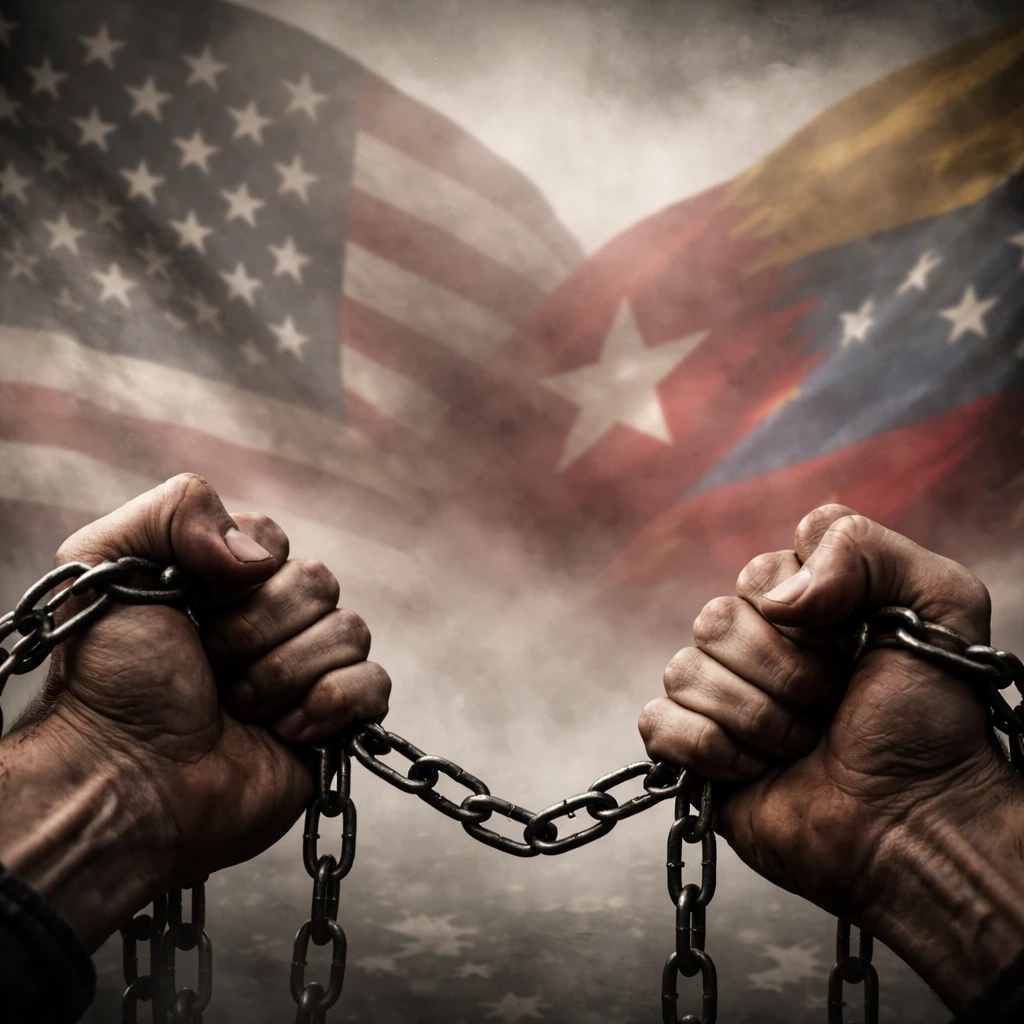

U.S. Secretary of State Marco Rubio delivered pointed remarks on Saturday that highlighted escalating tensions between the United States and Cuban leadership, directly in the wake of the U.S. military’s apprehension of Venezuelan President Nicolás Maduro. Speaking from Florida's Mar-a-Lago resort, Rubio sharply criticized Cuba's government, describing it as "incompetent" and accused it of heavily influencing Venezuela's security infrastructure.
Rubio's comments underscored his assessment that Cuba's presence in Venezuela extends deeply into its security domain, framing it as a form of de facto "colonization." He suggested that this entanglement represented a significant risk for Havana's ruling officials themselves, stating, "If I lived in Havana and I was in the government, I'd be concerned at least a little bit." This rhetoric marks a rare and stern public admonishment from a key U.S. official regarding Cuba’s role in regional dynamics.
Previously, President Trump had acknowledged the U.S. administration's commitment to nurturing favorable relations with neighboring nations but recognized challenges that Cuba presently faces. This broader context sets the backdrop for Rubio’s pointed critique.
On the other side of the diplomatic spectrum, Cuban government officials responded by condemning the U.S. military operation as an aggressive infringement on Venezuela’s sovereignty. Bruno Rodríguez Parrilla, Cuba's Foreign Minister, took to social media to express vehement opposition to the intervention. He framed the U.S. action as a strategic attempt to seize control of Venezuela's vital resources, particularly its oil reserves and mineral wealth, thereby undermining the country's political independence. Rodríguez asserted with conviction that such efforts "will not succeed." This official rebuttal reflects Cuba’s firm stance against what it perceives as unwarranted interference in Venezuelan affairs.
The U.S. operation against Maduro unfolded early Saturday morning, accompanied by reports of multiple explosions in Caracas as well as other Venezuelan regions. These blasts, numbering at least seven, occurred roughly around 2 a.m. local time, signaling the scale and intensity of the military action.
Venezuelan President Nicolás Maduro and his wife, Cilia Flores, were apprehended during this operation. They are currently en route to New York where they are expected to face criminal charges that include narco-terrorism and violations involving weapons. The circumstances of their capture have sent ripples through international political circles.
Within the United States, the military intervention has sparked controversy among lawmakers. Several Democratic members of Congress have voiced strong criticism, primarily over the administration’s decision to proceed without securing formal congressional authorization for the action. Prominent figures such as Senator Bernie Sanders from Vermont have articulated constitutional concerns, emphasizing that the President lacks the unilateral authority to engage in warfare. Sanders reinforced that this limitation applies even in cases involving dictators like Maduro.
From Venezuela’s official stance, the government publicly denounced the U.S. military incursion as an act of aggression. In addition to the explosions, Venezuelan Vice President Delcy Rodriguez has demanded "proof of life" concerning the status of Maduro and his wife, illustrating the heightened state of uncertainty and tension that has followed the operation.
These developments collectively depict a convoluted and heated geopolitical environment. The U.S. actions have provoked strong reactions on multiple fronts, ranging from Cuba’s outright denunciation to domestic debates about executive authority and international law. Moreover, Maduro’s capture and transfer to U.S. custody represent a significant moment in the ongoing Venezuelan crisis and U.S.-Latin America relations.
Experts and officials will likely continue monitoring how these events evolve and the potential repercussions on regional stability, diplomatic ties, and internal political dynamics within the involved nations.