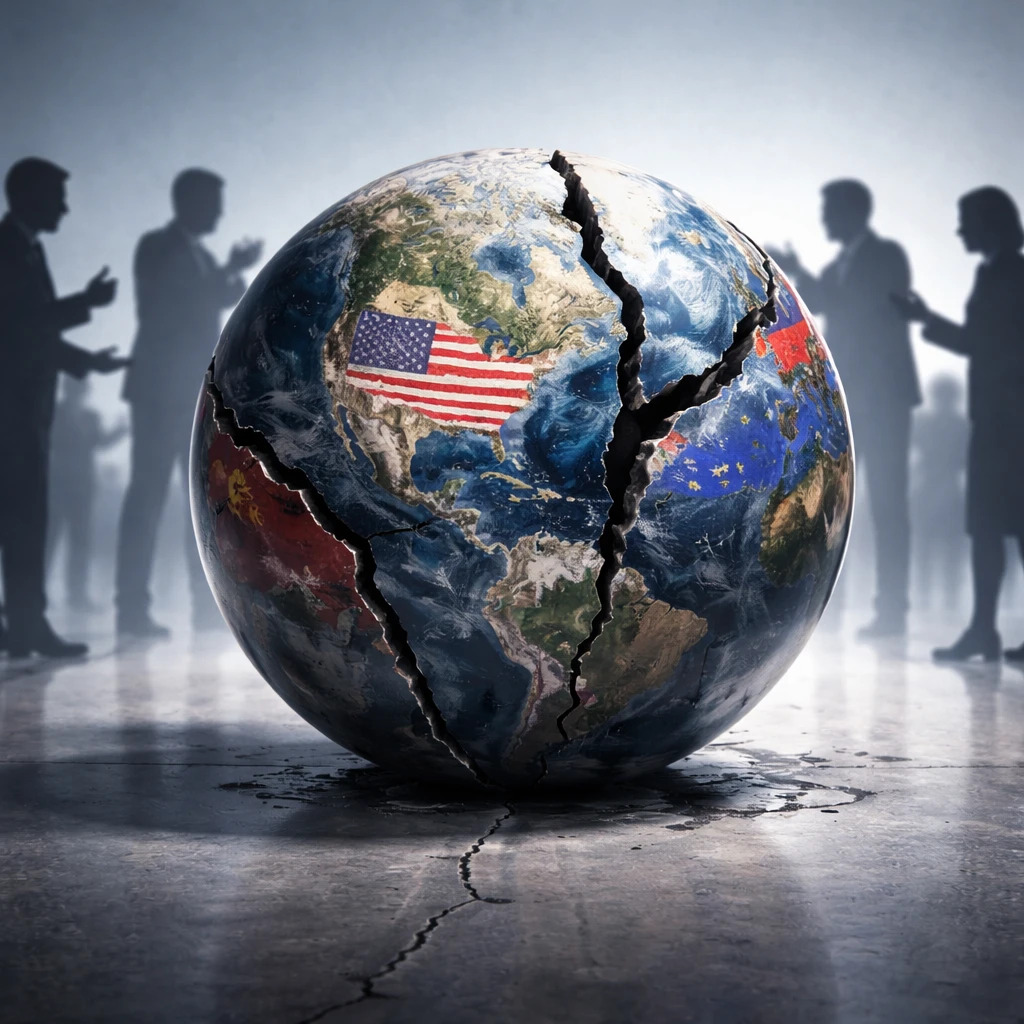

In a series of pointed statements, Senator Bernie Sanders (I-Vt.) publicly challenged President Donald Trump's commitment to an "America First" foreign policy, emphasizing actions that suggest a complex prioritization leveraging international deals and military support abroad.
On a social media platform on Saturday, Sanders articulated a critical view of the administration's foreign engagements. He specified several policy moves as examples that he believes undermine the foundational slogan. His criticisms targeted what he described as unilateral and unconstitutional military interventions in Venezuela, substantial arms sales amounting to $12 billion provided to Israeli Prime Minister Benjamin Netanyahu, a sizable $40 billion economic bailout extended to Argentina’s president, approval for military hardware sales including jets and tanks to Saudi Arabia, and the establishment of an Air Force facility in Idaho dedicated to Qatar’s forces.
Sanders encapsulated his skepticism with the rhetorical question: "America first? Really?" highlighting an evident contradiction in the administration’s approach.
Other political and governmental actors have also weighed in on aspects of international and domestic policymaking under President Trump in recent days. The U.S. Commerce Department underscored a historic $26 trillion discrepancy in foreign ownership of U.S. assets since 1985, attributing this gap partly to failed trade policies of the past, and credited President Trump as well as Secretary Lutnick for their efforts aimed at reversing the trend.
Meanwhile, House Minority Leader Hakeem Jeffries (D-N.Y.) voiced criticism of Republican factions for their concentrated attention on Greenland, questioning the relevance of such focus to the immediate welfare of ordinary American citizens and concluding that this fixation does "not a damn thing" to benefit them.
At a state level, Minnesota Governor Tim Walz highlighted the administration's deployment of thousands of armed federal officers within his state, an operation coinciding with a fatality occurring within the first day. Walz expressed concern that President Trump might seek to foment further disorder to divert attention from the incident, and he called on residents to resist opportunities for such manipulation.
On an economic front, Treasury Secretary Scott Bessent reported robust U.S. economic growth, citing a 4.3% gross domestic product (GDP) increase in the third quarter and forecasting a 5.4% expansion for the fourth quarter of 2025. Bessent identified exports, a narrowed trade deficit, and the administration's trade policies as key influences underpinning this growth.
Despite these optimistic projections, economic commentators like economist Peter Schiff have warned of the potential risks associated with President Trump’s assertive foreign rhetoric. Schiff argued that such posturing could exacerbate national debt challenges and destabilize the U.S. dollar, contributing to broader economic uncertainty.
These developments reflect an ongoing debate about the intersection of President Trump’s foreign policy maneuvers, domestic political strategies, and economic outcomes as the administration advances toward its future agenda.