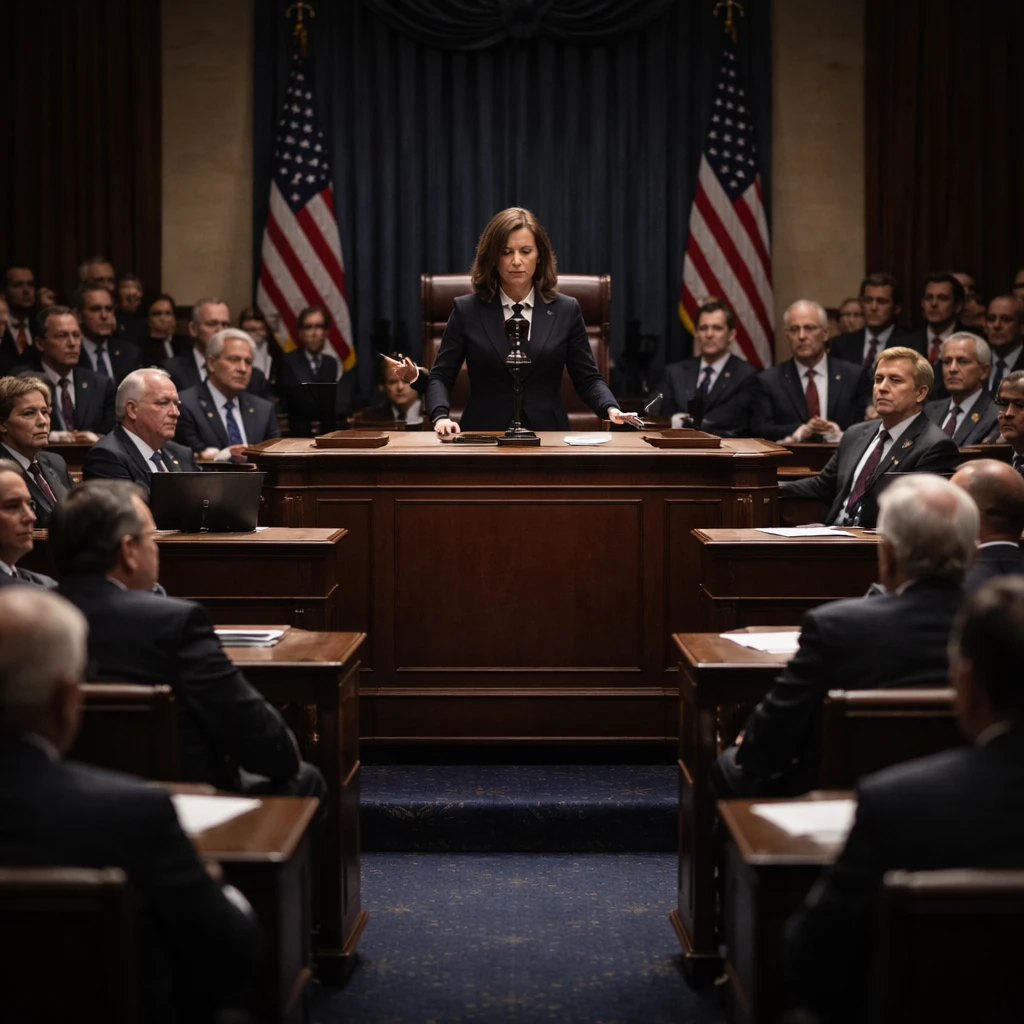

In a dramatic late-night session, the Senate failed to pass a war powers resolution designed to constrain President Donald Trump's authority to conduct further military actions in Venezuela without prior Congressional approval. Vice President J.D. Vance cast the deciding vote, tipping the Senate to defeat the measure by a narrow margin of 51-50.
The resolution, championed by Senator Tim Kaine (D-Va.), sought to prohibit American military forces from engaging within or against Venezuela unless explicitly authorized by Congress. This legislative effort is a direct response to the administration's operation on January 3 to capture Venezuelan leader Nicolás Maduro.
The Senate proceedings reflected intense deliberations and razor-thin margins. Earlier, the resolution had advanced out of the Senate Foreign Relations Committee with bipartisan support, bolstered by five Republican senators who joined their Democratic counterparts. This committee vote garnered a 52-47 majority, allowing the resolution to reach the Senate floor.
However, the final vote on the Senate floor revealed a shifting landscape. Initially holding sufficient votes, supporters of the resolution saw two Republican senators, Josh Hawley (R-Mo.) and Todd Young (R-Ind.), reverse their positions. This shift reduced the pro-resolution votes, culminating in a 50-50 deadlock.
This tie provided Vice President Vance the opportunity to break the impasse, which he utilized to reject the resolution, effectively maintaining the current scope of presidential authority over military operations in Venezuela.
The reversals by Senators Hawley and Young highlighted the significant influence exerted by President Trump over Republican members of the Senate. Following the committee vote, the President publicly criticized the five Republicans who had sided with Democrats on social media. Furthermore, according to a Reuters report, he conducted phone conversations urging these senators to reconsider their support for the resolution.
In explaining his change of mind, Senator Young cited discussions with senior national security officials, stating he had received assurances that American troops were not presently deployed in Venezuela. He also conveyed a firm commitment from the administration that if military deployments were deemed necessary, especially for major operations, Congress would be consulted in advance for authorization.
Supporting this claim, Senator Young shared a letter dated the day of the vote from Secretary of State Marco Rubio. The letter emphasized that the President would seek congressional authorization prior to introducing U.S. armed forces into substantial hostilities in Venezuela, circumstances permitting.
Proponents of the resolution argued that the ongoing presence of U.S. naval forces and the possibility of expanding military involvement in Venezuela necessitate clear congressional oversight and approval. They contended that the War Powers Resolution provides an essential check on executive authority in such instances.
Opponents, largely from the Republican leadership, maintained that no American ground troops are currently operating in Venezuela, and that the January operation was limited both in scope and duration. Consequently, they argued that invoking the War Powers Resolution was unwarranted.
The debate underscored a fundamental tension between legislative oversight and executive discretion regarding the deployment of U.S. military forces abroad, particularly within the context of Venezuela's evolving political situation.