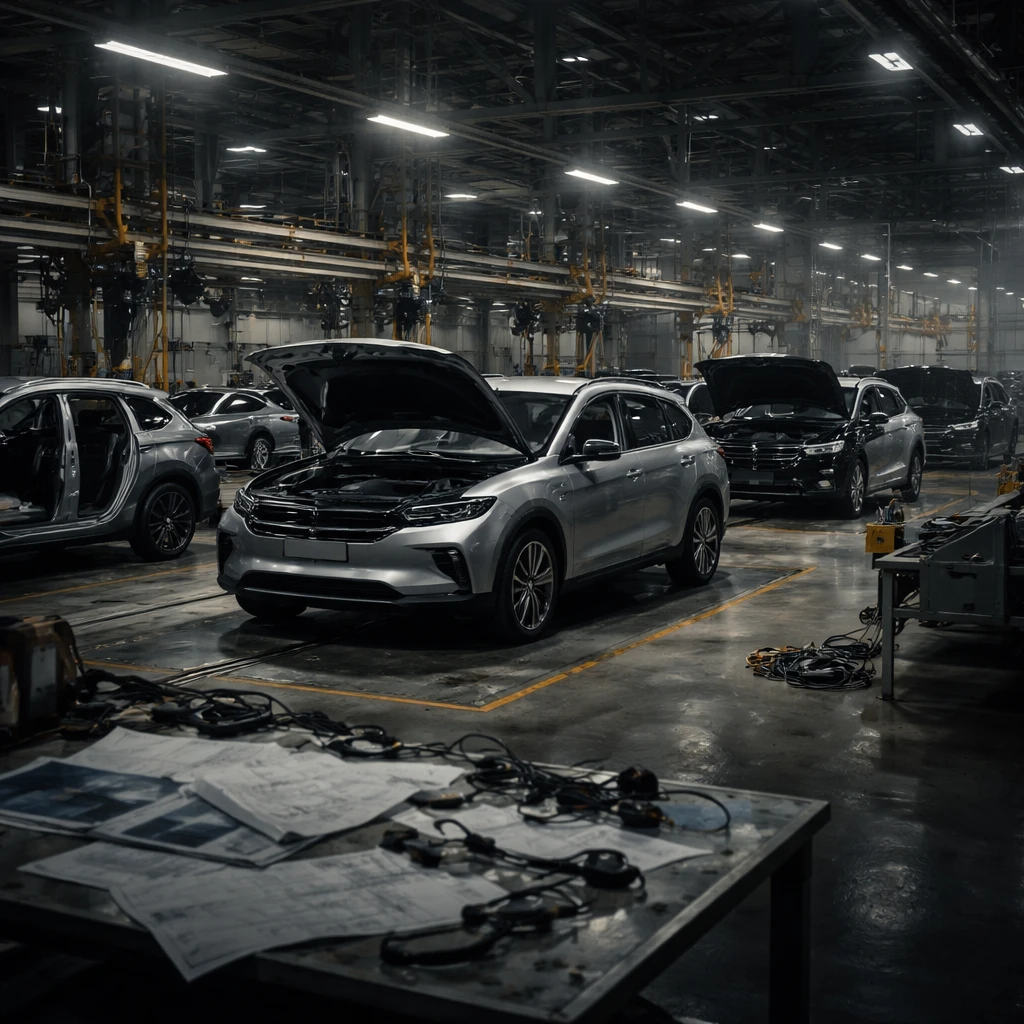

Automobile manufacturer Stellantis, responsible for iconic brands including Jeep and Chrysler, has declared a significant restructuring of its business strategy after its large-scale investments in electric vehicles (EVs) did not yield anticipated results. On Friday, the company revealed that it would record charges surpassing $26 billion. These charges chiefly consist of write-offs and cash outlays associated with the cancellation of certain EV projects and the downsizing of its electric vehicle supply chain operations.
The market reacted swiftly and negatively to this announcement, with Stellantis (traded under the symbol STLA) experiencing a steep drop in its share price, falling over 28% on Friday morning alone. This adjustment in strategic direction is comparable to recent costly decisions by other automotive manufacturers such as Ford and General Motors, who are also recalibrating EV strategies amid evolving market and regulatory environments.
Many American automobile manufacturers had initially heavily invested in EV development, driven by stringent environmental regulations enacted during the Biden administration. These policies also included expectations that multiple states might follow California's lead in prohibiting sales of gasoline-powered vehicles within the next decade. However, the continuation of some of these policies faces challenges. The Trump administration had reversed several emissions regulations and financial incentives supporting EV adoption, and the authority of states to impose tougher emission standards is under legal scrutiny.
Addressing the financial charges amounting to approximately 8.7 billion euros ($26.2 billion), Stellantis CEO Antonio Filosa acknowledged that these amounts largely represent costs arising from an overestimation of the speed at which the automotive energy transition would occur. The company asserted that the shift to electric vehicles should be led by actual consumer demand rather than regulatory commands. The firm emphasized its commitment to supporting customer freedom of choice, particularly accommodating those whose lifestyles or employment require vehicles powered by hybrid or advanced internal combustion technologies, alongside their growing electric lineup.
A significant portion of the charges, approximately 8.7 billion euros, relate specifically to aligning product offerings more closely with customer preferences and adapting to new emission regulations in the United States. Stellantis, which operates under listings in New York, Milan, and Paris, also disclosed a net loss for the year and signaled that it would withhold annual dividend payments scheduled for 2026 as part of this strategic repositioning. The company is set to release its 2025 earnings report on February 26.
In Europe, regulatory developments also present challenges for the EV transition. Initially, the European Union intended to ban all sales of new combustion engine vehicles by 2035. However, following lobbying from automotive manufacturers, in December the EU executive revised this approach, imposing the ban on only 90% of new vehicles, thereby still allowing 10% of new cars to be plug-in hybrids or combustion engine-powered beyond 2035.
European consumer uptake of EVs has not met manufacturers' expectations, hindered in part by inconsistent charging infrastructure availability across the continent. Evaluating the environmental impact of vehicles requires considering their entire lifecycle, including manufacturing emissions. While gas-powered, hybrid, and electric vehicles each emit similar pollution levels during manufacture until battery production commences, electric vehicles demand substantial mining for battery materials. This results in EVs having, on average, 40% higher manufacturing carbon emissions compared to hybrid and traditional gasoline vehicles.
However, over the total lifecycle, the comparative emissions balance shifts. Traditional gasoline-powered vehicles have the lowest manufacturing emissions but generate the highest lifetime carbon pollution due to tailpipe emissions. In contrast, although EVs have the highest production emissions, their total carbon footprint is the smallest across their operational lifetime, averaging a 40% reduction relative to gasoline-powered vehicles.