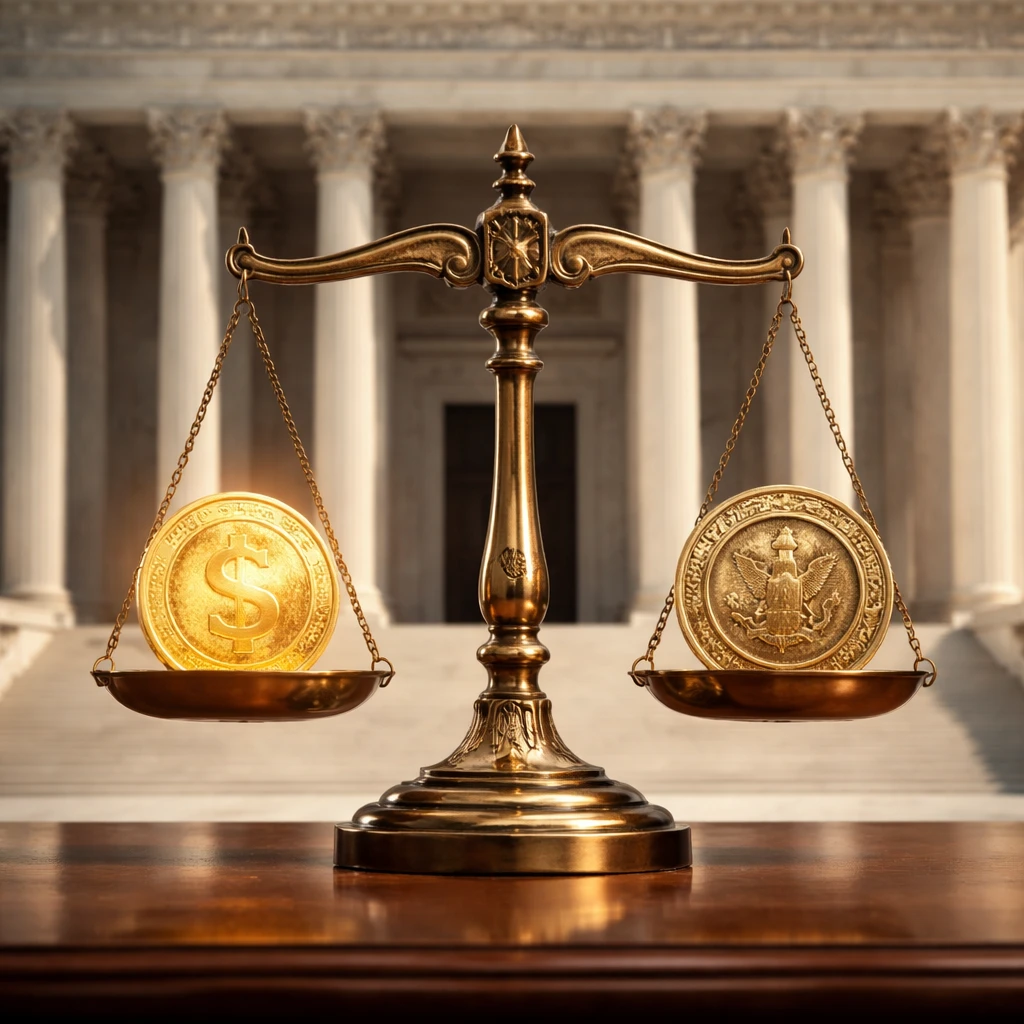

Washington, DC — The pivotal nature of the Supreme Court's deliberation this week could redefine the framework governing the Federal Reserve's independence in setting national interest rates, a critical pillar of United States economic strategy. At 10 a.m. ET, the Court began oral arguments regarding the challenge brought forth by Federal Reserve Governor Lisa Cook, who contests President Donald Trump's attempt to remove her from the influential Board of Governors. The administration alleges Cook engaged in mortgage fraud linked to reporting two distinct homes as her primary residences — a tactic that can potentially secure more favorable loan terms. These accusations have yet to be substantiated, with Cook denying any wrongdoing. Furthermore, the Department of Justice is investigating these claims but has not pursued formal charges.
Legally, the Federal Reserve Act of 1935 restricts the president's authority to remove Board members to instances where there is "cause," commonly interpreted as significant neglect or improper conduct in official duties. Should the Supreme Court side with President Trump, it could erode the crucial firewall that protects the Federal Reserve from political maneuvers, generating concern over heightened political interference in monetary policy and unsettling global markets. Such a ruling could lower the threshold for removal, enabling the White House to oust Fed officials whose policy views diverge from presidential preferences.
Patrick Harker, former president of the Philadelphia Federal Reserve, expressed his concerns at a recent central banking forum, emphasizing the Court as the foremost contemporary threat to the Fed's independence. He asserted, "If the decision goes against Governor Cook, independence effectively disappears as every future president may exploit this ruling to remove officials at will."
In addition to the constitutional stakes, a favorable ruling for Trump would provide an opportunity to appoint a new member to the Fed Board in the current year, effectively shaping the institution's future direction.
Fed Chair Jerome Powell, named as a co-defendant in the case, is attending the Supreme Court hearings accompanied by the Federal Reserve’s chief legal counsel. Experts note this participation as an unusual and overt sign of institutional solidarity. Treasury Secretary Scott Bessent criticized Powell’s presence, labeling it a "real mistake," highlighting tensions around the issue.
Context and Institutional Pressures
Governor Cook's lawsuit epitomizes the frustrations voiced by the Trump administration regarding its inability to exert influence over the Fed's control of interest rate policy — a potent economic lever. The administration, during Trump's second term, has exerted intense pressure on the Fed to accelerate rate reductions. Trump has repeatedly criticized Chair Powell with disparaging language, accusing him of failing to reduce rates swiftly enough following earlier hikes designed to counteract pandemic-related inflation pressures.
Powell has recently disclosed a subpoena from the Department of Justice related to his testimony before Congress about the Fed’s $2.5 billion renovation of its Washington headquarters. In a rare video statement responding to these investigations, Powell suggested the legal actions represent a pretext to undermine the central bank’s independence, stating, "The threat of criminal charges arises from the Fed setting rates based on our best judgment for public benefit rather than following the President's preferences."
Federal Reserve Independence at Risk
The Federal Reserve's institutional design maintains separation between monetary policy and political influence. The committee responsible for setting rates consists of 12 members, seven appointed by the president to staggered 14-year terms, which serve to buffer the Fed from transient political pressures.
Allowing Cook's removal without clear cause through this Court decision would potentially establish a dangerous precedent enabling any president to reshape the Board to fit political aims, particularly to achieve lower interest rates irrespective of economic fundamentals.
Kevin Gordon, senior analyst at Charles Schwab, emphasized the magnitude of this decision, stating the Court's ruling will significantly impact a president's capacity to dictate the Fed’s organizational structure.
Economists broadly concur that the Fed’s data-driven, sometimes difficult decisions on interest rates promote economic stability, contrasting with earlier eras when political considerations compromised policy effectiveness, such as in the 1970s and early 1980s. During that period, then Fed Chair Arthur Burns, closely aligned with President Nixon, failed to lower rates ahead of an election despite signs of impending inflation, exacerbating economic hardship marked by high unemployment and inflation.
Upcoming Leadership Changes
Adding further significance to the case, President Trump plans to announce a nominee for Fed Chair within the next fortnight. Chair Powell's term ends on May 15; he simultaneously holds a Board seat extending until 2028 but has not disclosed intentions regarding his future at the Fed after his chairmanship concludes.
There is also uncertainty about the continuation of Fed Governor Stephen Miran, whose temporary appointment expires later this month. The leading contenders for the Chair position include National Economic Council Director Kevin Hassett, former Fed Governor Kevin Warsh, Fed Governor Christopher Waller, and Rick Rieder, Chief Investment Officer for Global Fixed Income at BlackRock.