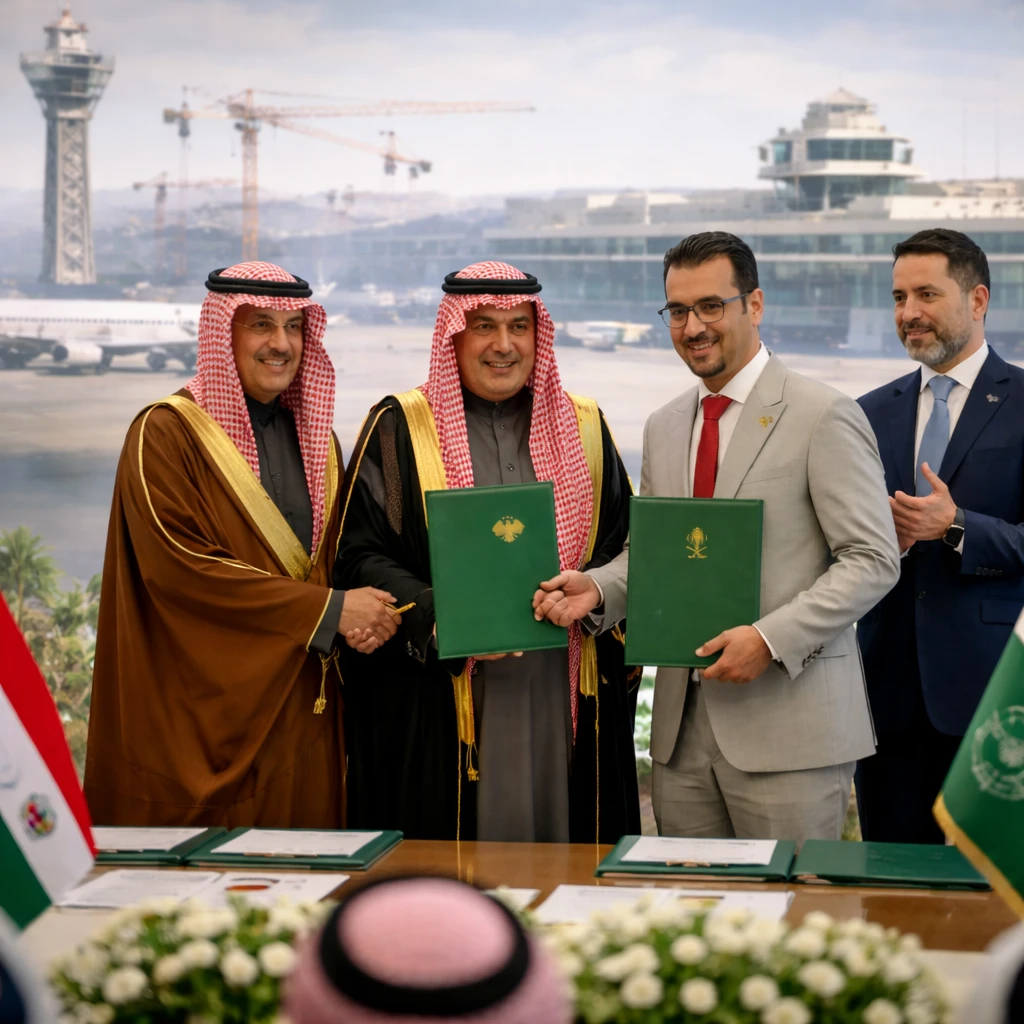

Syria and Saudi Arabia Forge Key Investment Deals to Revitalize Syrian Economy
February 7, 2026
News & Politics

Syria and Saudi Arabia Forge Key Investment Deals to Revitalize Syrian Economy

Milestone agreements include telecom infrastructure, affordable airline, and Aleppo airport development initiatives

Summary

Syria and Saudi Arabia have formalized investment agreements encompassing a telecommunications infrastructure boost, the launch of a budget airline, and the development of an international airport in northern Syria. These agreements come amid Syria’s efforts to recover economically following prolonged conflict and the easing of Western sanctions after leadership changes. The array of projects signals increased foreign involvement aimed at reconstructing critical sectors including communications, transportation, and utilities.

Key Points

Syria and Saudi Arabia signed investment contracts involving telecommunications, airline services, and airport infrastructure, marking a strategic push to rebuild Syria's economy.
The nearly $1 billion SilkLink telecom project aims to transform Syria into a key international telecommunications hub by enhancing connection lines between Asia and Europe.
Saudi Arabia's ACWA Power will collaborate with Syria's Energy Ministry on water infrastructure projects, while a new low-cost airline Flynas Syria will enter the transport market to enhance air connectivity.

In a significant step toward economic recovery, Syria and Saudi Arabia finalized several major investment agreements on Saturday, committing billions of dollars in collaborative projects designed to strengthen Syria’s telecommunications, aviation, and infrastructure sectors. These accords include an ambitious telecom initiative to enhance regional connectivity, the establishment of a low-cost joint airline, and plans for an international airport in Syria’s northern city of Aleppo.

The war-torn Syrian economy, greatly weakened after years of devastation that resulted in nearly half a million deaths and widespread infrastructure collapse, is now cautiously reopening to foreign investments. This shift has been facilitated by the removal of most Western sanctions following a regime change that saw the ouster of former President Bashar Assad in late 2024, enabling capital inflows and international business engagement.

Abdulsalam Haykal, Syria's Minister of Communications and Information Technology, revealed details about the telecommunications project, which is allocated close to $1 billion in investment. The initiative will unfold in two phases over a period ranging from eighteen months to two years. Haykal explained that the project — named SilkLink — aims to position Syria as a strategic hub in global telecommunications by laying down thousands of kilometers of fiber optic cables to improve internet connectivity linking Asia and Europe.

Saudi Telecom Company (STC Group) will spearhead the telecom project, as confirmed by Saudi Investment Minister Khalid al-Falih, underlining the depth of Saudi participation in Syria's economic revitalization.

Further enhancing bilateral cooperation, the Syrian Energy Ministry entered into an agreement with Saudi Arabia’s ACWA Power, an established entity in power generation and water desalination. This collaboration is expected to facilitate advancements in Syria's water infrastructure, a critical component in supporting both domestic needs and industrial activities.

Among the investment deals is the formation of Flynas Syria, a new budget airline created through joint efforts by the two nations. While financial specifics of this venture remain undisclosed, it highlights a strategic thrust to reinvigorate Syria's aviation sector by providing affordable air travel options domestically and possibly internationally.

Moreover, Saudi Arabia is undertaking the establishment of an investment fund tasked with upgrading and developing Aleppo’s international airport to accommodate up to 12 million travelers annually. This project represents a pivotal infrastructure undertaking aimed at boosting the region’s accessibility and economic potential.

These initiatives follow a prior announcement in July when Syria and Saudi Arabia declared 47 investment agreements collectively worth more than $6 billion, underscoring a growing momentum in cross-border economic engagement.

Risks
  • The realization of these projects depends on the stability of Syria’s political and economic environment amid recent regime changes.
  • The extent to which international sanctions have been lifted or could be reinstated may affect foreign investment flows and project implementation.
  • Uncertainties surrounding the full operationalization and sustained management of large-scale infrastructure projects could impact projected economic benefits.
Disclosure
This article is based on publicly available statements and official announcements from Syrian and Saudi government sources and does not contain any forward-looking projections beyond stated plans.
Search Articles
Category
News & Politics

News & Politics

Related Articles
Amazon's Investment Propels Beta Technologies Stock in After-Hours Trading

Beta Technologies Inc, an aerospace company specializing in electric aircraft and propulsion systems...

Maximizing Your 401(k): Understanding the Power of Employer Matching

Overestimating investment returns can jeopardize retirement savings. While it's prudent to plan cons...

SoFi Shares Slip Slightly Despite Strong Q4 Earnings and Bullish Outlook

SoFi Technologies Inc’s stock saw a minor decline Tuesday afternoon following a period of heighten...

UBS Adjusts Tech Sector Outlook, Advocates Diversification Into Healthcare and Financials

UBS has revised its stance on the U.S. information technology sector from attractive to neutral, hig...

ArcelorMittal Advances Green Steel Production with Major Dunkirk Investment

ArcelorMittal's recent announcement of a €1.3 billion investment in an electric arc furnace (EAF) ...

Why Retirement Savings Remain Stagnant and How to Address Common Pitfalls

Many individuals find themselves concerned about the insufficient growth of their retirement account...