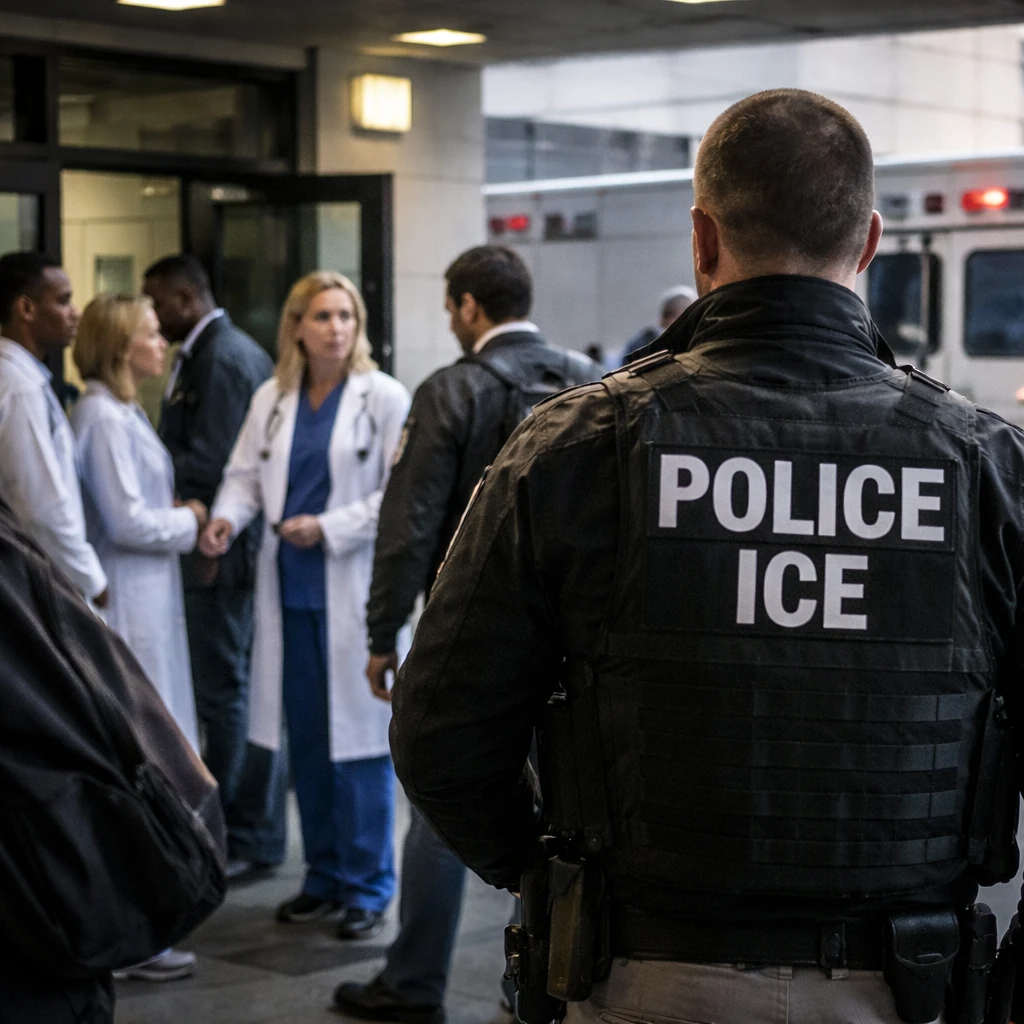

Federal immigration officials' involvement at Minneapolis hospitals has created notable unease among medical staff, sparked by an incident involving Alberto Castañeda Mondragón, a 31-year-old Mexican immigrant who sustained severe facial and cranial injuries. Upon his admission to Hennepin County Medical Center, intensive care nurses expressed immediate skepticism toward Immigration and Customs Enforcement (ICE) officers' account of his injuries.
ICE initially reported that Castañeda Mondragón attempted to flee custody while handcuffed and sustained his injuries by running headfirst into a brick wall, according to legal documents filed on his behalf. However, nurses familiar with the case have stated that the nature and extent of his fractures and brain hemorrhages do not align with such an explanation.
One nurse, choosing to remain anonymous due to professional restrictions, remarked on the implausibility of the federal officers' narrative, emphasizing that his injuries were inconsistent with a collision against a wall.
The relationship between ICE agents and hospital personnel has been strained, with reports of officers restraining patients contrary to hospital guidelines and maintaining a constant presence by patients' sides, as well as within hospital grounds where they have questioned others on citizenship status. These behaviors have intensified tensions within the medical community at Hennepin County Medical Center.
Following the initiation of Operation Metro Surge, a campaign within Minnesota targeting undocumented immigration, ICE's visible presence has grown significant enough for hospital administration to release new engagement protocols for staff. Some employees report a heightened sense of intimidation, leading them to avoid ICE personnel during work hours and communicate via encrypted platforms to safeguard their privacy.
Similar federal initiatives have been implemented in other major cities, where allegations of excessive force and aggressive tactics have been echoed. Details regarding the number of detainees requiring hospitalization remain unclear.
An investigation involving interviews with hospital physicians and nurses disclosed unanimous professional opinions that Castañeda Mondragón's injuries could not have resulted from an accidental fall or from running into a wall. The evolving explanations provided by ICE officers during the patient's hospital stay further complicated the situation.
Officers reportedly described the detainee as having been assaulted following his arrest on January 8 near a St. Paul shopping center, an event occurring shortly after two fatal shootings involving immigration enforcement in Minneapolis. Tensions escalated when agents insisted on securing his ankles to the hospital bed with handcuffs, prompting confrontations with the medical staff.
At that time, the patient was severely disoriented and unable to recall the year or the cause of his injuries. ICE personnel interpreted his movement within the hospital room as an escape attempt, an interpretation challenged by nurses who explained that such impulsivity is common in patients suffering traumatic brain injuries.
The conflict was resolved through negotiation, resulting in a nursing assistant being assigned to monitor the patient instead of the continued use of physical restraints. The Department of Homeland Security did not respond to inquiries about these events, though court documents briefly acknowledged the necessity of emergency care for a head injury identified during intake at a detention center.
Castañeda Mondragón's background includes legal entry into the United States in 2022 and the establishment of a business entity in St. Paul in 2023, with no criminal history noted. Legal representatives argue that his arrest was a product of racial profiling within federal immigration strategies, with his visa overstay identified post-arrest.
Following his January 8 arrest, he was transferred from an ICE processing facility to a suburban emergency room due to visible trauma and neurological symptoms. Imaging revealed multiple skull fractures and extensive brain hemorrhages, prompting transfer to Hennepin County Medical Center. Initial awareness and communication from the patient devolved as the injuries progressed in severity.
External medical consultation from a forensic pathologist supported the hospital staff's assessments, deeming the injuries incompatible with the reported mechanism and asserting that the extent and locations of the skull fractures make self-inflicted blunt trauma from running into a wall highly improbable.
ICE officials have maintained a continuous presence at patients’ bedsides for extended periods, a practice that has unsettled hospital teams. Concerns include the perceived intimidating behavior of armed agents unfamiliar with medical protocols and the intrusion into healthcare settings. Staff members reported avoiding certain areas to evade contact and adopting encrypted communications to mitigate potential surveillance risks.
In response, hospital policies underscore the primacy of patient rights and privacy, restricting ICE access without appropriate legal authorization and forbidding the use of restraints absent medical necessity. Nevertheless, the interaction between hospital protocols and federal enforcement actions has remained a source of friction.
More than two weeks after his detention, a federal judge ordered Castañeda Mondragón's release from ICE custody. Despite a lack of detailed information regarding his condition at discharge, his recovery challenges are considerable, including significant memory impairment. Absent family support within Minnesota, friends and associates have assumed caretaking roles.
His brother expressed concern over the lasting negative impressions his brother’s experience created about the United States, contrasting sharply with prior aspirations and support for his daughter's future back in Mexico.
Reported by Ajmal Hussain from Minneapolis, with contributions from national correspondents.