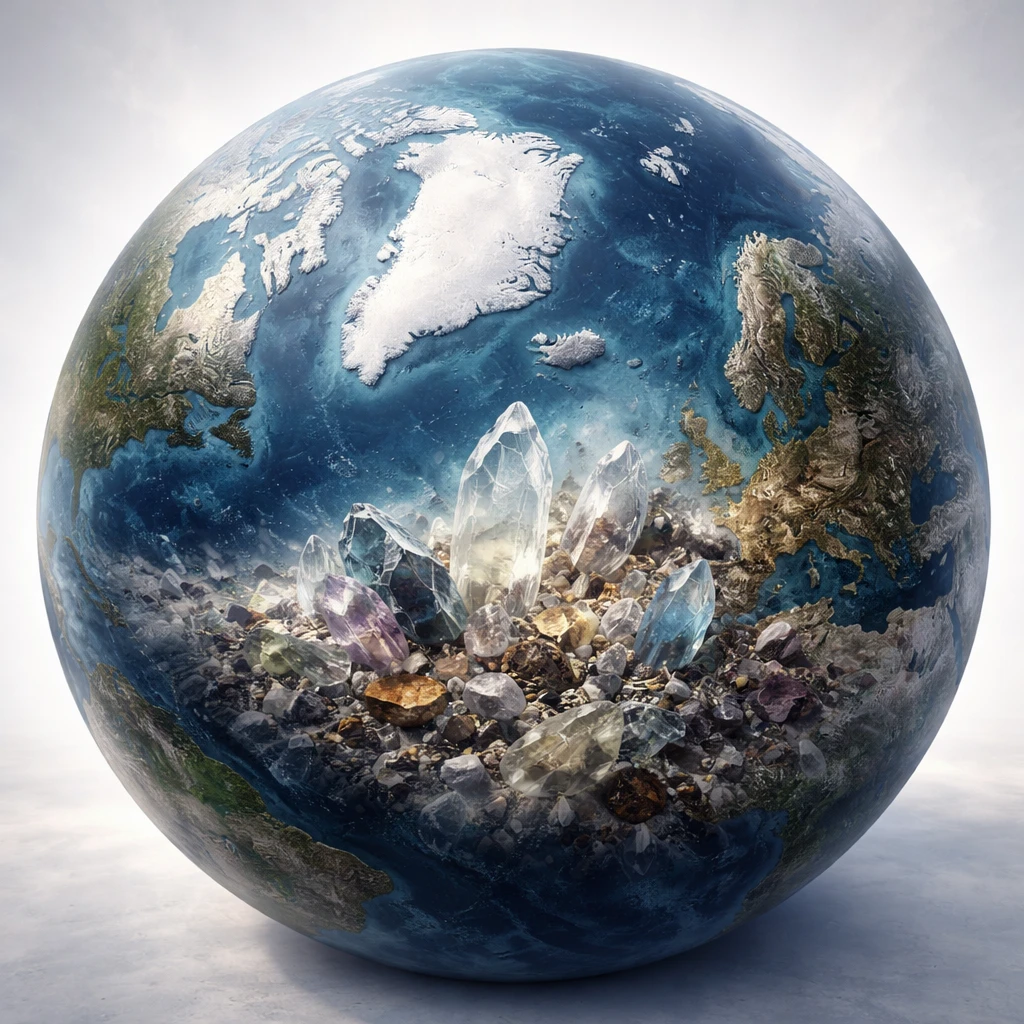

On Wednesday, President Donald Trump publicly declared that agreements reached with NATO over Greenland encompass rights concerning rare-earth minerals. During an interview with CNBC, he stated, "They’re going to be involved in mineral rights, and so are we," referring to NATO and the United States. However, specific terms of the arrangement were not disclosed.
Greenland’s largely untapped mineral reserves have attracted attention from the Trump administration, viewing the island as a strategic asset to diminish China’s stronghold on rare-earth metals. These materials are essential components in advanced technologies, including fighter jets, lasers, electric vehicles, and medical imaging devices. Despite this, Trump has minimized the importance of Greenland’s natural resources. Speaking at the World Economic Forum in Davos, he emphasized that America’s interest in Greenland transcends mineral wealth, focusing instead on national security imperatives. "Everyone talks about the minerals. There’s so many," he said. "There’s no such thing as rare earth. There’s rare processing. But there’s so much rare earth. And to get to this rare earth, you got to go through hundreds of feet of ice. That’s not the reason we need it. We need it for strategic national security and international security."
Later the same day, Trump asserted that the Greenland deal had two components: his "Golden Dome" missile defense initiative and mineral rights. This aligns with disclosures from former national security adviser Mike Waltz, who earlier indicated the administration’s focus lies on critical minerals and natural resources.
Experts emphasize that Denmark’s sovereignty over Greenland does not pose the principal barrier to resource extraction; rather, the formidable Arctic environment presents substantial challenges. The island’s mineral sites are predominantly located in remote, ice-covered regions above the Arctic Circle, characterized by extreme cold, a polar ice sheet often measuring up to a mile thick, and extended periods of darkness. Due to these harsh conditions, mining operations would require significant investment to overcome logistical obstacles.
Malte Humpert, founder and senior fellow at The Arctic Institute, described the notion of establishing Greenland as the United States’ primary source for rare-earth elements as "science fiction" and "completely bonkers." He pointed out that the difficulties surpass those of lunar mining, underscoring the immense technical and environmental hurdles. Indeed, about 80% of Greenland’s surface remains ice-covered, and activities in the Arctic frequently incur costs five to ten times higher than comparable operations in more temperate areas.
Trump’s interest in Greenland is longstanding and not unique among U.S. presidents. For decades, Greenlandic authorities have sought foreign investment, demonstrating willingness to engage without hostility. Yet, analysts caution that the so-called "pot of gold" myth surrounding the island’s mineral wealth can be misleading.
Jacob Funk Kirkegaard, a nonresident senior fellow at the Peterson Institute for International Economics with prior experience at the Danish Ministry of Defense, noted the challenges private enterprises face in justifying the enormous upfront costs required to develop mining infrastructure in Greenland. He suggested that while governmental financial incentives could potentially encourage U.S. companies to venture into Greenland’s mineral extraction—similar to guarantees extended to oil firms operating in places like Venezuela—such approaches may not establish a solid foundation for acquiring territorial interests.
Environmental considerations also complicate the feasibility of mining endeavors. Although climate change has led to accelerated ice melt and rising Arctic temperatures, potentially opening new economic avenues, these developments simultaneously introduce new risks. Melting ice destabilizes the ground, elevating the threat of landslides and complicating drilling operations. Humpert remarked that despite climate changes, Greenland remains a formidable environment, far from mild conditions like those of the Mediterranean.
Further adding to operational complexity are Greenland’s strict environmental regulations, which increase costs but reflect the local population’s commitment to preserving their natural surroundings. Should regulatory frameworks be weakened or disregarded by external administrations, such actions could provoke significant local opposition.
Beyond technical and environmental aspects, the proposed U.S. approach has raised concerns about its effect on political relationships. Adam Lajeunesse, an expert in Canadian and Arctic policy at St. Francis Xavier University, warned that President Trump’s controversial rhetoric concerning Greenland risks transforming the United States’ image from a cooperative partner to an aggressive intruder, potentially prompting resistance from Greenland and Denmark. This perception may already be manifesting, as Christian Keldsen, managing director of the Greenland Business Association, observed heightened skepticism towards American intentions. He described a current climate in Greenland wherein everything associated with the United States raises alarm, with many residents questioning if they are endorsing an effective takeover of their territory.