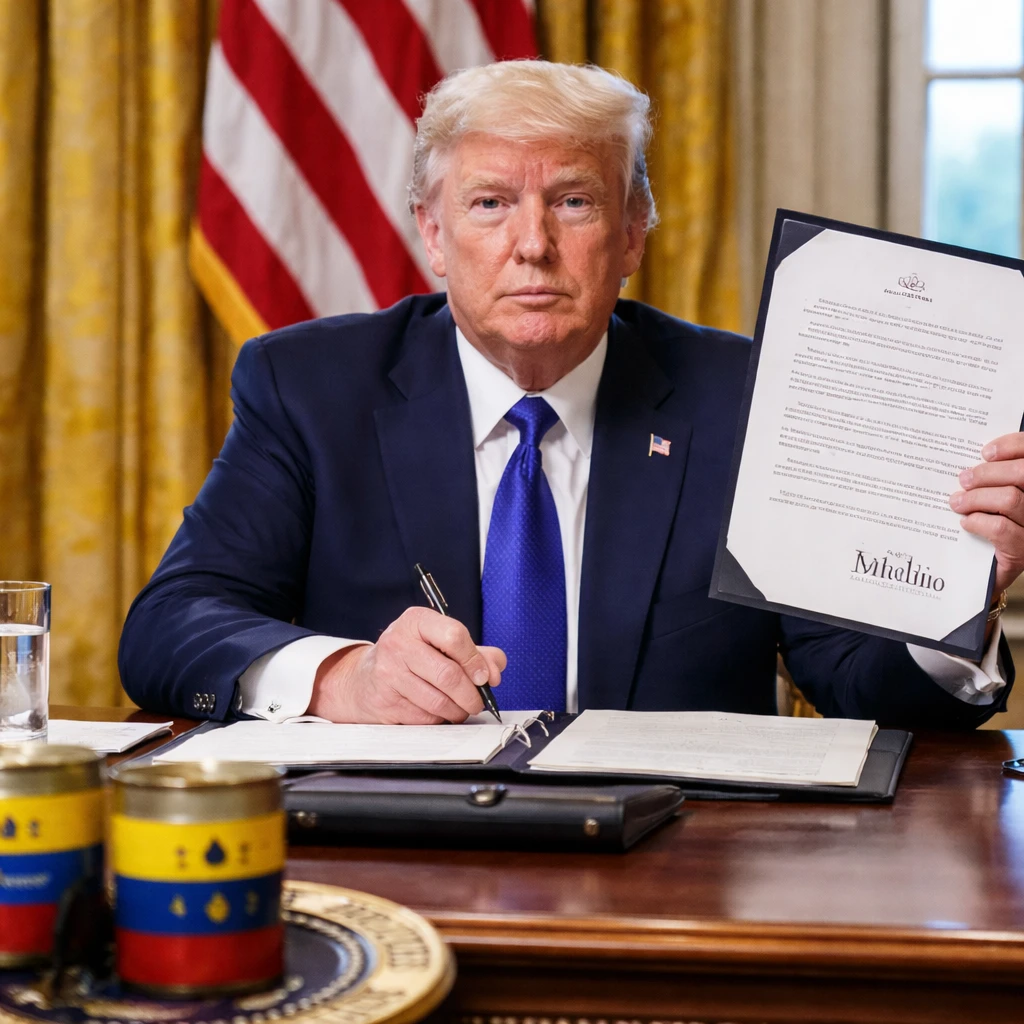

Trump Enacts Executive Order Safeguarding Venezuelan Oil Revenues
January 10, 2026
News & Politics

Trump Enacts Executive Order Safeguarding Venezuelan Oil Revenues

New directive aims to shield oil earnings from legal claims amidst efforts to stabilize Venezuela and attract U.S. energy investment

Summary

President Donald Trump signed an executive order intended to protect revenues from Venezuelan oil held by the United States from being seized through judicial proceedings. This action complements broader U.S. governmental efforts to stabilize Venezuela politically and economically while encouraging American oil companies to invest in the country's infrastructure. The order cites the National Emergencies Act and the International Emergency Economic Powers Act as its legal foundation and emphasizes the threat posed by potential legal claims on these funds.

Key Points

The executive order protects Venezuelan oil revenues held by the U.S. from seizure tied to judicial proceedings, aiming to uphold economic and political stability in Venezuela.
Top U.S. oil executives have expressed that Venezuela's current investment climate is unfavorable due to political turbulence and operational uncertainties.
The Trump administration focuses on an economic strategy to manage Venezuela's oil assets, including seizing tankers and controlling sales of sanctioned crude to facilitate reconstruction efforts.

In a move designed to secure Venezuelan oil revenues held in the United States, President Donald Trump issued an executive order over the weekend. The directive stresses that such funds are safeguarded from judicial seizure, noting that any interference could jeopardize vital U.S. initiatives aimed at fostering economic and political stability within Venezuela.

The timing of the order is significant as leading executives from major U.S. oil companies have voiced concerns about investing in Venezuela due to the nation's ongoing political unrest and economic volatility. According to ExxonMobil CEO Darren Woods, the current commercial agreements and operational frameworks in Venezuela render the country unappealing for investment at this time.

During a meeting convened by President Trump with top oil sector leaders on Friday, the president sought to quell these investment apprehensions by indicating that these companies would be engaging directly with U.S. officials rather than Venezuelan governmental entities.

Venezuela's landscape of challenges includes a history marked by the expropriation of state assets, persistent U.S. sanctions, and prolonged political uncertainty, all of which contribute to a complex investment environment for international oil companies.

The Trump administration has prioritized encouraging U.S. oil firms to engage with Venezuela to aid in the reconstruction of the country's energy infrastructure following the deposing of Nicolás Maduro. U.S. policy efforts have taken an economic approach to managing Venezuela, with recent actions including the seizure of oil tankers carrying Venezuelan crude and the U.S. government's intention to oversee the sale of tens of millions of barrels of previously sanctioned Venezuelan oil, with plans to maintain indefinite control over these operations worldwide.

On his social media platform, President Trump expressed a commitment to Venezuelans, stating that efforts are underway to restore prosperity and safety to the country, acknowledging the contributions of those involved in these developments.

The executive order formally declares that the oil revenues are Venezuelan state property held by the United States solely for governmental and diplomatic objectives, thereby not subject to individual claims. It references legal authority grounded in the National Emergencies Act and the International Emergency Economic Powers Act. The order further identifies the prospect of these revenues becoming entangled in judicial actions as an unusual and extraordinary threat to U.S. interests.

Risks
  • Persistent political instability and history of asset seizure in Venezuela pose ongoing challenges for foreign investment, particularly in the energy sector.
  • Potential legal claims or judicial actions targeting Venezuelan oil revenues could undermine U.S. diplomatic and economic strategies.
  • Instability in Venezuela could continue to deter private investment necessary for rebuilding the country's oil infrastructure.
Disclosure
This article is based on information publicly released by U.S. government officials and statements from industry executives without additional speculations or undisclosed sources.
Search Articles
Category
News & Politics

News & Politics

Related Articles
Amazon's Investment Propels Beta Technologies Stock in After-Hours Trading

Beta Technologies Inc, an aerospace company specializing in electric aircraft and propulsion systems...

Maximizing Your 401(k): Understanding the Power of Employer Matching

Overestimating investment returns can jeopardize retirement savings. While it's prudent to plan cons...

SoFi Shares Slip Slightly Despite Strong Q4 Earnings and Bullish Outlook

SoFi Technologies Inc’s stock saw a minor decline Tuesday afternoon following a period of heighten...

UBS Adjusts Tech Sector Outlook, Advocates Diversification Into Healthcare and Financials

UBS has revised its stance on the U.S. information technology sector from attractive to neutral, hig...

ArcelorMittal Advances Green Steel Production with Major Dunkirk Investment

ArcelorMittal's recent announcement of a €1.3 billion investment in an electric arc furnace (EAF) ...

Equinor (EQNR): A Dividended, Buyback-Supported Long with Reserve and Licensing Upside

Equinor combines scale (2.1 mmboe/d production in 2024, 6.1 billion barrels proven reserves) with gr...