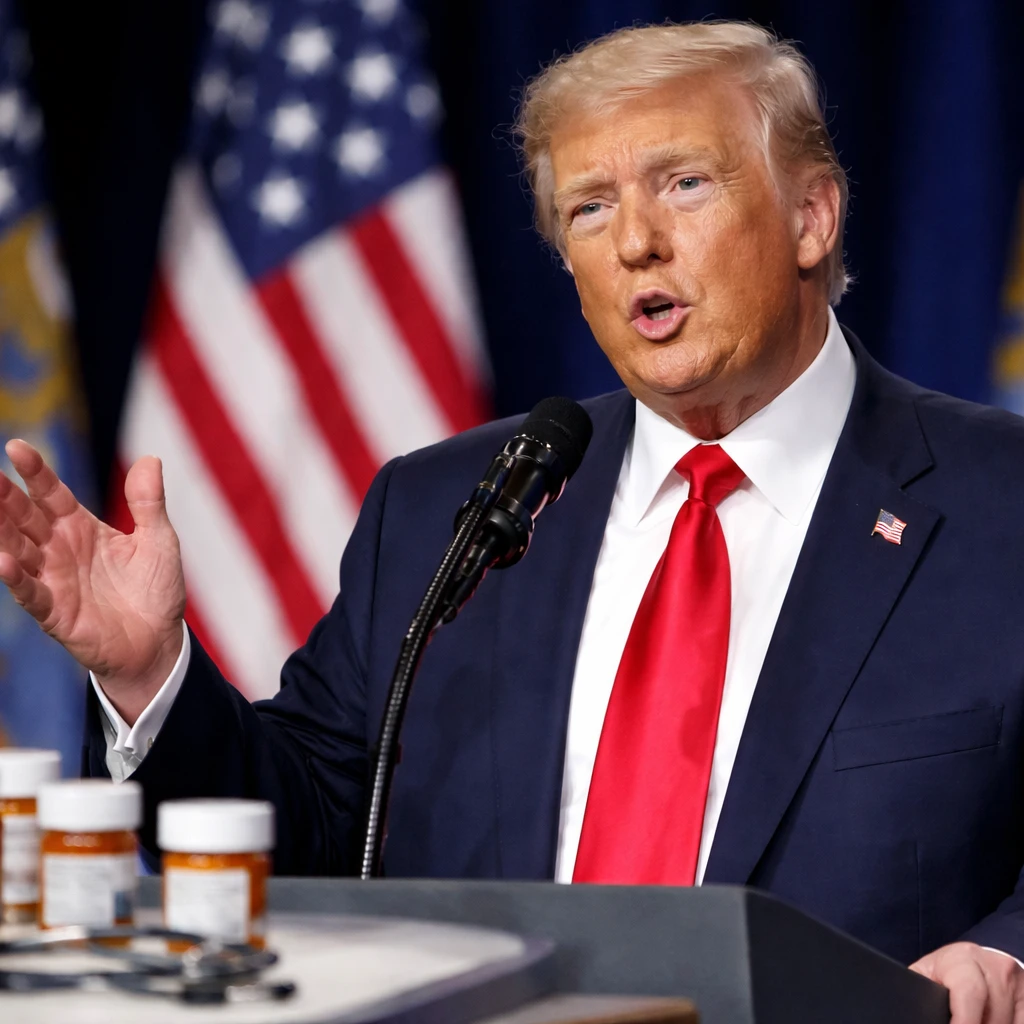

On Thursday, President Donald Trump presented his vision for a new health care plan intended for Congressional consideration amidst growing concerns over escalating health care expenses. Central to the proposal is the concept of providing direct payments to American consumers via health savings accounts (HSAs), granting individuals greater control over how they manage their insurance and medical expenses.
In a White House-released prerecorded message, Trump emphasized the plan's direct payment approach: "The government is going to pay the money directly to you. It goes to you and then you take the money and buy your own health care." This initiative also includes measures to reduce the cost of prescription drugs and mandates that insurance providers disclose more detailed information to the public regarding costs, revenues, rejected claims, and delays in care.
Throughout his tenure, Trump and Republican lawmakers have aimed to dismantle former President Barack Obama’s Affordable Care Act (ACA), but have faced setbacks in enacting comprehensive replacement health care legislation. When campaigning for the 2024 presidential election, Trump acknowledged having only "concepts of a plan" addressing health care, which appears to reflect the preliminary nature of this new framework.
Dr. Mehmet Oz, head of the Centers for Medicare and Medicaid Services, described the initiative during a phone briefing as a "framework that we believe will help Congress create legislation." An anonymous White House official mentioned ongoing discussions with Congressional allies but did not identify specific legislators working on advancing the plan. Senate Health Committee Chair, Senator Bill Cassidy of Louisiana, publicly supported Trump’s proposal, stating on social media that his committee "has and will take action on the President’s affordability agenda."
Details on the financial aspects of the HSAs remain vague. The administration has yet to specify the amount of funding that would be directed to consumers or clarify whether these payments would be accessible to all ACA enrollees or limited to those with lower-tier plans like bronze and catastrophic coverage. The concept resembles a proposal considered by Republican senators last year, which Democrats criticized as inadequate compared to prior subsidized tax credits that helped reduce insurance premiums.
Karoline Leavitt, White House press secretary, refrained from guaranteeing that the proposed plan would cover all health costs comprehensively but asserted, "If this plan is put in place, every single American who has health care in the United States will see lower costs as a result." She referred to the expiration of enhanced tax credits at the end of 2025, which had previously been instrumental in decreasing insurance costs for many.
Senator Bernie Moreno of Ohio leads a bipartisan group of twelve senators working on an alternative compromise to extend subsidies for two years while imposing new eligibility restrictions. This proposal would allow the option of HSAs in its second year, aligning with Republican preferences. The White House official clarified that Trump has not dismissed bipartisan negotiations but favors a direct payment mechanism to consumers.
The timing of Trump’s announcement follows significant Republican-led cuts exceeding $1 trillion over a decade to federal health and food assistance programs, which included implementing work requirements for aid recipients and transferring some costs to states. Democrats have strongly criticized these reductions for adversely affecting vulnerable populations dependent on programs such as Medicaid. Among the Whit House’s noted actions in the previous year was an allocation of $50 billion over five years for rural health initiatives, an amount experts regard as insufficient to bridge funding gaps.
The proposed plan aims to lower insurance premiums by fully funding cost-sharing reductions (CSRs), financial supports insurers provide for low-income enrollees on mid-tier silver plans under the ACA. The federal government ceased CSR reimbursements to insurers beginning in 2017, which heightened premiums for silver plans but increased financial assistance for users. Analysts posit that while restoring CSR payments could reduce silver plan premiums, it might simultaneously push up net premiums for bronze and gold plans.
Addressing prescription drug prices is another priority highlighted by the administration. Dr. Oz mentioned plans to approve over-the-counter availability for certain medications, such as higher-dose nonsteroidal anti-inflammatory drugs and peptic ulcer therapies, contingent on safety evaluations. It is unclear whether legislative action is requested to facilitate these changes, as historically, the FDA has independently approved drugs for over-the-counter sales based on safety studies. Trump’s initiative also includes codifying efforts to benchmark U.S. drug prices against the lowest international prices, building on already established agreements with multiple pharmaceutical companies to voluntarily reduce prices.
The White House recently launched an online drug purchasing platform, TrumpRx.gov, allowing consumers to buy pharmacy-ready medications directly, though the site had not listed any drugs as of Thursday. Dr. Oz indicated that medications would be available on the website by the end of the month.