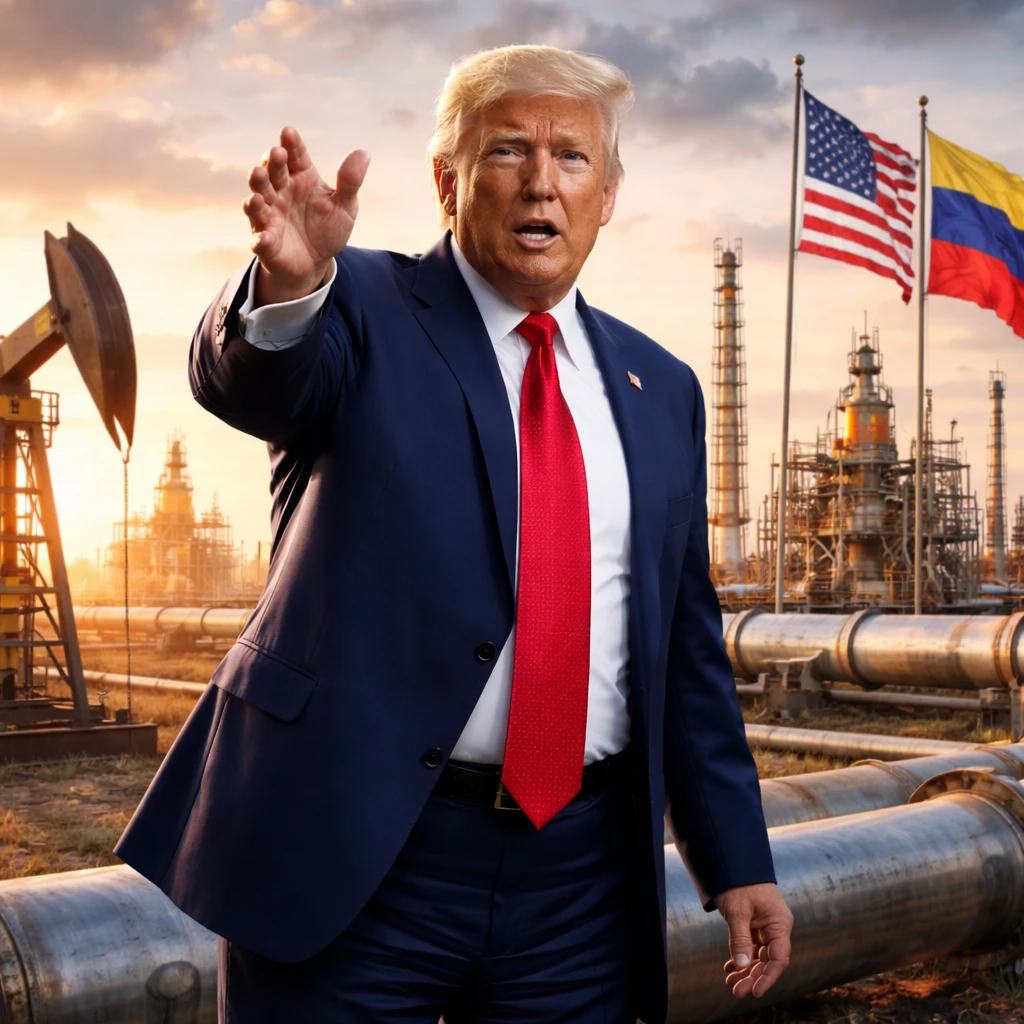

President Donald Trump publicly invited top executives from major oil corporations to consider investing heavily in Venezuela’s oil sector on Friday, aiming to quickly channel $100 billion into the country’s outdated infrastructure. This call to action follows recent U.S. military efforts to capture former Venezuelan leader Nicolás Maduro and an intensified push by the administration to assert control over Venezuela’s vast petroleum reserves.
In recent developments, the U.S. has seized multiple tankers transporting Venezuelan oil and asserted plans to manage between 30 million and 50 million barrels of sanctioned Venezuelan crude, with intentions to oversee sales going forward indefinitely. This intensified engagement represents an attempt by the administration to integrate Venezuela’s oil resources under U.S. control amid geopolitical uncertainty.
During a White House meeting convened to discuss this initiative, major oil companies conveyed cautious interest in the opportunity while emphasizing the challenging investment climate in Venezuela. ExxonMobil CEO Darren Woods remarked, "If we look at the commercial constructs and frameworks in place today in Venezuela, today it's un-investable," reflecting the impact of political instability, legal uncertainties, and previous state asset seizures experienced by international players.
President Trump addressed such concerns directly, assuring executives that investments would be secured by the U.S. government, not Venezuela. "You have total safety," he emphasized, adding, "You're dealing with us directly and not dealing with Venezuela at all. We don’t want you to deal with Venezuela." He additionally specified that investing oil companies would contribute their own capital without government funding but reaffirmed that governmental protection would be afforded to safeguard these investments.
Trump outlined that security guarantees would rely on collaboration with Venezuelan leaders and citizens rather than deploying U.S. military forces and indicated that companies themselves might provide additional security measures. This approach aims to balance on-the-ground realities with assurances intended to attract substantial private sector investment despite the fraught environment.
The meeting occurred on a day when U.S. forces marked the fifth tanker seizure in a month connected with Venezuelan oil, signaling a determined effort to control all aspects of Venezuela’s oil exports, refining, and production. This initiative is part of a broader strategy to stabilize or reduce gasoline prices domestically, with Trump leveraging presidential authority to showcase decisive action reassuring to American voters concerned about energy costs and inflation.
While acknowledging the risk involved, Trump highlighted the oil sector’s capacity for navigating difficult geographies and disputes, stating, "These are not babies. These are people that drill oil in some pretty rough places. I can say a couple of those places make Venezuela look like a picnic." Executives, however, remain measured; ExxonMobil committed to dispatching a team to evaluate the situation, with Woods underscoring the necessity for fundamental reforms, including enhanced legal protections, investment frameworks, and changes to Venezuela’s hydrocarbon laws to create a viable commercial environment.
Beyond ExxonMobil, Chevron—still active in the country—and other firms like ConocoPhillips, Halliburton, Valero, Marathon, Shell, Trafigura, Eni, and Repsol were also part of the discussions. Venezuela's current oil production has declined below one million barrels daily, but officials estimate it could take eight to twelve years to increase output to three million barrels per day if investments and conditions improve substantially.
Energy Secretary Chris Wright reported strong interest from the attending companies, noting Chevron’s commitment, suggesting a tentative but meaningful engagement from industry players.
Trump also justified U.S. oversight on geopolitical grounds, asserting that without American intervention, countries like China or Russia might have established control over Venezuelan oil assets. This framing connects the policy to broader strategic competition over energy resources.
The initiative, however, has faced criticism from advocacy groups such as Public Citizen, whose energy program director Tyson Slocum characterized the U.S. military action against Maduro as "violent imperialism" and contended that the administration’s objective is to grant billionaires control over Venezuela’s oil wealth.
In diplomatic developments concurrent with these energy sector moves, the U.S. government has been engaging with Venezuela’s interim President Delcy Rodríguez. Despite Rodríguez’s public criticism of Trump and Maduro’s ousting, the U.S. president indicated behind-the-scenes cooperation. Additionally, both nations are exploring reopening diplomatic relations, with a U.S. delegation recently dispatched to Caracas to assess the feasibility of reestablishing the U.S. Embassy.
President Trump also announced scheduled meetings with Venezuela’s opposition leader Maria Corina Machado and Colombian President Gustavo Petro. While previously critical of Petro, Trump’s recent shift to inviting him to the White House indicates a pragmatic approach to regional relations aimed at advancing strategic interests, including counter-narcotics cooperation, for which Colombia has historically been a key partner backed by substantial U.S. aid.