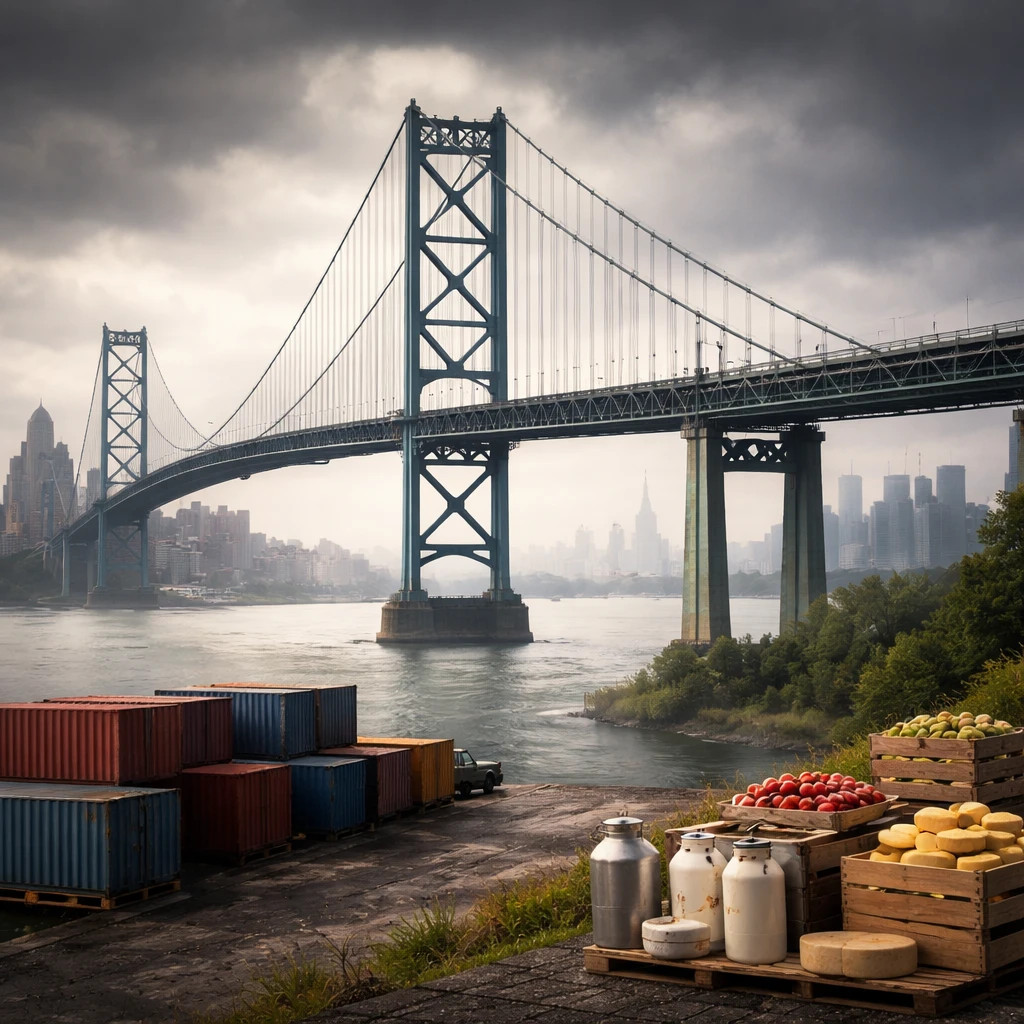

President Donald Trump announced his intention to potentially prevent the inauguration of a pivotal bridge that links Detroit, Michigan, with the Canadian province of Ontario unless Canada engages in meaningful trade negotiations with the United States. This declaration came amid escalating tensions over trade practices and infrastructure ownership between the two countries.
Making his position clear on Truth Social, Trump accused Canada of treating the United States unfairly for numerous years. He pointed out that Canada holds ownership over both ends of the bridge connecting Detroit to Ontario and highlighted that the project incorporated virtually no American-made components. This observation ties into broader concerns over domestic content in critical infrastructure projects and perceived imbalances in cross-border investments.
In his remarks, Trump also criticized former President Barack Obama for granting Canada a waiver from the Buy American Act, a legislative measure designed to prioritize American-made products in federal government procurements. According to Trump, this waiver enabled Canada to circumvent the act's requirements, which he suggests weakened protections for U.S. industrial producers and contractors.
Further expanding on trade issues, Trump raised concerns about Canada's approach to trade partnerships and tariffs. He warned that Prime Minister Mark Carney aims to finalize a deal with China, a development Trump contends would be detrimental to Canadian interests and cultural staples such as ice hockey and the Stanley Cup. Trump argued this China-Canada agreement could significantly undermine Canada's traditional industries and national identity.
Additionally, Trump focused on Canadian tariffs imposed on U.S. dairy products, calling the measures unacceptable to American farmers. The tariff framework, which utilizes a tariff-rate quota system, restricts the volume of dairy imports from the U.S. that can enter Canada without tariffs. Current quotas have reportedly prevented tariff activation on U.S.-made dairy items, but concerns remain over market access and fairness for American agricultural producers.
The president also condemned a recent China-Canada agreement allowing imports of Chinese-made electric vehicles (EVs) into the Canadian market at reduced tariff rates. The deal initially permits 49,000 EVs with potential expansion to 70,000 units under lower tariffs, a move Trump and Transportation Secretary Sean Duffy have heavily criticized. They view the agreement as undermining U.S. manufacturing and competitive positioning in the EV sector.
Trump asserted unequivocally, "I will not allow this bridge to open until the United States is fully compensated for everything we have given them." He indicated that negotiations would commence immediately and stressed that the U.S. should secure ownership of at least half of the bridge asset. He described the bridge as a source of "astronomical" potential revenue for America, which he insists must be fairly realized for U.S. interests.
This latest stance aligns with previous threats by the president to impose punitive tariffs on Canada. Trump had earlier signaled plans to enforce a 100% tariff on all Canadian goods entering the U.S. if Canada solidifies its deal with China regarding electric vehicles. He also explained moves to revoke certifications of Canadian-made aircraft within the U.S., coupled with threats of a 50% tariff on Canada unless American-made Gulfstream jets receive authorization to operate in Canada.
These policy pronouncements underscore a volatile phase in U.S.-Canada trade relations, focusing on cross-border infrastructure, import tariffs, and regulatory certifications affecting multiple industries ranging from dairy to aviation to automotive sectors.