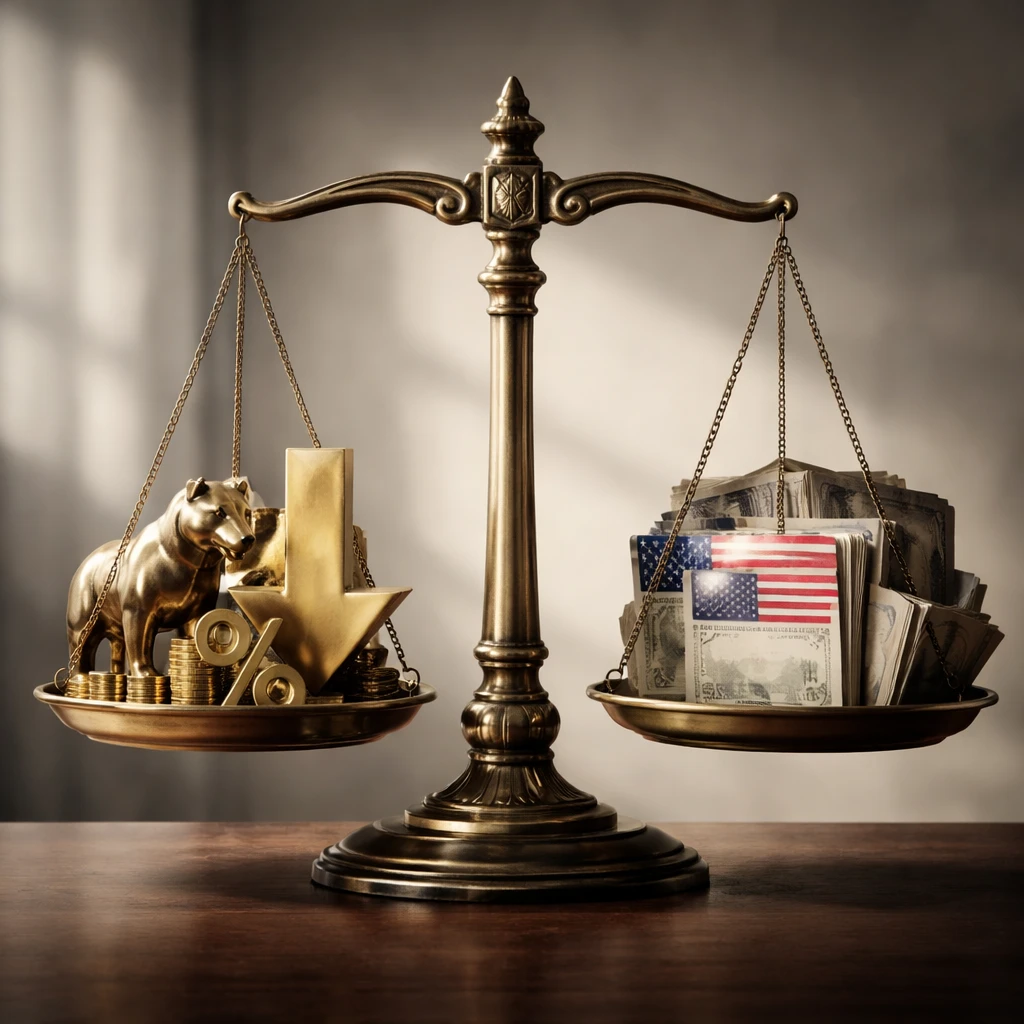

As the anticipation builds for President Donald Trump's announcement of his nominee for the Federal Reserve chair, the spotlight is firmly on Rick Rieder, a senior executive at BlackRock. Rieder's extensive expertise in complex financial markets and his established reputation among investors position him as a formidable candidate. Known for advocating lower interest rates, Rieder's stance aligns with President Trump's preference for substantial rate reductions, a factor that significantly influences market expectations.
Rieder’s public profile has surged recently, marked by frequent televised appearances that have resonated within the White House. This visibility contributed to his swift ascent in predictive markets wagering on the Fed chair selection. However, the dynamics shifted after President Trump suggested his choice would come as no surprise and hinted, "a lot of people think that this person could have been there a few years ago." This comment generated speculation that former Federal Reserve official Kevin Warsh might be the frontrunner, reminding observers of the 2017 chair selection process when Warsh was also a finalist before Jerome Powell's appointment.
Warsh's involvement was noted with his recent White House visit, coinciding closely with President Trump's public criticisms of Chairman Powell, whom Trump referred to in less than flattering terms. Despite this, Rieder maintains higher odds on some prediction markets, including Kalshi, compared to competitors like White House economist Kevin Hassett and current Fed Governor Christopher Waller.
Nonetheless, Rieder's nomination faces scrutiny on several fronts. For one, his previous public comments have occasionally diverged from Trump’s policy priorities. In particular, Rieder expressed reservations about the corporate tax cuts championed during Trump's first term. Speaking to CNN in March 2021, he indicated that the corporate tax rate reduction to 21% was excessively low, questioning the broader benefits to the economy. He noted that significant portions of the savings were channelled into shareholder rewards such as share buybacks, rather than reinvestment.
At the time of President Biden’s 2020 campaign, which proposed increasing corporate taxation, Rieder remarked that the U.S. economy could ‘‘definitely’’ absorb a higher corporate tax rate, adding a subtle critique that such a position might not align with preferences typically expressed in White House interviews. While his current views are not fully transparent and a BlackRock spokesperson declined to comment on his earlier statements, it is important to observe that the Federal Reserve chair does not directly influence tax policy.
During the same CNN interview, Rieder addressed inflation concerns prevalent at the time, indicating that he anticipated inflation rates could move toward approximately 2.5% but was not alarmed by the possibility of dramatic inflation spikes. This perspective was consistent with many economists’ forecasts before inflation surged to a peak of 9.1% by mid-2022 due to global supply chain disruptions, geopolitical tensions stemming from Russia's invasion of Ukraine, and expansive federal stimulus measures.
Another point of divergence involves immigration policy. In April 2023, Rieder voiced support for expanding immigration, explicitly contrasting with President Trump's stance, which has emphasized immigration restrictions. Participating in a Morningstar podcast, Rieder highlighted the economic necessity of immigrant labor, citing challenges faced by sectors like airlines and hospitality, which struggle to operate at full capacity due to labor shortages. He underscored the demographic challenges posed by an aging workforce and asserted immigration as a critical mechanism to mitigate these effects.
This perspective contrasts starkly with recent administration statements celebrating a reversal in migration trends for the first time in half a century, which was counted among the president’s "365 wins" during his initial year back in office.
Furthermore, Rieder's political contributions may introduce complexity into his confirmation process. His donations in recent years include Democrats such as House Minority Leader Hakeem Jeffries, Senators Cory Booker, Jon Tester, and Sherrod Brown, alongside Republican figures characterized as ‘‘Never Trumpers’’ including Nikki Haley, Jeb Bush, and Larry Hogan. While campaign donations do not inherently reflect one’s qualifications for the Federal Reserve chair, the current partisan climate and President Trump’s demonstrated sensitivity to perceived adversaries could weigh against Rieder’s prospects.
Conservative commentator Larry Kudlow has openly criticized Rieder's political contributions, contrasting them with other candidates perceived as more aligned with Trump’s economic philosophy, such as Warsh and Hassett. Kudlow emphasized the importance of selecting a candidate who embraces ‘‘Trumponomics,’’ particularly its supply-side orientation, while maintaining market credibility.
Addressing questions about Rieder’s political background, White House spokesman Kush Desai refrained from elaborating before the formal announcement, indicating that premature speculation regarding the nomination was unproductive.
A notable consideration in Rieder’s profile is his lack of prior government service. Historically, every Federal Reserve chair since 1935 has held an executive branch role before appointment. For example, current chair Jerome Powell served in the Treasury Department under George H. W. Bush, and Janet Yellen previously held a senior economist position in the Clinton administration. This absence of government experience could present a steep learning curve should Rieder assume the role, although it might simultaneously appeal to President Trump's preference for candidates outside the traditional political establishment.
Analysts like Raymond James' Ed Mills have observed that while Rieder’s political donations and limited public policy experience could trigger ‘‘awkward moments’’ during confirmation hearings, his stature in the private sector and recognition on Wall Street are substantial advantages. For Trump, who aims to sustain economic growth and market stability ahead of upcoming elections, a candidate with strong market confidence is critical.
Nevertheless, the potential Fed chair pool bears inherent compromises. While Hassett is viewed as loyal to Trump and favors lower interest rates, his perceived lack of independence might unsettle bond markets. Warsh and Waller enjoy investor respect but may not align with Trump’s preference for a more compliant appointee. According to Wolfe Research’s chief economist Stephanie Roth, none of the prospective candidates fulfill the triad of desired characteristics perfectly: loyalty, dovish monetary policy, and market credibility.
As the administration prepares to reveal its choice, these contrasting factors contribute to a complex decision-making landscape, with the ultimate pick needing to balance economic imperatives, political considerations, and institutional norms.