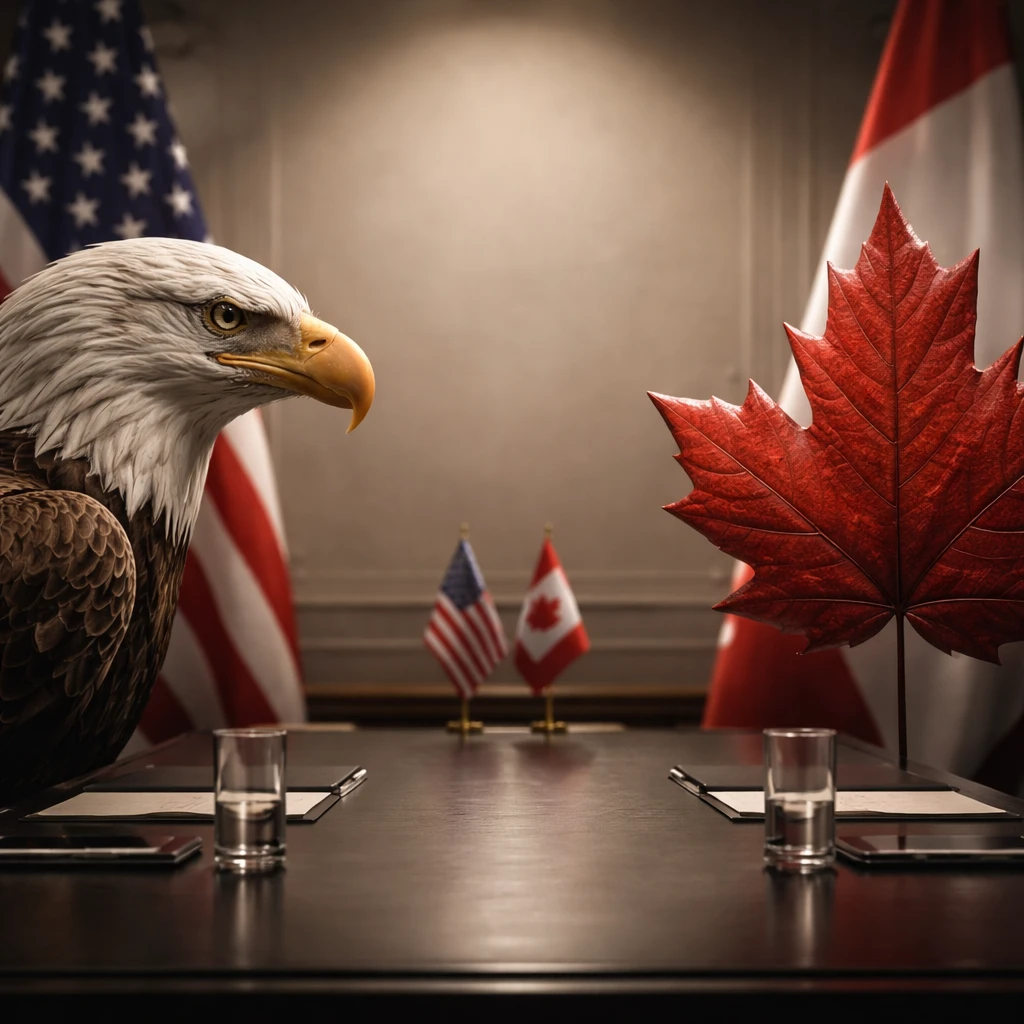

The ongoing diplomatic discord between the United States and Canada has intensified following a significant development involving President Donald Trump and Canadian Prime Minister Mark Carney. President Trump formally withdrew an invitation previously extended to Carney to participate in the so-called “Board of Peace.” This entity, initially proposed to oversee post-war reconstruction and the demilitarization of Gaza, is now being considered for expansion in a manner that could potentially rival the existing United Nations framework.
The announcement regarding the invitation withdrawal was made public via Truth Social, President Trump's proprietary social media platform, on a Thursday. In his public statement directed at Prime Minister Carney, Trump stated: “Please let this Letter serve to represent that the Board of Peace is withdrawing its invitation to you regarding Canada's joining.” Notably, prior to this retraction, Carney had expressed his interest in joining the Board; however, negotiations concerning critical details, including financial conditions tied to Canada’s involvement, remained ongoing.
Originally, President Trump’s “Board of Peace” was conceived with the specific objective to facilitate Gaza's post-conflict reconstruction and promote demilitarization in the region. However, recent developments suggest an ambitious expansion of the board’s mandate, which could see it operate in a capacity that complements or challenges the recognized international oversight traditionally maintained by the United Nations. The initiative has garnered backing from a selection of Middle Eastern nations — Turkey, Egypt, Saudi Arabia, and Qatar fall within this group — as well as from emerging economies such as Indonesia. Conversely, several Western countries including Australia, France, Germany, and Italy, have either expressed reservations or opposition regarding the proposal. Russia is currently assessing the board plan, while China has yet to declare its stance or potential engagement.
The trigger for Canada’s exclusion from the Board appears to have been Prime Minister Carney’s recent address at the World Economic Forum in Davos. During his speech, Carney refrained from explicitly naming the United States or President Trump but implied criticism by asserting that the prevailing “rules-based international order” is essentially defunct. He further advocated for collective action by “middle powers” to counteract economic coercion exerted by dominant nations within the global arena. This speech occurred shortly after Carney's official visit to China, where he negotiated a broad agreement with President Xi Jinping to reduce tariffs and rejuvenate bilateral relations between Canada and China.
President Trump responded to Carney’s Davos remarks during his own speech at the forum, asserting: “Canada lives because of the United States. Remember that, Mark, the next time you make your statements.” This retort effectively underscored the increasingly fractious nature of U.S.-Canada relations in the wake of these diplomatic exchanges.
Heightened tensions between the two countries have also attracted commentary from other strategic analysts. Notably, China strategist Michael Pillsbury cautioned that Canada’s trade agreement with China, coupled with Prime Minister Carney’s decision to bypass engagement with the United States, risks backfiring. Pillsbury recommended that Canada prioritize cooperation with the U.S. rather than actions perceived as confrontational or antagonistic toward President Trump.
In parallel, Canadian businessman and commentator Kevin O’Leary speculated on the possibility of upcoming negotiations between the U.S. and Canada, triggered by the aftermath of Trump’s Davos speech. O’Leary indicated that such negotiations could emerge as mutually advantageous, potentially influencing Canadian energy exports and the valuation of its currency in international markets.
This recent sequence of diplomatic maneuvers, public statements, and strategic reassessments reveals an intensifying strain in the historically cooperative relationship between the United States and Canada. The withdrawal of the invitation to Canada from the Board of Peace exemplifies a broader contestation of alliances and influence, especially amidst shifting global economic and political alliances involving key players such as China, Middle Eastern countries, and Western allies.
Key Points:
- President Donald Trump rescinded Canada’s invitation to join the expanding "Board of Peace," a new international initiative initially centered on Gaza’s reconstruction.
- Prime Minister Mark Carney’s critical remarks at the World Economic Forum in Davos questioning the rules-based international order preceded the invitation withdrawal.
- The “Board of Peace” has varied international support, including Middle Eastern nations and emerging economies, but faces skepticism or opposition from several Western countries.
- Growing diplomatic tensions are underscored by Canada’s recent trade agreement with China and subsequent strategic positioning against perceived U.S. economic coercion.
Risks and Uncertainties:
- The scope and authority of the “Board of Peace” remain under debate, with uncertain implications for existing international institutions like the United Nations.
- The evolving U.S.-Canada relationship is marked by uncertainties, particularly how recent diplomatic disputes will affect future economic and political cooperation.
- Canada’s expanding trade ties with China may complicate its alignment with U.S. foreign policy interests and could provoke retaliatory economic measures or political distancing.
- The response of major global actors such as Russia and China to the board proposal and regional diplomatic tensions remains unclear.