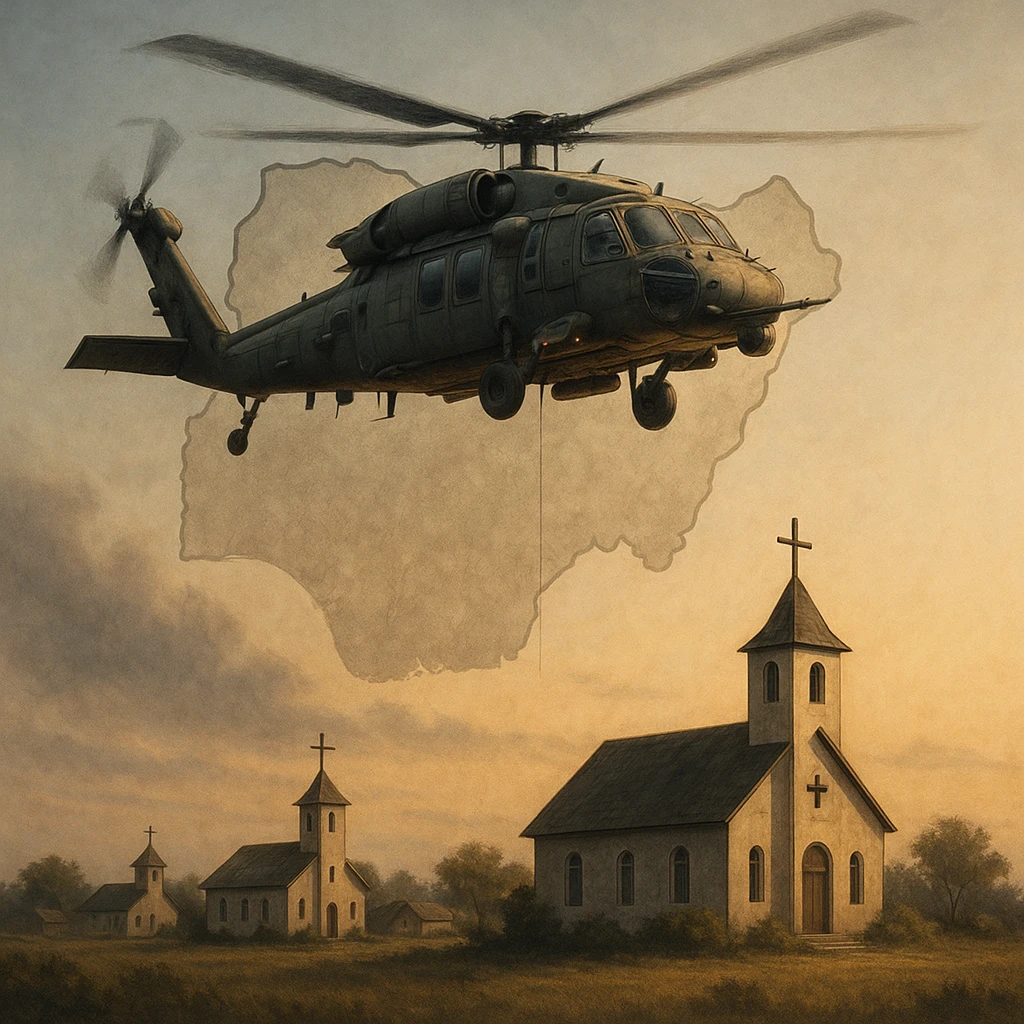

On Thursday, former President Donald Trump declared that the United States had launched a forceful airstrike against militants linked to the Islamic State in the northwestern region of Nigeria. The announcement came through his social media platform, Truth Social, where Trump characterized the attacks as an unequivocal military response to escalating violence aimed principally at Christian communities.
In his statement, Trump explained, "Tonight, at my direction as commander in chief, the United States launched a powerful and deadly strike against ISIS terrorists in northwest Nigeria." He underscored the nature of the threat by noting that these militants have been "viciously killing, primarily, innocent Christians."
Trump's message further implied that this operation could mark the beginning of continued military actions, expressing a strong warning to the perpetrators: "May God Bless our Military, and MERRY CHRISTMAS to all, including the dead Terrorists, of which there will be many more if their slaughter of Christians continues."
Supporting the president's announcement, U.S. Defense Secretary Pete Hegseth echoed the administration's firm stance against acts of violence directed at Christian populations, both in Nigeria and globally. Posting on the social media platform X, formerly Twitter, Hegseth stated, "The President was clear last month: the killing of innocent Christians in Nigeria (and elsewhere) must end."
The Defense Secretary emphasized that the Department of Defense is fully prepared to respond promptly to such crises and acknowledged the collaboration with Nigerian government officials in carrying out this strike.
This military action follows a significant political decision by President Trump to reinstate Nigeria on the U.S. State Department's "Countries of Particular Concern" list. This list identifies nations that have engaged in severe violations of religious freedom. Notably, Nigeria had previously been labeled as such during Trump's earlier term but was removed from the designation in 2021 under the Biden administration.
Nigeria, recognized as Africa's most populous nation, contends with a multitude of security challenges, including extremist violence, criminal gangs, and widespread banditry. These challenges impact various communities across religious lines, encompassing Christianity, Islam, and traditional practices among its hundreds of ethnic groups.
This development in Nigeria occurs against the backdrop of a shifting U.S. military presence in West Africa. The United States has scaled back its regional footprint recently, including the withdrawal of approximately 1,000 troops from neighboring Niger in the previous year.
Compounding the changing landscape, reports from the Wall Street Journal have indicated that the Trump administration ordered the abrupt recall of nearly 30 career ambassadors from U.S. missions worldwide, signaling a reshaping of diplomatic engagement at a global level.
These actions collectively illustrate a recalibrated U.S. approach to foreign policy and military involvement in a complex and volatile region, balancing the response to extremist threats with evolving diplomatic strategies.